


DTF Transfer Alternatives for Small Shops UK: 2026 Guide

Table of Contents
- DTF Transfer Alternatives for Small Shops: Quick Comparison
- How to Choose a DTF Transfer Supplier or Alternative Method
- Heat Transfer Vinyl UK: A Practical Alternative for Small Businesses
- Screen Printing for Small Business UK: When It Outperforms DTF
- DTG Printing UK Small Orders: Direct-to-Garment as a DTF Alternative
- Cost-Effective T-Shirt Printing UK: Profit Margins and Pricing Breakdown
- Integration with Print-on-Demand Workflows: Scaling Without the Headache
- Troubleshooting Common Press Errors: Avoiding Costly Mistakes
Last Updated: July 28, 2026
When small shop owners evaluate printing solutions for custom apparel, the question often becomes whether a usa dtftransfers alternative for small shops might serve their business better than their current method. Direct-to-film (DTF) transfers have dominated conversations about small-batch production, but they're far from the only option worth considering. BB5wholesale specializes in high-quality DTF and UV DTF printing solutions, yet understanding the full landscape of alternatives, from heat transfer vinyl to screen printing to direct-to-garment, helps you make an informed decision based on your actual volume, budget, and quality standards.
What works brilliantly for one shop may create bottlenecks for another. A shop doing 50 orders monthly faces completely different constraints than one handling 500.
DTF Transfer Alternatives for Small Shops: Quick Comparison
The printing landscape for small businesses offers several distinct paths forward, each with genuine trade-offs. Heat transfer vinyl (HTV) delivers durable results with creative finishes like glitter and flock. Screen printing excels at high-volume runs and produces extremely wash-durable transfers, but demands setup time and minimum order quantities that don't suit every shop. Direct-to-garment (DTG) printing eliminates transfer film entirely, appealing to shops prioritizing speed and design flexibility. Ready-to-press DTF transfers from providers like BB5wholesale offer simplicity and consistency, while custom gang sheets optimize your cost per unit when juggling multiple designs.
The choice hinges on three variables: your monthly order volume, the complexity of your designs, and whether you're willing to invest in equipment or prefer outsourcing production.
| Method | Best For | Typical Turnaround | Equipment Investment | Per-Unit Cost (approx.) |
|---|---|---|---|---|
| Heat Transfer Vinyl | Small runs, specialty finishes | 2-5 days | $500-$2,000 | $1.50-$3.50 |
| Screen Printing | 100+ units per design | 5-10 days | $2,000-$5,000+ | $0.50-$1.50 |
| Direct-to-Garment (DTG) | Complex, full-color designs | 1-3 days | $8,000-$15,000 | $2.00-$4.00 |
| Ready-to-Press DTF | 1-50 units per design | 2-4 days | None (outsourced) | $1.00-$2.50 |
| Custom Gang Sheet DTF | Mixed designs, bulk orders | 3-5 days | None (outsourced) | $0.80-$2.00 |
How to Choose a DTF Transfer Supplier or Alternative Method
If you're handling fewer than 20 orders per week, outsourcing typically makes financial sense. You avoid capital expenditure on equipment, eliminate inventory management of transfer film and adhesive powder, and can test new designs without bulk commitments. Providers like DTF Prints Online, a Manchester-based specialist offer same-day dispatch for orders placed before 2pm.
If your volume exceeds 50 orders weekly and designs are relatively consistent, investing in a DTF printer or heat press may lower per-unit costs significantly. DTF printers range from several thousand pounds, giving you control over quality, turnaround time, and transfer experimentation.
Consider these factors when evaluating a supplier or method:
- Minimum order quantities: Some providers require gang sheets; others accept single transfers.
- Customization options: Can you request specific transfer sizes, film types, or curing methods?
- Reliability: Check turnaround consistency and rush options.
- Quality consistency: Request samples before committing to large orders.
- Support availability: 24/7 support from BB5wholesale means you're not stuck if an order goes wrong at 11pm on a Friday.
Quality vs. Speed vs. Cost: What Matters Most
If you're competing primarily on price, screen printing wins for orders over 100 units of a single design, with per-unit costs below £0.50 for large runs.
If speed is your differentiator, DTG printing or ready-to-press DTF transfers make sense. DTG eliminates the transfer step entirely, getting garments from design to shipping in hours.
For premium brands where customers expect wash-resistance and vibrant colors, properly applied screen prints and DTF transfers can withstand 50+ commercial washes without significant fading or cracking.
Ready-to-Press vs. Custom Transfers: Finding Your Fit
Ready-to-press transfers arrive pre-sized and ready to apply directly to garments. You simply heat press them, minimizing labor and eliminating the learning curve around curing times and pressure settings.
Custom transfers are printed to your exact specifications, with custom sizing, gang sheets combining multiple designs, or specialty options like UV-cured finishes. For shops handling orders with unique sizing requirements or mixed designs, custom gang sheets often deliver better economics. Instead of paying per transfer, you pay per sheet, fitting 10-20 designs onto a single A3 sheet.
BB5wholesale's gang sheet builder simplifies this process. Rather than manually arranging designs in Photoshop or Illustrator, you upload your artwork, and the builder automatically nests designs to minimize waste.
Heat Transfer Vinyl UK: A Practical Alternative for Small Businesses
Heat transfer vinyl (HTV) requires minimal upfront investment compared to DTF printers or screen printing equipment, and it offers creative finishes that DTF transfers cannot replicate.
HTV works by cutting designs from adhesive-backed vinyl sheets using a vinyl cutter, then heat pressing the cut vinyl onto garments. The result is a durable, long-lasting design ideal for personalized gifts, event merchandise, and custom orders.
Stahls' UK supplies over 350 colors and 17 different types of HTV, ranging from basic PU (polyurethane) vinyl to specialty materials like glitter, flock, and reflective finishes. For shops already owning a vinyl cutter and heat press, HTV represents an accessible way to expand their product range without significant additional investment.
The workflow is straightforward: upload your design to cutting software, adjust sizing and placement, cut the vinyl, weed away excess material, position on the garment, and heat press. The entire process typically takes 10-15 minutes per garment.
HTV vs. DTF: Durability, Wash Testing, and Real-World Performance
Both HTV and DTF transfers deliver durable results, but they perform differently under specific conditions.
HTV excels in durability for solid colors and bold designs. The vinyl bonds mechanically to the fabric, creating a physical layer that resists fading and cracking. A properly applied HTV design can survive 100+ washes without visible degradation. However, HTV struggles with fine detail and photographic images.
DTF transfers handle photographic images and fine detail far better. Because the ink sits on the transfer film before being pressed onto the garment, you can achieve photo-quality results with vibrant colors and sharp gradients. Wash durability depends on the supplier's curing process. High-quality DTF transfers from reliable providers withstand 50+ washes without significant fading.
Screen Printing for Small Business UK: When It Outperforms DTF
Screen printing remains the gold standard for wash durability and cost-effectiveness at scale. For any design you'll repeat more than 50 times, screen printing typically beats DTF and HTV on per-unit cost and longevity.
The process involves creating a mesh screen with your design, then pushing ink through the screen onto the garment. Once the screen is ready, printing additional garments is fast and cheap.
A basic screen printing setup costs £2,000-£5,000. For shops doing fewer than 100 orders monthly, this investment rarely pays for itself. But for shops with consistent repeat orders or seasonal bulk production, screen printing becomes economically compelling.
DTF vs. Screen Printed Transfers: Print Quality and Durability Compared
For photographic images or complex gradients, DTF transfers produce visibly sharper results. Screen printing excels with bold, solid-color designs and spot colors (Pantone-matched inks).
Durability favors screen printing significantly. A screen-printed design can survive 100+ commercial washes with minimal fading. DTF transfers typically hold up to 50 washes before showing visible wear.
Cost-per-unit varies dramatically by volume. For a single design printed 500 times, screen printing costs £0.50-£1.00 per garment. For the same volume via DTF, you're paying £1.50-£2.50 per unit. However, if you're printing 10 different designs in quantities of 5-10 each, screen printing becomes uneconomical. DTF transfers or HTV make far more sense for mixed, low-volume orders.
DTG Printing UK Small Orders: Direct-to-Garment as a DTF Alternative
Direct-to-garment (DTG) printing bypasses transfer film entirely. The printer applies water-based ink directly to the fabric, then cures it with heat. The result is a soft hand-feel, excellent color vibrancy, and no visible transfer layer.
DTG appeals to shops prioritizing design flexibility and fast turnaround. Because there's no setup time or transfer production, you can print a single garment as easily as 100. This makes DTG ideal for print-on-demand workflows.
The trade-off is equipment cost and maintenance. DTG printers start around £8,000-£15,000 and require regular cleaning and ink maintenance. They also work best on 100% cotton or cotton-blend fabrics; polyester and synthetic blends can produce inconsistent results.
For shops handling fewer than 50 orders monthly, outsourcing DTG printing makes more sense than buying equipment.
Cost-Effective T-Shirt Printing UK: Profit Margins and Pricing Breakdown
Your profit margin depends on the printing method you choose and your production volume.
For ready-to-press DTF transfers from suppliers like BB5wholesale, your material cost typically ranges from £0.80-£2.00 per transfer. Add your garment cost (£3-£6 for blank t-shirts), labor (5 minutes at £15/hour = £1.25), and overhead allocation. A £10 blank t-shirt with a £1.50 transfer and £1.25 labor costs £12.75 to produce. Selling at £25 yields a 48% gross margin.
For screen printing, material costs drop significantly at volume. A £10 blank t-shirt with £0.50 screen-printed ink and £1.25 labor costs £11.75 to produce. The £50-£150 screen setup gets amortized: on a 100-unit run, that's £0.50-£1.50 per garment. Your total cost reaches £13.25-£14.25, still leaving a 43-47% margin at £25 retail.
For HTV, your costs are similar to DTF: £0.80-£1.50 for vinyl, £10 for the blank, £1.50 for labor. Total cost: £12.30-£13.00, yielding a 48-51% margin at £25.
The key insight: margins are relatively consistent across methods. Your choice should be based on production volume, design complexity, and turnaround time requirements, not margin optimization alone.
Turnaround Times and Shipping: What Affects Your Bottom Line
Turnaround time directly impacts your ability to take rush orders and your cash flow. Faster turnaround lets you charge premium pricing and capture time-sensitive orders.
Ready-to-press DTF transfers from UK-based suppliers typically ship within 2-4 business days. DTF Prints Online offers same-day dispatch for orders placed before 2pm. Screen printing takes 5-10 days depending on screen complexity. DTG printing is fastest, 1-3 days, because there's no transfer production step.
Fast door-to-door delivery from BB5wholesale means your customers receive orders within 1-2 business days of production completing, enabling you to offer "ready by Friday" guarantees.
Integration with Print-on-Demand Workflows: Scaling Without the Headache
Print-on-demand (POD) workflows automate the journey from customer order to production to shipping. Rather than managing inventory or printing in batches, you print each order individually as it arrives.
DTF transfers and DTG printing integrate cleanly with POD systems. Your e-commerce platform connects to your supplier via API or CSV file uploads. Customer orders flow directly to production, transfers are printed and shipped, and you're paid your margin.
Heat transfer vinyl and screen printing work less smoothly with POD. HTV requires manual production steps that don't scale automatically. Screen printing requires advance setup and minimum quantities per design, which contradicts the POD model.
BB5wholesale's gang sheet builder simplifies POD workflows. Rather than uploading individual orders as separate files, you batch multiple customer orders into a single gang sheet. The builder automatically arranges designs to minimize waste, reducing your material costs while maintaining fast turnaround.
Troubleshooting Common Press Errors: Avoiding Costly Mistakes
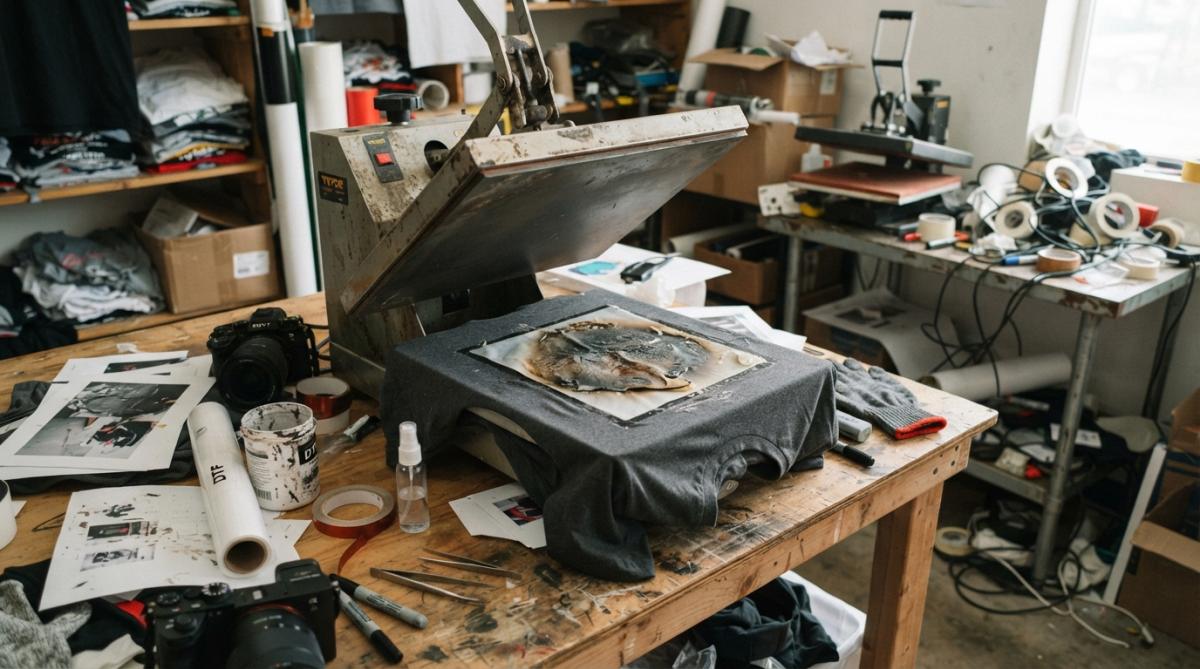
Heat press mistakes destroy margins fast. A single batch of 20 garments ruined by incorrect temperature or pressure costs £200-£400 in materials and labor.
Peeling, Fading, and Adhesive Issues: Real Solutions
Peeling is the most common problem. Transfers peel because the adhesive powder didn't cure properly, the fabric wasn't pre-pressed, or the pressure or temperature was too low.
The fix: ensure your heat press reaches the correct temperature before pressing. Most DTF transfers require 160-180°C for 10-15 seconds. Pre-press the garment for 3-5 seconds to remove moisture, which improves adhesive bonding. Apply firm, even pressure; too light and the adhesive won't bond; too heavy and you'll crush fine details.
Fading occurs when ink isn't properly cured or when you're using low-quality transfers. If you're experiencing fading after just 5-10 washes, your supplier may be using inadequate curing processes.
Adhesive failure, where the transfer separates from the fabric entirely, usually indicates that the garment wasn't pre-pressed or that you're applying transfers to synthetic fabrics without pre-treatment. Polyester and nylon require slightly higher temperatures or longer dwell times to bond properly.
Before producing a large order, always test your settings on sample garments. Press one at your standard settings, one at 5°C lower, and one at 5°C higher. Wash them 10 times and inspect for peeling or fading. This £5-£10 test prevents £200+ in wasted production.
Frequently Asked Questions
What are the main DTF transfer alternatives for small UK shops?
The primary alternatives include heat transfer vinyl (HTV), screen printing, direct-to-garment (DTG) printing, and ready-to-press transfers. HTV offers flexibility and durability but requires a vinyl cutter and heat press. Screen printing works well for bulk orders and vibrant colours but has higher setup costs. DTG printing suits small orders without minimum quantities, while ready-to-press transfers provide convenience without equipment investment. Each method has different turnaround times, cost-per-unit structures, and quality profiles depending on your design complexity and order volume.
How does heat transfer vinyl UK compare to DTF transfers for wash durability?
Heat transfer vinyl typically offers excellent wash durability when properly applied, lasting 50+ washes without significant cracking or fading. DTF transfers also provide strong durability with vibrant colours, though longevity depends on curing process and adhesive powder application. HTV requires weeding and precise heat application, while DTF transfers arrive ready-to-press. Both methods are durable for small business apparel when applied correctly. The key difference is application effort: HTV demands more labour but offers creative design options, while DTF transfers streamline the production workflow.
What's the cost-per-unit difference between DTF alternatives for small orders?
Pricing varies significantly by method. Heat transfer vinyl requires upfront equipment investment (vinyl cutter, heat press) but low per-unit costs once set up. Screen printing has high setup costs but lower per-unit rates for bulk orders (typically 10+ items). DTG printing and ready-to-press transfers work well for small quantities with no minimums, though per-unit costs are higher. DTF Owl, for example, starts at £2.99 per A5 sheet with no minimum order. Ultimately, profitability depends on your order volume, design complexity, and labour availability. Small shops with 10-15 monthly orders often find ready-to-press DTF or DTG printing more cost-effective than investing in equipment.
Which DTF transfer alternative handles detailed multi-colour artwork best?
DTF and DTG printing excel with detailed, multi-colour designs because they don't require colour separation or complex setup. Screen printing requires separate screens per colour, making it labour-intensive for intricate designs. Heat transfer vinyl works for detailed designs but requires precise weeding of small elements, which is time-consuming. UV DTF transfers handle fine detail particularly well, offering sharp colour reproduction on complex graphics. For freelance designers and graphic-heavy orders, DTF or DTG printing offers the fastest turnaround and highest quality without manual intervention.
How do I know if a DTF transfer supplier offers reliable 24/7 support?
Check whether the supplier provides multiple contact channels, email, live chat, phone, and explicitly states 24/7 availability. Look for customer reviews mentioning response times, especially for urgent issues. Reliable suppliers like BB5wholesale offer more than 10 secure payment methods and dedicated support for order issues. Before committing to a large order, test their support with a small query and note response time. Verify they have UK-based operations or clear turnaround commitments. Reputable suppliers also provide clear FAQs, design guidelines, and troubleshooting resources to prevent common press errors and minimise the need for emergency support.
This article was written using GrandRanker