


What Are the Benefits of UV DTF Decals? A 2026 Guide

Table of Contents
- What Are the Benefits of UV DTF Decals?
- Material Compatibility: Which Hard Surfaces Take UV DTF Decals
- How to Apply UV DTF Decals Without Bubbles or Peeling
- UV DTF vs Vinyl Stickers: Where Each One Wins
- Durability, Finish Quality and Long-Term Testing
- Alternatives to UV DTF for Promotional Merchandise
- Design Limitations and What UV DTF Cannot Do
- Cost, Turnaround Time and ROI for Small Shops
- Frequently Asked Questions
Last Updated: September 21, 2026
What Are the Benefits of UV DTF Decals?
UV DTF decals are printed transfers that bond full-colour graphics to hard surfaces without heat, a press, or a weeding knife. Instead of cutting vinyl by hand, you press a pre-printed film onto glass, metal, acrylic or leather and peel the carrier away. The result is a glossy, waterproof graphic that resists scratching.
How UV DTF Printing Works (in Plain Terms)
UV DTF printing is a two-part process: a UV-curable ink layer is printed onto a carrier film, then sealed under a protective varnish and a second adhesive film. The ink cures instantly under ultraviolet light, so colours stay sharp rather than bleeding into the surface.
Material Compatibility: Which Hard Surfaces Take UV DTF Decals
Substrate compatibility is broader than most people expect. UV DTF transfers bond to glass and mirrors, stainless steel, aluminium, wood, acrylic, hard plastics, ceramics, tumblers, and leather or faux leather.
How to Apply UV DTF Decals Without Bubbles or Peeling
Bubbles and peeling almost always trace back to two causes: a dirty surface or rushed peeling. Follow these steps and both problems disappear.
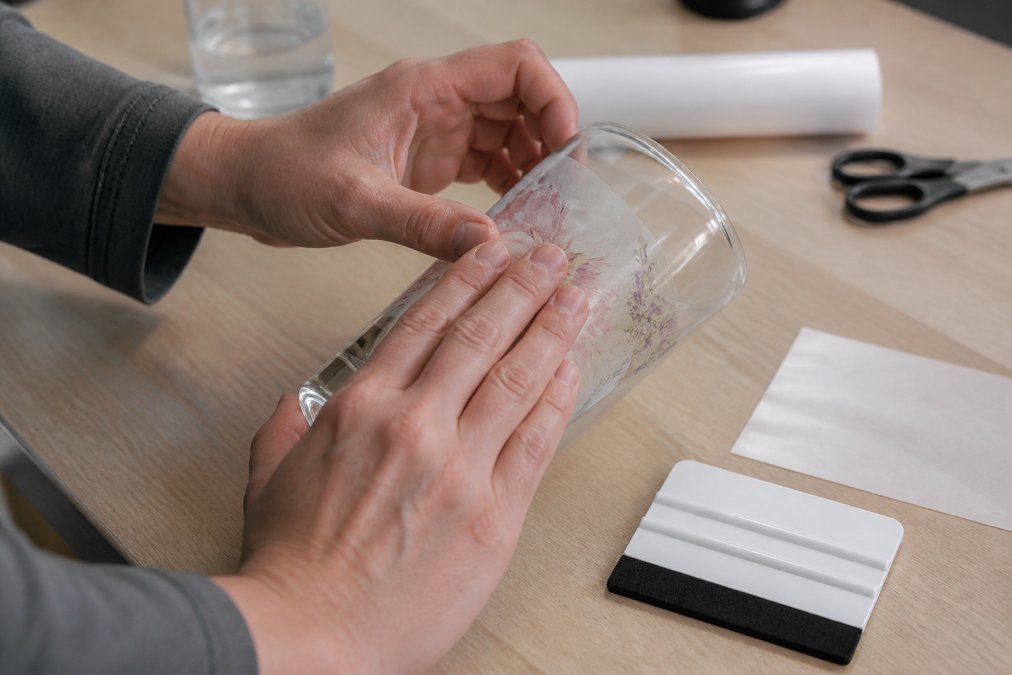
- Clean the surface with isopropyl alcohol and let it dry completely.
- Peel the backing film away from the design, not the design away from the backing.
- Position the decal and press firmly from the centre outward with a squeegee.
- Work edges and curves with your thumb to push out trapped air.
- Peel the top carrier film slowly, at a low angle, holding the design down as you go.
- Let the decal cure for 24 hours before washing or handling roughly.
UV DTF vs Vinyl Stickers: Where Each One Wins
Vinyl wins on cost for simple single-colour shapes. If you're cutting a one-colour logo for 200 units, vinyl is cheaper and faster to produce.
| Factor | UV DTF Decals | Vinyl Stickers |
|---|---|---|
| Multi-colour artwork | Full colour, one pass | Layering required |
| Weeding | Not needed | Required |
| Curved surfaces | Good with pressure | Good |
| Setup cost | Low | Low |
| Best for | Detailed graphics | Simple shapes |
Durability, Finish Quality and Long-Term Testing
A properly applied UV DTF decal holds up well in normal use. The protective varnish layer is what does the work: it shields the ink from UV light, moisture, and abrasion. But "holds up well" is not a specification, so here is what the layers actually do and how they behave under the conditions that shorten a decal's life.
What each layer contributes
A UV DTF transfer is a stack, and each layer fails differently:
- Carrier film, removed after application, so it plays no part in longevity.
- Protective varnish, the sacrificial top coat. It absorbs UV, resists abrasion and stops the ink beneath from chalking.
- UV-curable ink, the colour layer. Once cured it is chemically stable, but it is brittle if the varnish is breached.
- Pressure-sensitive adhesive, the bond to the substrate. This is the layer that decides whether the decal stays put or lifts at the edge.
How it performs against the things that actually happen
| Exposure | Typical outcome | Notes |
|---|---|---|
| Indoor display, no washing | Multi-year life | Varnish does the work; ink stays sharp |
| Hand washing with mild soap | Good | Avoid soaking the edge line |
| Dishwasher cycles | Poor | Heat and detergent attack the adhesive first |
| Microwave | Do not | Heat delaminates the stack |
| Abrasive sponges or scouring pads | Poor | Scratches the varnish, then the ink |
| Isopropyl alcohol wipe | Acceptable | Fine for occasional cleaning, not repeated soaking |
| Household bleach-based cleaners | Avoid | Aggressive chemistry degrades the varnish |
| Direct sunlight, outdoor use | Degrades over time | Varnish slows UV damage but does not stop it indefinitely |
Most practitioners find that a decal on a tumbler or phone case outlasts the novelty of the design when the three care rules below are followed. The failure mode people report is not fading, it is edge lift after repeated hot washing.
Care instructions matter more than most sellers admit:
- Avoid dishwasher cycles
- Do not microwave decorated items
- Skip abrasive sponges on the graphic
UV DTF versus laser engraving on longevity
Engraving removes material, so there is nothing to peel, fade or scratch off. On metal and wood it is effectively permanent, and it survives dishwashers, solvents and years of handling. That is its genuine advantage, and no decal matches it.
Alternatives to UV DTF for Promotional Merchandise
Screen printing remains the cheapest option at high volume on flat items, but setup costs make it uneconomical below a few hundred units.
WRAP guidance on promotional merchandise and product compliance
Design Limitations and What UV DTF Cannot Do
UV DTF can't wrap a sphere cleanly. Anything with compound curvature, like a golf ball or a rounded bottle shoulder, will wrinkle unless the design is small enough to sit on a flatter section.
Cost, Turnaround Time and ROI for Small Shops
The economics favour small-batch production, but "favours" is not a number. Here is how to build the number yourself, using a worked example rather than a checklist.
The cost stack
Every decorated unit carries four costs:
- Decal cost, the gang sheet price divided by how many designs you fit on it.
- Blank cost, the tumbler, mug, journal or award you are decorating.
- Application labour, your time to clean, press, squeegee and peel.
- Failure allowance, the percentage of units you redo because of a bubble, a misalignment or a bad peel.
That fourth line is the one most people forget, and it is the one that decides whether a job is profitable.
A worked example
Take a 15-unit personalised tumbler order. A UV DTF gang sheet from BB5wholesale starts at £3.75, and a typical sheet fits six designs.
- Sheets needed: 15 units ÷ 6 designs per sheet = 3 sheets (rounded up)
- Decal cost: 3 × £3.75 = £11.25
- Decal cost per unit: £11.25 ÷ 15 = £0.75
- Blank cost per unit: add your actual supplier price
- Application time: roughly 2-3 minutes per unit once you are practised
- Failure allowance: budget 5-10% on a first run, dropping as your technique settles
Why there is no setup cost
This is where UV DTF separates from the alternatives:
- Screen printing, setup cost per colour, so it only pays off at high volume.
- Pad printing, plate cost per design, plus limited colour range.
- Laser engraving, no consumable per unit, but slow per unit and monochrome only.
- UV DTF, no screens, no plates, no minimum order. The first unit costs the same as the hundredth.
That last property is what makes it viable for one-off personalised orders, which is exactly the market small shops live on.
Turnaround time
There is no setup, no screen burning, no waiting on a supplier minimum. Upload your gang sheet. For a rush order, the constraint is your application time, not the printing, and at 2-3 minutes per unit, a 15-unit order is well under an hour of hands-on work.
Running your own ROI check
Before you commit to a method, work through this for a real order:
- Cost per sheet ÷ designs per sheet = decal cost per unit
- Blank product cost per unit
- Your hourly rate × application minutes per unit
- Add a failure allowance percentage
- Total cost per unit
- Selling price minus total cost = margin per unit
- Margin per unit × order size = order profit
Frequently Asked Questions
What makes UV DTF decals different from standard vinyl stickers?
Vinyl stickers are cut from coloured sheets, so multi-colour designs need layering or weeding. UV DTF decals are printed with UV-curable ink onto a transfer film, so full-colour artwork, gradients and fine detail transfer in one piece with no weeding. They also bond to hard surfaces like glass, metal, wood and acrylic, where vinyl often lifts at the edges. The trade-off is that UV DTF needs a clean, flat surface and gentle hand washing to last.
Are UV DTF decals waterproof and scratch-resistant?
Yes. UV DTF transfers use UV-curable ink sealed under a protective varnish, which makes them water-resistant and scratch-resistant on hard surfaces. They hold up to everyday handling on tumblers, phone cases and promotional items. Two limits matter: dishwasher cycles and microwaves will break down the adhesive and finish over time. Hand wash decorated items in warm water and avoid harsh solvents, and the print should stay sharp for a long period.
Can UV DTF decals be applied to curved surfaces?
They can, within reason. UV DTF film is flexible enough to wrap around gentle curves such as tumblers, bottles and phone cases. The design needs to be sized so it does not crease as it bends. For tight compound curves or heavily textured surfaces, adhesion drops and lifting becomes more likely. Always clean the surface, press firmly from the centre outwards, and peel the top film slowly to let the decal settle.
Do UV DTF decals require a heat press for application?
No heat press is needed. Unlike fabric DTF transfers, UV DTF decals apply with hand pressure alone: clean the surface, peel the backing, place the design, press firmly, then remove the top film slowly. That makes them practical for glass, metal, acrylic and ceramics that would be damaged by heat. For gang sheet production, you can order a UV DTF gang sheet from BB5wholesale starting at £3.75 and fit multiple designs on one sheet.
Rush orders, mixed substrates, and multi-colour artwork are where most decoration methods fall apart. UV DTF decals handle all three without a heat press or a minimum order. BB5wholesale gives you an intuitive gang sheet builder, more than ten secure payment methods, fast door-to-door delivery, and 24/7 support from a real person when an order is due tomorrow. Upload your gang sheet and see the finish for yourself.