


Why Use UV DTF for Custom Awards: A 2026 Guide

Table of Contents
- What UV DTF Brings to Custom Awards
- UV DTF vs UV Printing for Awards: Which Method Fits Your Workflow
- How to Apply UV DTF Transfers to Acrylic Awards
- Durability of UV DTF Stickers on Trophies: What to Expect Long Term
- Design Limitations and How to Work Around Them
- Cost and Turnaround: The Small-Batch Advantage
- Conclusion
- Frequently Asked Questions
Last Updated: September 20, 2026
What UV DTF Brings to Custom Awards
UV DTF is a direct-to-film printing method using UV-curable ink and a protective varnish to create hard-wearing transfers for rigid surfaces, which is the first reason why use UV DTF for custom awards. It lets award makers put full-colour artwork onto acrylic, metal or glass without the cost and setup of direct UV printing.
Here is what that means in practice:
- Full-colour artwork on demand. Photographs, gradients and fine type all reproduce without per-colour setup charges.
- No flatbed printer required. The investment sits in the transfers, not the hardware.
- Wider substrate range. Acrylic, glass, metal, wood, hard plastic and leather all accept the same film.
- Small batches stay viable. A single personalised trophy costs the same to produce as the fiftieth.
- Faster quoting. You can price a job the day the enquiry lands.
UV DTF vs UV Printing for Awards: Which Method Fits Your Workflow
Direct UV printing wins on flat, high-volume runs; UV DTF wins on everything else, and most award businesses need the second far more often.
| Factor | Direct UV Printing | UV DTF Transfers |
|---|---|---|
| Setup per job | High, needs print file and bed alignment | Low, gang sheet reused across items |
| Substrate shape | Flat or gently curved | Flat, curved and complex geometry |
| Minimum order | Usually high to justify setup | One-off viable |
| Hardware cost | Significant capital outlay | Cost sits in the film |
| Best for | Repeat runs on standard blanks | Personalised, varied, small-batch work |
How to Apply UV DTF Transfers to Acrylic Awards
Applying a UV DTF transfer to a flat acrylic award takes about two minutes and needs no heat press. Curved trophies, recessed plaques and cast-metal bases take longer and need different technique.
Flat acrylic and glass
- Clean the surface. Wipe with isopropyl alcohol and let it dry fully, dust or fingerprint oil becomes a visible flaw under gloss film.
- Position the design. Peel the backing and lay the transfer on a flat, well-lit bench. For repeated runs, make a foam-board jig so every award sits in the same spot.
- Tack one edge. Press a 10 mm strip along one edge with your thumb to stop the film sliding.
- Press firmly from the centre out. Squeegee air toward the edges, overlapping each pass by a third. This is where adhesion is created.
- Check the edges. Run a fingertip around the perimeter; any lifted corner will spread.
- Peel the top film slowly. Pull back at a shallow angle, close to the surface.
Curved trophies and cylindrical awards
A transfer conforms to a gentle curve but wrinkles around a tight radius. Split the design into panels, or use a relief cut.
- Dry-fit first. Hold the transfer against the curve without peeling the backing and mark where the film lifts.
- Make relief cuts. Cut small V-notches into the backing at the tightest points so the film fans out without creasing.
- Apply from the apex outward. Press the centre down first, then work toward both edges. On a cylinder, work in one direction only.
- Re-press the relief cuts. Go back over each notch with firm thumb pressure.
- Peel in the direction of the curve. Pull the top film back along the cylinder's axis.
Recessed plaques and cast bases
Deep recesses and cast-metal bases with existing lettering are the hardest surfaces, film cannot bridge a recess without tenting.
- Cut the transfer to fit the recess rather than stretching it over the lip. A slightly smaller transfer that sits cleanly inside looks better than one that bridges and lifts.
- Use a felt-edged squeegee, not a hard plastic one, on cast metal. Hard edges scratch the varnish and can mark the base.
- Warm the film slightly with a hairdryer on low if the workshop is cold. Adhesive performs best at room temperature; a cold cast base causes poor initial tack.
Common Application Mistakes and How to Avoid Them
Most complaints trace to four failures: contamination, insufficient pressure, impatience at the peel, and forcing a flat transfer onto a compound curve.
- Skipping the alcohol wipe. Trapped dust shows as a speckled edge and cannot be fixed after application.
- Light squeegee passes. Contact pressure bonds the adhesive; a quick once-over leaves edges that lift within weeks.
- Peeling too fast or at a steep angle. Fine lines and small text stretch and tear. Slow, shallow, steady.
- Applying in a cold workshop. Cold acrylic or metal causes poor initial tack.
- Bridging a recess instead of cutting to fit. The film tents, edges lift, and the award comes back.
- Stacking awards immediately. Give the bond a few hours before boxing or stacking.
Durability of UV DTF Stickers on Trophies: What to Expect Long Term
A correctly applied UV DTF transfer is a long-term decoration, not a temporary sticker: the UV ink and varnish resist water, scratching and fading under normal display. But "long term" depends on light exposure, cleaning regime and handling frequency.
Light exposure
UV-curable ink resists fading under indoor lighting; the varnish layer absorbs most UV energy that would otherwise break down the pigments.
What this means in practice:
- Indoor display, away from direct sun: colour shift is negligible over the typical life of an award.
- Indoor display, direct sun through glass: a dark ink layer on a south-facing windowsill will show gradual lightening over years. Lighter colours and whites hold up better than deep blacks and saturated reds.
- Outdoor or semi-outdoor display: UV DTF is not the right choice. The varnish slows degradation but does not stop it. For outdoor awards, engraving or a cast metal plate is the correct specification.
Cleaning chemicals
UV DTF transfers resist water and mild detergents, but not every cleaning product a customer might reach for.
Safe for regular use:
- Damp cloth with water
- Mild washing-up liquid diluted in water
- Standard glass cleaner applied to the cloth, not sprayed directly on the award
- Isopropyl alcohol for spot cleaning
Will degrade the finish over repeated use:
- Abrasive creams and scouring pads, which scratch the varnish
- Solvent-based cleaners containing acetone, xylene or similar
- Chlorine-based bleaches at high concentration
- Dishwasher cycles, where heat, detergent and mechanical action combine
Handling and abrasion
The varnish layer is the scratch-resistant part. It handles normal abrasion, being picked up, passed around a stage, set on a shelf, but not face-to-face stacking or loose carriage with keys.
How this compares to engraving
| Factor | UV DTF transfer | Engraving |
|---|---|---|
| Indoor fade resistance | Excellent | Excellent (no ink to fade) |
| Outdoor fade resistance | Poor | Excellent |
| Scratch resistance | Good, varnish-dependent | Excellent, mark is below the surface |
| Chemical resistance | Good against mild cleaners | Excellent |
| Colour capability | Full colour, photographs, gradients | Single colour or limited fill |
| Feel | Sits on the surface | Cut into the surface |
The trade-off: engraving wins on permanence and chemical resistance; UV DTF wins on colour, detail and decorating curved or mixed-material awards without a flatbed printer. For indoor awards, the vast majority of the market, UV DTF's durability is more than sufficient.
Design Limitations and How to Work Around Them
UV DTF has real limits; knowing them before you quote saves reprints. The two that catch people out are edge behaviour on dark substrates and minimum detail size.
Cost and Turnaround: The Small-Batch Advantage
Small-batch production is where UV DTF changes the economics of custom awards and answers why use UV DTF for custom awards: no plate charge, no setup fee, no minimum run, so a single personalised trophy carries the same per-unit cost as the twentieth on the sheet.
Conclusion
The hardest part of custom award work is not printing, it is accepting a one-off, full-colour, oddly shaped job on a tight deadline without losing money on setup. That is the problem UV DTF solves, and why it has become the default for small-batch trophy personalisation.
Frequently Asked Questions
Is UV DTF durable enough for glass and acrylic awards?
Yes. UV DTF transfers use UV-curable ink with a protective varnish layer, giving them scratch-resistant and water-resistant properties. On glass and acrylic, adhesion is strong once the surface is clean and dry. For awards, avoid dishwasher cleaning and prolonged high heat, as these can reduce adhesion and dull the high-gloss finish over time.
How does UV DTF compare to traditional laser engraving for trophies?
Laser engraving cuts or etches into the surface, so the design is limited to one colour and depends on the material reacting well to the laser. UV DTF awards print in full colour at high resolution, which suits logos, gradients and detailed artwork. Engraving feels permanent and premium on metal; UV DTF is faster for multi-colour designs and works on curved or complex shapes.
Can UV DTF stickers be applied to curved trophy surfaces?
UV DTF transfers handle gentle curves well because the film is flexible. Apply from the centre outward, pressing firmly with a squeegee or your thumb to push out air bubbles. For tight compound curves, choose a smaller design or split it into sections. Very sharp bends on metal or acrylic may need a relief cut to prevent lifting at the edges.
Is UV DTF cost-effective for small-batch custom awards?
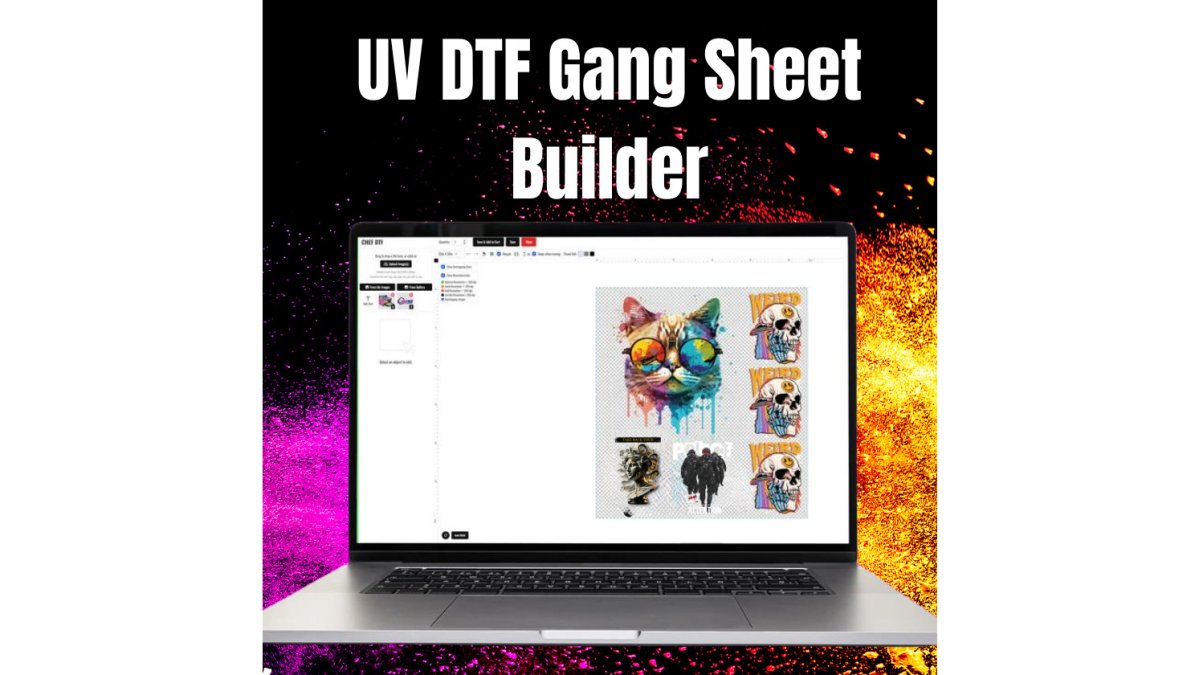
UV DTF suits small-batch production because you can place multiple designs on one gang sheet. BB5wholesale's UV DTF Gang Sheet Builder starts at £3.75, and you only print what you need. That avoids the setup costs of engraving or screen printing, and it means a run of ten awards costs far less per unit than ordering a large minimum batch.