


DTF vs Screen Printing: Which Method Wins in 2026?

Table of Contents
- DTF Transfer Printing vs Screen Printing: The Core Differences
- How to Print Vibrant Colours with DTF Transfers
- DTF Transfer Durability Test: What the Data Shows
- Cost Comparison: DTF vs Screen Printing
- Design Complexity and Colour Capabilities
- Production Speed and Turnaround Time
- Equipment, Setup, and Substrate Compatibility
- Which Method Should You Choose?
Last Updated: August 18, 2026
DTF Transfer Printing vs Screen Printing: The Core Differences
DTF vs screen printing represents one of the most significant decisions custom apparel businesses face today. Both methods produce durable, vibrant garment decorations, but they operate on fundamentally different principles and suit vastly different production scenarios. Understanding these core differences isn't just academic, it directly affects your profitability, turnaround time, and the quality of what reaches your customers.
What is Direct to Film (DTF) Printing?
Direct to Film printing is a digital printing process that transfers pre-printed designs onto fabric using heat and pressure. The workflow begins with printing your design directly onto a special PET transfer film using DTF-specific inks and adhesive powder. Once the film is ready, you apply it to your garment with a heat press, and the design bonds permanently to the fabric. The process eliminates the need for screens, mesh, or colour separations, you print what you see on your screen directly onto the shirt.
BB5wholesale specialises in providing ready-to-press DTF transfers in multiple sizes, handling the production complexity so you don't have to. Their gang sheet builder allows you to arrange multiple designs efficiently before production, which is especially valuable if you're managing orders from different customers simultaneously.
What is Screen Printing?
Screen printing is a traditional, manual printing method that forces ink through a fine mesh screen onto fabric. Each colour in your design requires a separate screen and a separate pass through the press. The process involves creating film positives, exposing screens with emulsion, and then manually or mechanically pressing each colour layer onto the garment. The ink sits on the fabric surface and cures through heat, creating a textured, tactile finish that many consider the hallmark of quality apparel.
The durability of screen printing is legendary, properly executed screen prints can withstand hundreds of washes without significant degradation. However, this durability comes at the cost of setup time, labour, and the need for dedicated equipment.
How to Print Vibrant Colours with DTF Transfers
Achieving vibrant, saturated colours with DTF transfers depends on several technical factors working in concert. The foundation is high-quality transfer film paired with properly formulated DTF inks and adhesive powder that cures correctly under heat. When these elements align, DTF produces colour vibrancy that rivals or exceeds screen printing, with the added advantage of unlimited colour gradients and photographic detail.
The critical step is heat press temperature and pressure. Most DTF transfers require pressing at 160-180°C for 10-15 seconds with firm, even pressure across the entire design. Under-pressing leaves the adhesive powder partially uncured, resulting in a transfer that feels stiff and may peel prematurely. Over-pressing can scorch the film and degrade the ink pigments, dulling colours. The sweet spot is consistent, moderate pressure applied evenly, which is why industrial heat presses with digital temperature controls outperform manual alternatives.
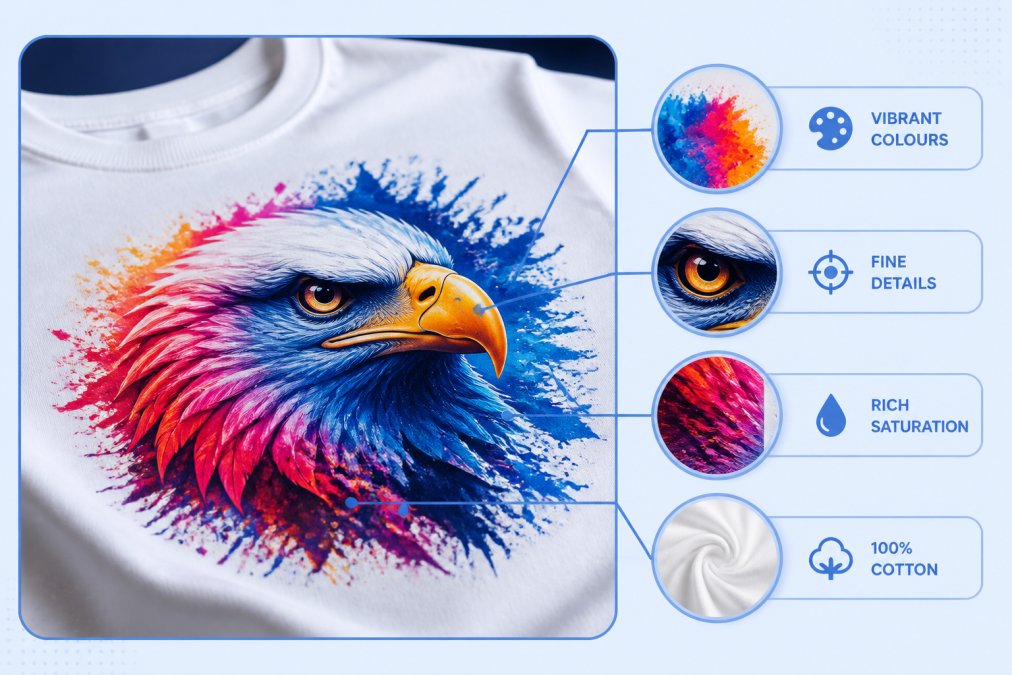
Fabric choice matters significantly. Natural fibres like 100% cotton accept DTF transfers more reliably than synthetic blends. Polyester and nylon can work, but they require slightly lower pressing temperatures to avoid shine or distortion. Pre-washing new garments removes sizing and finishes that can interfere with adhesion, so this step, though often skipped, measurably improves colour intensity and durability.
The adhesive powder consistency is where many operators stumble. Powder that's too coarse leaves visible texture and uneven coverage. Powder that's too fine doesn't provide enough adhesion. Quality suppliers like BB5wholesale manage this in their manufacturing, ensuring the powder-to-ink ratio is optimised for durability without compromising the feel of the garment.
DTF Transfer Durability Test: What the Data Shows
Durability is where DTF transfers historically faced criticism, but modern formulations have closed the gap considerably. A DTF transfer's longevity depends on the quality of the film, ink formulation, adhesive powder, and application technique. Poorly executed DTF transfers crack and peel after 10-15 washes. Well-manufactured transfers from quality suppliers withstand 50+ wash cycles with minimal visible degradation.
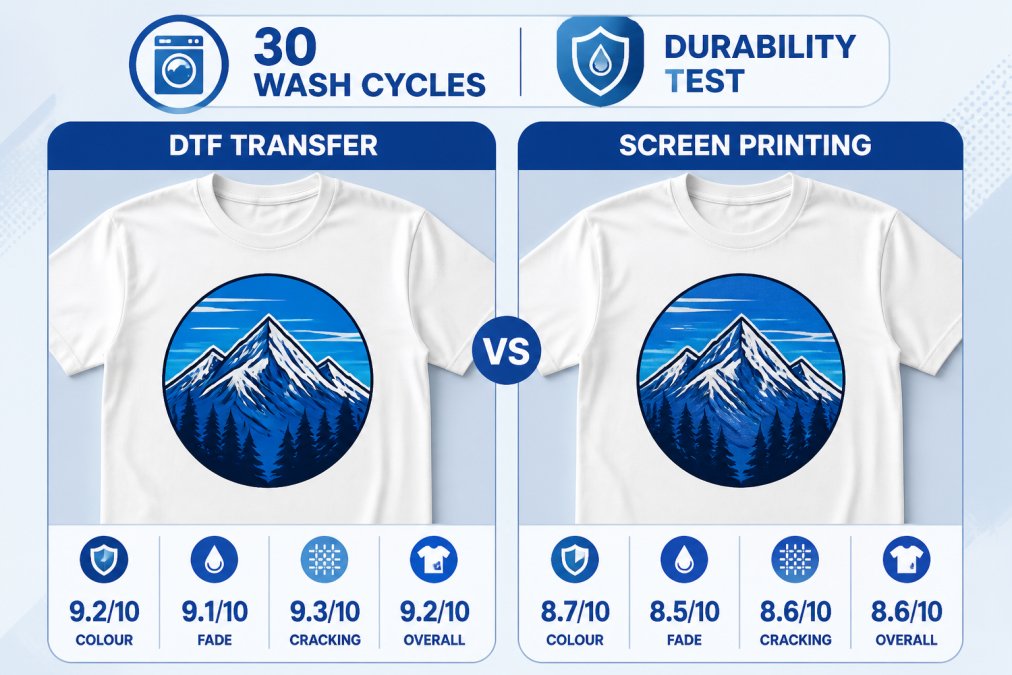
The wash fastness test is the industry standard for measuring durability. Garments are washed repeatedly in hot water with detergent, then inspected for cracking, peeling, colour fading, and hand feel changes. DTF transfers from established manufacturers typically achieve ISO 105-C06 ratings of 4-5 (excellent wash fastness), which means the design survives 40+ industrial wash cycles with negligible colour loss.
Hand Feel and Texture Comparison
This is where the two methods diverge most noticeably. Screen printing creates a raised, textured finish, the ink sits on top of the fabric and cures into a distinct layer. This tactile quality is beloved by many customers and is often associated with premium apparel. The hand feel is firm, slightly stiff, and unmistakably present when you touch the garment.
DTF transfers create a flatter, softer hand feel. The design bonds more intimately with the fabric fibres, resulting in a finish that feels closer to the original cloth. For customers accustomed to screen printing, DTF can feel less substantial, though many prefer the comfort and flexibility of the softer finish, especially for fitted garments or designs covering large areas.
The texture difference has practical implications. Screen-printed designs on tight-fitting t-shirts can feel restrictive and uncomfortable during movement. DTF transfers, sitting flatter against the skin, feel less constraining. For oversized apparel or loose-fitting designs, this distinction matters less.
Wash Fastness and Long-Term Performance
Both methods, when properly executed, produce durable prints. The difference lies in failure modes. Screen printing fails gradually, colours fade evenly over many washes, and the ink layer gradually thins. DTF transfers fail more abruptly, if the adhesive bond weakens, the transfer can peel or crack suddenly rather than fading gracefully.
This distinction matters for products intended for heavy use (workwear, athletic apparel) versus occasional wear (event merchandise, fashion items). Workwear benefits from screen printing's gradual degradation, which signals wear but maintains function. Event merchandise often benefits from DTF's sharper colour retention over 20-30 washes, which is typically the product's useful life.
Environmental factors accelerate failure in both methods. Chlorine in swimming pools degrades both screen-printed and DTF inks. Direct sunlight causes fading in both. Excessive heat (dryers on high settings) damages both. The difference is marginal, modern DTF and screen printing are roughly equivalent in real-world durability when quality standards are maintained.
Cost Comparison: DTF vs Screen Printing
Cost analysis requires separating fixed setup costs from per-unit variable costs. Screen printing has high fixed costs (screen creation, setup labour, colour separation) but low per-unit costs once production begins. DTF has minimal fixed costs but higher per-unit costs, especially for small orders.
Small Orders and Minimum Order Quantities
DTF transfers excel in scenarios where you're producing 1-50 units of a single design or managing multiple designs simultaneously. There's no screen to create, no colour separation required, and no setup labour. You upload your design, arrange it on a gang sheet if needed, and production begins immediately.
BB5wholesale's gang sheet builder addresses a real pain point here, if you're managing 10-15 orders per month with different designs, manually arranging transfers on a sheet wastes time and material. A properly built gang sheet maximises the printable area while minimising waste, reducing per-unit costs significantly.
Screen printing becomes cost-competitive around 100+ units of the same design. At that volume, the per-unit cost of the screen amortises across many garments, and labour efficiency improves. Below 100 units, screen printing's fixed costs make DTF the more economical choice.
Bulk Production Economics
At 500+ units of the same design, screen printing becomes substantially cheaper per unit. A single screen costs £30-80 to produce, but printing 500 garments amortises that to pennies per unit. DTF per-unit costs remain relatively constant regardless of volume, you're paying for film, ink, and powder for every transfer.
This is where bulk manufacturers and print shops with high-volume clients favour screen printing. The economics are simply better. However, the break-even point depends on design complexity. A simple one-colour design has lower screen costs and faster setup than a full-colour photographic print. A complex gradient design might never justify screen printing economics because the production time and labour remain high.
For promotional product managers ordering 200-300 branded items for corporate events, DTF often wins on cost and turnaround. For custom apparel shops running 50+ units of the same design weekly, screen printing's per-unit cost advantage becomes significant.
Design Complexity and Colour Capabilities
DTF transfers support unlimited colours, gradients, photographic detail, and fine line work without additional setup. A design with 50 colours prints identically to a design with 2 colours, there's no colour separation, no additional screens, no increased labour.
Screen printing is limited by practical constraints. Each colour requires a separate screen and a separate pass through the press. A design with 6 colours requires 6 screens and 6 manual (or semi-automatic) passes. This multiplies labour time, increases error risk, and raises costs. Most screen-printed designs use 2-4 colours to remain economical.
Photographic images and gradients are impractical with screen printing. You can approximate them using halftone techniques (breaking the image into tiny dots), but the results are inferior to DTF, which preserves photographic fidelity directly.
For graphic designers and artists wanting to print digital artwork onto apparel, DTF is the only practical choice. Screen printing requires simplifying artwork into spot colours, which defeats the purpose of complex, nuanced designs.
Production Speed and Turnaround Time
DTF transfers are ready in days, often within 24-48 hours from order to delivery. There's no setup time, designs go directly to film. Quality suppliers like BB5wholesale offer fast door-to-door delivery, which means a customer can place an order on Monday morning and have finished transfers in their hands by Wednesday.
Screen printing requires 3-7 days minimum, even for simple designs. Screen creation alone takes 1-2 days. Setup, colour matching, and test runs add another 1-2 days. Actual production, depending on volume, adds 1-3 days. Rush orders are possible but costly.
For event merchandise, time-sensitive promotional items, or customers with unpredictable demand, DTF's speed advantage is decisive. For planned production runs with known demand, screen printing's longer lead time is manageable.
Equipment, Setup, and Substrate Compatibility
DTF requires a heat press (£500-2,000 depending on size and automation) and optionally a DTF printer if you're producing your own transfers (£3,000-15,000). For most small businesses, purchasing ready-to-press transfers from a supplier eliminates the printer investment entirely.
Screen printing requires screens (£30-100 each), a screen printing press (£2,000-10,000 for manual carousel presses), squeegees, emulsion, ink, and workspace. A functional screen printing setup costs £5,000-15,000 minimum.
DTF transfers work reliably on cotton, cotton-blend, and polyester garments. They work less reliably on 100% synthetic fabrics without pre-treatment. They don't work well on textured surfaces (corduroy, terry cloth) because the uneven surface prevents even heat transfer.
Screen printing works on virtually any substrate, cotton, synthetics, canvas, leather, wood, metal, and textured fabrics. This versatility is valuable for promotional product managers needing to brand diverse items.
Which Method Should You Choose?
Choose DTF transfers if you're producing small-to-medium runs (1-200 units), managing multiple designs simultaneously, need fast turnaround, or want photographic detail and unlimited colours. Choose DTF if you're an Etsy seller, event organiser, or custom apparel shop with variable demand.
Choose screen printing if you're running high-volume orders (500+ units) of the same design, want the classic tactile feel of screen-printed apparel, or need to print on diverse substrates beyond fabric. Choose screen printing if you're a print shop with consistent, predictable demand.
For most small businesses and independent creators, DTF is the better starting point. The low fixed costs, fast turnaround, and design flexibility align with how modern custom apparel businesses operate. BB5wholesale's ready-to-press transfers eliminate the need to invest in a DTF printer while giving you access to the speed and flexibility DTF offers. Their gang sheet builder optimises material usage, reducing per-unit costs, which directly addresses the concern many small operators have about DTF's per-unit economics at scale.
The real advantage isn't choosing one method over the other, it's understanding when each wins and using the right tool for each job.
Choosing between DTF and screen printing ultimately depends on your production volume, design complexity, and timeline. If you're managing multiple orders monthly with varying designs and need fast turnaround, DTF transfers eliminate the setup complexity and cost that screen printing demands. BB5wholesale provides ready-to-press transfers with an intuitive gang sheet builder, 24/7 customer support, and secure payment options, giving you the speed and flexibility DTF offers without the equipment investment. Upload your gang sheet and get professional results without the operational overhead.
Frequently Asked Questions
Is DTF transfer printing more durable than screen printing?
Both methods can deliver durable results when executed properly. DTF transfers offer excellent wash fastness and colour retention on most fabrics, especially when cured correctly. Screen printing produces prints that bond with the fabric fibres, creating a textured, embedded finish. The key difference: DTF sits on the surface, while screen printing integrates into the weave. For long-term durability, proper curing temperature, wash temperature, and fabric type matter more than the method itself. DTF transfer durability tests show strong performance across 30+ wash cycles when applied with adequate pressure and heat.
Which is cheaper for small orders: DTF or screen printing?
DTF transfer printing wins decisively for small orders. Screen printing requires setup costs for each colour and design (screen preparation, mesh count selection, colour separation), making orders under 50 units uneconomical. DTF transfers have minimal setup costs and no minimum order quantity requirements, making them ideal for Etsy sellers, event organisers, and custom apparel shops running 10-20 unit orders. Pricing depends on transfer size, quantity, and delivery, so contact BB5wholesale for a quote on your specific order volume.
Can DTF transfers work on all fabric types?
DTF transfers perform best on natural and cotton-blend fabrics (100% cotton, cotton-polyester mixes). They adhere well to synthetic blends but may show reduced breathability on 100% polyester due to the adhesive powder layer. Stretch fabrics require careful application to avoid cracking. Darker fabrics benefit from DTF's opacity, whilst lighter fabrics showcase the colour vibrancy advantage. Screen printing offers broader substrate compatibility, including wood, metal, and rigid surfaces. For your specific fabric, BB5wholesale's support team can advise on suitability and application techniques.
What makes DTF transfer quality different from other suppliers?
Quality DTF transfers depend on film quality, ink formulation, adhesive powder consistency, and curing process. BB5wholesale prioritises colour vibrancy and durability through careful material selection and production control. Key differences between suppliers include transfer film grade, ink opacity, adhesive powder adhesion, and curing temperature precision. Lower-quality transfers often peel after a few washes due to insufficient adhesive coverage or improper curing. BB5wholesale's 24/7 support and secure payment protection mean you can test orders confidently and get help if any issues arise.
How long does DTF transfer printing take compared to screen printing?
DTF transfer printing is significantly faster. Ready-to-press DTF transfers arrive pre-cured and require only heat press application (typically 10-15 seconds), making turnaround time measured in hours. Screen printing involves design separation, screen preparation (emulsion exposure, mesh tension), ink mixing, and multi-colour registration, taking days for complex artwork. For on-demand fulfillment and fast turnaround, DTF transfers deliver orders within 24-48 hours. Screen printing suits bulk production where setup time is amortised across hundreds of units.
This article was written using GrandRanker