


Custom Apparel Printing: A 2026 Guide

Table of Contents
- Understanding Your Custom Apparel Printing Options
- How to Prepare Artwork for Apparel Printing
- Selecting the Right Garment and Fabric
- Custom Apparel Printing Cost Breakdown
- Step-by-Step Design Process for Professional Results
- Sustainability and Eco-Friendly Printing Solutions
- Post-Print Care and Legal Considerations
- Getting Started with Your Custom Apparel Project
Last Updated: August 16, 2026
Understanding Your Custom Apparel Printing Options
Custom apparel printing transforms blank garments into branded merchandise, promotional items, and personalised products. Your printing method choice affects quality, cost, turnaround time, and customer satisfaction. Three primary technologies dominate: screen printing, direct-to-garment (DTG), and heat transfer solutions including direct-to-film (DTF) and ultraviolet DTF decals. Each has distinct strengths depending on your volume, design complexity, fabric types, and budget.
Screen Printing vs DTG: Which Method Suits Your Business
Screen printing remains the industry standard for high-volume orders and vibrant, long-lasting results. For bulk orders of 50+ units with simple designs, screen printing delivers exceptional value and durability through hundreds of washes.
Direct-to-garment printing works like an inkjet printer for fabric, spraying water-based ink directly onto the garment. This method excels for small batches, intricate designs, and print-on-demand operations.
The trade-off is clear: screen printing requires higher upfront setup costs but lower per-unit pricing at scale. DTG eliminates setup costs but costs more per garment. For small businesses running 10-15 monthly orders, DTG typically makes more financial sense. For promotional product managers ordering 200+ items, screen printing becomes the obvious choice.
Heat transfer methods, including DTF solutions, occupy the middle ground. DTF transfers print your design onto special film, then apply it to the garment using heat and pressure, combining small-batch flexibility with impressive durability and colour vibrancy.
How to Prepare Artwork for Apparel Printing
Print-ready artwork is non-negotiable. Submitting poorly prepared files wastes time, money, and damages relationships with printing partners.
File Formats and Resolution Requirements
Your design software must export files in the correct format for your printing method. Screen printing and heat transfer typically require vector files in EPS or PDF format. Vector files use mathematical formulas to draw shapes, scaling infinitely without quality loss.
Raster images (JPG, PNG, BMP) use pixels and lose quality when enlarged. However, raster images are acceptable for DTG printing. The critical specification is DPI (dots per inch). Print-ready artwork requires minimum 300 DPI for photographic quality.
Common mistake: designers submit 72 DPI web graphics and expect print-quality output. A 72 DPI image printed at 300 DPI appears pixelated and blurry. Always start with high-resolution source files.
For custom apparel printing, vector files remain the gold standard. Adobe Illustrator produces industry-standard AI and EPS files. Corel Draw exports CDR files. Free alternatives like Inkscape generate SVG and PDF files. If you're using a gang sheet builder like BB5wholesale's platform, the system typically handles format conversion automatically.
Colour Modes: RGB vs CMYK and Pantone Matching
Your computer screen displays colours in RGB (red, green, blue), which mixes light. Printers use CMYK (cyan, magenta, yellow, black), which mixes pigment. These colour spaces don't align perfectly, so a vibrant neon pink on screen might print as duller coral.
Professional print shops require CMYK files. Converting RGB to CMYK in Photoshop or Illustrator is straightforward, but the conversion can shift colours noticeably. The solution is to design in CMYK from the start or use Pantone colour matching.
Pantone colours are industry-standard reference colours with specific ink formulations. Instead of specifying "RGB 255, 0, 128," you specify "Pantone 219C" and every printer worldwide produces identical results. For screen printing and professional heat transfer, Pantone matching ensures colour consistency across production runs.
DTG printing handles RGB files more gracefully because modern DTG printers include colour management software. However, providing CMYK files still produces more predictable results.
Bleed Areas and Crop Marks
Bleed area and crop marks prevent white edges on your finished garment. The bleed area is extra space beyond your final design, typically 3-5mm, that extends to the edge of the printing area. If your design has a coloured background, that background must extend into the bleed area. When the printer cuts or trims your garment, the blade removes the bleed area, leaving your design perfectly aligned.
Crop marks are small lines printed outside your design area that show the printer exactly where to cut. They're invisible on the finished product because they're trimmed away. Most professional design software includes crop mark functions. If you're using BB5wholesale's gang sheet builder, the system typically applies crop marks automatically.
Selecting the Right Garment and Fabric
Garment choice affects print quality, durability, and customer satisfaction. Not all fabrics accept ink equally. The interaction between fabric composition, weight, and weave determines how ink adheres and how long the print lasts.
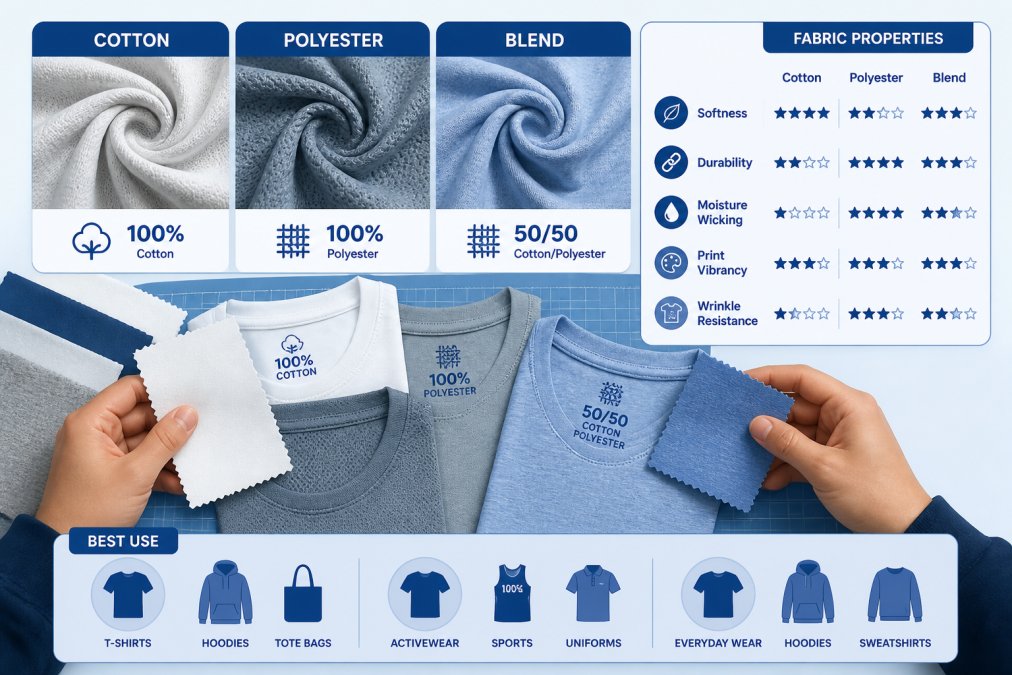
Cotton vs Polyester: Fabric Composition Matters
Cotton is the traditional choice for custom apparel printing. It's breathable, comfortable, and accepts water-based inks readily. Cotton fibres are porous, allowing ink to penetrate and bond with the fabric. A well-executed print on 100% cotton lasts hundreds of washes without cracking or peeling.
Polyester presents challenges for traditional screen printing because it's non-porous. Water-based inks don't adhere as effectively. However, polyester offers advantages: it's wrinkle-resistant, dries faster, and resists fading. For athletic wear, polyester is essential.
The solution is cotton-polyester blends (typically 50/50 or 65/35 cotton) that balance comfort with printability. DTG and heat transfer methods handle polyester better than screen printing because they use different ink chemistry. DTF transfers use polyurethane adhesive that bonds regardless of fabric composition.
Fabric Weight and Print Quality Impact
Fabric weight, measured in GSM (grams per square metre), affects how ink sits on the surface and how the finished garment feels. For most custom apparel businesses, 150-180 GSM provides good printability, comfortable wear, and reasonable cost. For performance or athletic wear, polyester blends at 150-160 GSM are standard because the fabric dries quickly and resists moisture.
When selecting garments, examine the fabric weave. Ring-spun cotton has a softer hand and prints cleanly. For professional results, source from established blank garment suppliers who maintain consistent quality.
Custom Apparel Printing Cost Breakdown
Understanding pricing factors helps you make informed decisions and set realistic expectations with customers.
Pricing Factors: Quantity, Turnaround Time, and Method
Volume dramatically affects per-unit cost. A 10-shirt screen printing order costs significantly more per shirt than a 100-shirt order because setup costs distribute across fewer units. DTG and DTF eliminate setup costs, so per-unit pricing remains relatively stable whether you're printing 1 or 50 units.
Turnaround time is the second major cost factor. Standard turnaround is typically 5-10 business days. Rush orders incur premium charges because they require priority scheduling and often overtime labour.
Method selection directly impacts cost. Screen printing offers the lowest per-unit cost at high volume but highest upfront cost. DTG printing costs more per unit but has zero setup cost. Heat transfer and DTF solutions fall between these extremes.
Colour count also influences pricing. Screen printing charges per colour because each colour requires a separate screen. DTG and DTF don't charge per colour because they print the entire design simultaneously, making multi-colour designs economical.
Bulk Ordering and Print-on-Demand Economics
Bulk ordering means committing to large quantities upfront, typically 100+ units. Bulk orders spread fixed costs across many units, reducing per-unit pricing significantly. However, bulk ordering requires capital investment and storage space.
Print-on-demand (POD) means printing small quantities as orders arrive. POD has higher per-unit costs but zero inventory risk and infinite flexibility. DTF transfers enable a hybrid approach: produce gang sheets (multiple designs on one sheet) in small batches, then cut individual transfers as orders arrive. This approach reduces waste, minimises inventory, and maintains fast turnaround. BB5wholesale's gang sheet builder facilitates this workflow by allowing designers to arrange multiple designs efficiently.
Step-by-Step Design Process for Professional Results
Creating print-ready artwork requires a systematic approach. Rushing through design preparation leads to reprints, customer dissatisfaction, and wasted materials.
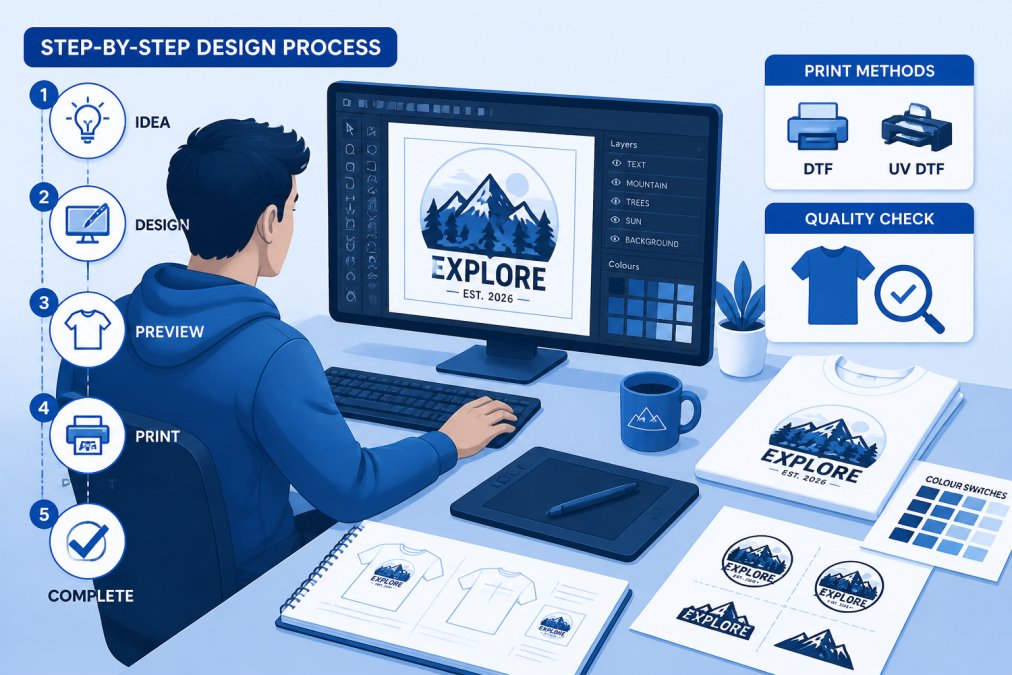
Start by defining your design specifications: final size, colour count, printing method, and fabric type. Create your design in your chosen software. If designing for vector-based printing (screen printing or DTF), use vector software from the start. Build in your bleed area (typically 5mm) from the beginning.
Apply colour corrections based on your printing method. If screen printing, convert to CMYK and specify Pantone colours. If DTG, work in RGB but verify CMYK conversion. If DTF, most modern systems accept RGB, but CMYK ensures predictability.
Create crop marks and registration marks if required by your printer. Flatten your design into a single layer, ensuring no hidden elements. Export your file in the required format. For screen printing and DTF, export as high-resolution PDF or EPS. For DTG, high-resolution PDF or TIFF works well. Include your bleed area in the exported file.
Before submitting, print a test copy to verify colours and sizing. If using BB5wholesale's gang sheet builder, the platform provides visual previews of your designs before production begins.
Common Design Mistakes to Avoid
Designers frequently submit artwork with invisible text or text that's too small to print clearly. Text below 8 points becomes illegible when printed. For apparel, 12+ points is safer.
Another common error is using gradients that require too many colours. Screen printing can't reproduce gradients smoothly. DTG handles gradients well, but DTF transfers perform better with limited colour variations.
Thin lines (under 0.5mm) often disappear during printing. Use minimum 1mm line width for durability. Keep critical design elements at least 5mm from the edge to prevent them being cut off.
Ink Opacity and Colour Accuracy
Ink opacity determines whether the ink completely covers the fabric or allows the fabric colour to show through. Full opacity means the design completely masks the underlying fabric. For most custom apparel, full opacity is preferred because it ensures colours match your design specifications regardless of fabric colour.
Colour accuracy depends on your colour specification method. Pantone matching is most accurate for screen printing. CMYK conversion is adequate for DTG and DTF but less precise than Pantone. If colour matching is critical for your brand, request physical colour proofs before production.
Sustainability and Eco-Friendly Printing Solutions
Environmental impact increasingly influences purchasing decisions. Understanding eco-friendly printing options positions your business as conscious and forward-thinking.
Water-based inks used in DTG printing are significantly more environmentally friendly than plastisol inks traditionally used in screen printing. Water-based inks contain fewer volatile organic compounds (VOCs), reduce chemical waste, and are easier to wash from equipment. DTG production generates minimal fabric waste because the printer applies ink only where the design exists.
DTF transfers also offer environmental advantages. Modern DTF inks are increasingly eco-formulated, and the transfer process minimises water usage compared to traditional screen printing. Fabric choice also impacts sustainability. Organic cotton requires fewer pesticides than conventional cotton. Recycled polyester reduces landfill waste. Offering sustainable fabric options alongside eco-friendly printing methods appeals to environmentally conscious customers.
Post-Print Care and Legal Considerations
Quality doesn't end when the garment leaves the printer. Proper care instructions and legal compliance protect both your reputation and your business.
Washability and Print Durability
Print durability depends on method and care. Screen-printed garments typically withstand 100+ washes before noticeable fading. DTG prints last 50-75 washes with proper care. DTF transfers, when properly applied, rival screen printing durability at 100+ washes.
Proper care extends print life significantly. Cold water washing prevents ink bleeding. Turning garments inside-out protects prints from friction. Air drying is gentler than machine drying. Avoiding bleach and harsh detergents preserves colours and prevents ink degradation.
Communicate care instructions clearly to customers. Include a hang tag or email with washing instructions. This reduces returns and complaints whilst educating customers on maximising their garment's lifespan.
Copyright and Licensing for Custom Designs
Legal compliance is non-negotiable. You cannot print copyrighted images, trademarked logos, or protected characters without explicit permission.
For custom orders, request confirmation that the customer owns or has licensed the artwork. Many print shops include this requirement in their terms and conditions. This protects you from liability if a customer submits infringing artwork.
Licensed artwork requires proper documentation. If a customer provides artwork licensed from a stock photo site, verify the licence permits commercial use and apparel printing. For your own designs, consider trademarking distinctive logos or brand marks to protect your intellectual property.
Getting Started with Your Custom Apparel Project
Beginning your custom apparel printing journey requires clear planning. Define your goals: are you building a print shop, launching a merchandise line, or creating personalised gifts?
Start small. Test your chosen printing method with a small order before committing to bulk production. This reveals quality standards, turnaround reliability, and actual costs. Many successful custom apparel businesses began with DTG or DTF transfers because low setup costs allowed experimentation without financial risk.
Invest in design skills or hire a designer. Professional artwork dramatically improves results and customer satisfaction. Partner with a reliable printing provider. Consistency matters more than lowest price. BB5wholesale's combination of high-quality DTF transfers, intuitive gang sheet builder, and 24/7 customer support addresses the core needs of small businesses and designers. With secure payment options, fast door-to-door delivery, and commitment to best value, the platform eliminates friction from custom apparel production.
Document your workflow. Track which designs sell, which printing methods work best for your customer base, and which fabric choices receive the most positive feedback. This data informs better decisions as you grow.
Custom apparel printing transforms blank garments into branded assets that represent your business or creative vision. The technical requirements, file preparation, colour management, and fabric selection seem complex initially but become routine with practice. For small businesses, Etsy sellers, and independent designers, DTF transfers through BB5wholesale eliminate setup complexity whilst delivering durability and colour vibrancy that rivals traditional screen printing. Start with a test order, refine your process, and scale confidently knowing your supplier has your back with professional support and reliable production.
Frequently Asked Questions
What is the most durable method for custom apparel printing?
Screen printing typically offers the highest durability for custom apparel, with prints lasting 50+ washes when properly applied. DTG printing provides excellent durability on 100% cotton but may show wear faster on blends. Direct-to-garment methods produce vibrant, long-lasting results when the fabric composition and ink opacity are optimised. Durability depends on fabric type, ink quality, and post-print care. UV DTF decals offer exceptional durability on hard surfaces and synthetic materials.
How do I prepare artwork files for professional custom apparel printing?
Use vector files (AI, EPS, PDF) rather than raster images for best results. Ensure resolution is at least 300 DPI for print-ready artwork. Convert colours from RGB to CMYK to match print output accurately. Include bleed areas (typically 3-5mm) and crop marks to guide production. Save files in industry-standard formats and ensure all fonts are embedded or converted to outlines to prevent printing errors.
Is screen printing or DTG better for small orders?
DTG (direct-to-garment) is ideal for small orders and print-on-demand work because it requires no setup fees and handles single-unit production efficiently. Screen printing works best for bulk orders (typically 25+ units) where setup costs are spread across larger quantities. For Etsy sellers or event organisers with 10-15 orders monthly, DTG or heat transfer methods provide better value. Consider turnaround time and your typical order volume when choosing between methods.
What fabric composition works best for custom apparel printing?
100% cotton is the gold standard for most printing methods, offering excellent ink absorption and colour vibrancy. Cotton-polyester blends (80/20 or 65/35) provide durability and reduced shrinkage. Polyester works well with DTG printing but requires different ink formulations. Fabric weight matters too: heavier weights (200gsm+) provide better print quality and durability. Always verify your chosen printing method's fabric compatibility before ordering garments.
What are the legal considerations when printing copyrighted images on apparel?
You must have explicit permission or own the copyright to any images used on custom apparel. Using copyrighted designs without authorisation violates intellectual property law and can result in legal action. Ensure clients provide licensed artwork or original designs when ordering custom merchandise. For corporate promotional products, verify trademark and brand usage rights. Consider requiring customers to confirm they own or have licensed any designs they submit.
How do I avoid common mistakes in custom apparel design?
Convert artwork to CMYK and verify colour accuracy before printing. Avoid placing critical design elements too close to garment seams or edges. Use sufficient bleed area (3-5mm) to prevent white borders. Ensure text is at least 8pt for readability and use vector fonts. Test print resolution at actual size before full production. Confirm fabric type compatibility with your chosen printing method to prevent ink adhesion issues.
What factors affect the total cost of custom apparel printing?
Costs depend on printing method (screen printing, DTG, heat transfer), order quantity, turnaround time, and design complexity. Setup fees apply to screen printing but decrease per-unit cost on bulk orders. Garment price, fabric quality, and ink opacity all influence final pricing. Rush delivery typically increases costs. Print-on-demand services charge higher per-unit rates but eliminate minimum order quantities. Request quotes from suppliers to compare pricing structures for your specific project needs.
How does ink opacity affect print quality and durability?
Higher ink opacity produces more vibrant colours and better coverage on darker fabrics, but can feel stiff if over-applied. Proper opacity ensures colours match Pantone specifications and resist fading through multiple washes. Under-opaque prints fade quickly and may show garment colour through the design. Professional printers balance opacity for comfort and durability. Eco-friendly inks sometimes require adjusted opacity settings to achieve the same vibrancy as conventional inks.
This article was written using GrandRanker