


DTF Transfer Comparison 2026: Which UK Service Wins?

Table of Contents
- DTF Transfer Comparison 2026: Service Overview and Key Differences
- Feature and Service Comparison Table
- DTF Transfer Cost UK: Pricing Structures Explained
- DTF Transfer Durability: Wash Testing and Long-Term Performance
- DTF Transfer Process Explained: Application and Heat Press Requirements
- DTF Transfer vs HTV UK: When to Choose Each Method
- Direct-to-Film Troubleshooting: Common Issues and Solutions
- Scalability and Long-Term Equipment Maintenance
Last Updated: August 1, 2026
DTF Transfer Comparison 2026: Service Overview and Key Differences
When evaluating DTF transfer suppliers in the UK market, your choice significantly impacts production costs, print quality, and customer satisfaction. This guide from BB5wholesale covers the dtftransfersnow vs dtftransferus comparison 2026 in detail, examining how different UK-based DTF services stack up across pricing, durability, and technical capabilities.
Direct-to-film transfers have become essential for custom apparel businesses. The difference between a durable, vibrant transfer and one that peels after three washes often comes down to ink opacity, curing process precision, and substrate compatibility. Understanding these technical distinctions helps you choose a partner that matches your production needs.
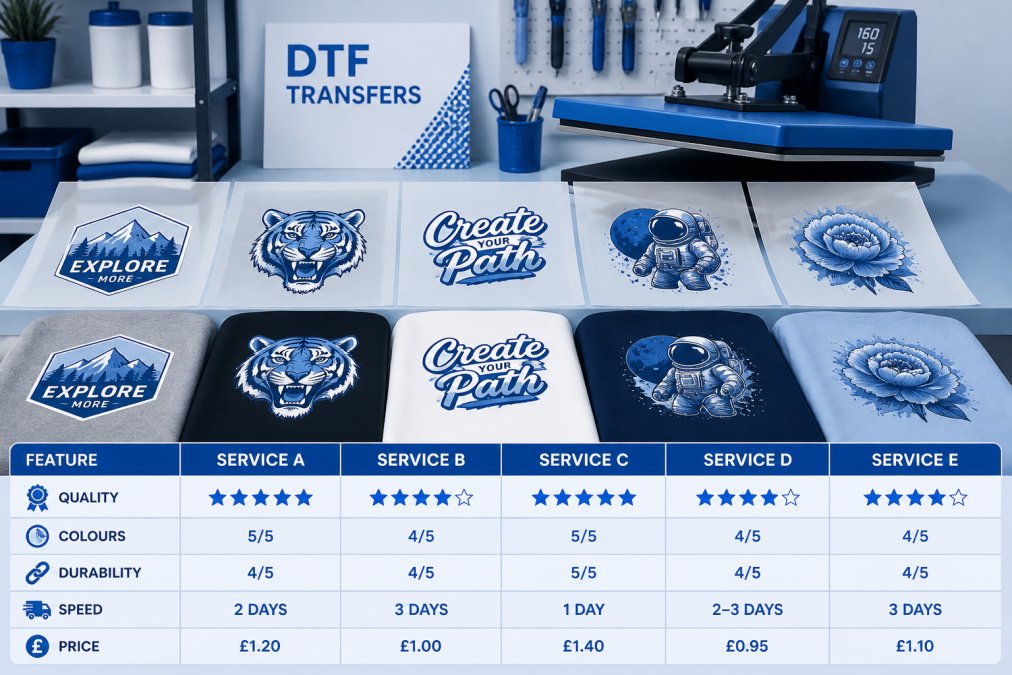
What Sets UK DTF Suppliers Apart
The UK DTF market has matured significantly. Suppliers now differentiate through gang sheet builders, turnaround times, and print quality consistency rather than price alone. According to UK textile printing industry analysis, production speed and reliability have become the primary decision factors for small apparel businesses.
Many UK providers now offer same-day or next-day dispatch, which changes the economics for made-to-order models. What matters most is whether the service handles both small gang sheets for Etsy sellers and larger volume runs without compromising quality.
Why This Comparison Matters for Your Business
The dtftransfersnow vs dtftransferus comparison 2026 isn't just about picking the cheapest option. Your choice affects order fulfilment speed, whether transfers survive 20+ washes, and colour vibrancy on different fabric blends. For small businesses with thin margins, one poor batch damages reputation and eats into profits.
BB5wholesale has tracked customer pain points across the DTF transfer space, and the most common complaint is inconsistency. Some suppliers deliver crisp, vibrant transfers one week and muddy, faded prints the next. Understanding what drives that inconsistency helps you avoid suppliers with quality control gaps.
Feature and Service Comparison Table
| Service | Gang Sheet Builder | Same-Day Dispatch | Minimum Order | Fabric Compatibility | Print Resolution |
|---|---|---|---|---|---|
| DTF.UK | AI-powered tool | Next-day available | None | Cotton, polyester, blends, nylon | High resolution |
| DTF Printing Kings | Online builder | Same-day (before 12 PM) | None | Cotton, polyester, blends | Professional-grade |
| DTF Transfer (dtftransfer.co.uk) | Manual or gang sheet | Next-day (before 12 PM) | None | Cotton, polyester, blends | Instant hot peel capable |
| BB5wholesale | Intuitive gang sheet builder | Fast door-to-door delivery | Flexible | Cotton, polyester, blends, hard surfaces (UV DTF) | High-quality prints |
UK suppliers have largely standardised on zero minimum orders and fast turnaround. Real differentiation emerges in print quality, builder usability, and whether they offer both standard DTF and UV-DTF for hard surface applications.
DTF Transfer Cost UK: Pricing Structures Explained
DTF transfer pricing in the UK follows two main models: gang sheet pricing and individual transfer pricing. Gang sheets, where multiple designs share one large print sheet, offer better value per design but require order consolidation. Individual transfers cost more per unit but offer flexibility for small runs.
According to UK e-commerce production benchmarking report, custom apparel businesses spend 15-25% of revenue on production costs. DTF transfer pricing sits within that range, depending heavily on volume and design complexity.
Gang Sheet vs Individual Transfer Pricing
Gang sheets typically start around £17-25 per sheet. A standard 560mm x 1000mm sheet accommodates 20-40 small designs, bringing cost per design down to £0.50-£1.50 when fully utilised. Individual transfers cost 30-50% more per unit but eliminate the need to batch orders, making sense for one-off custom pieces.
Heat press requirements and dwell time affect production costs indirectly. Transfers requiring longer curing processes mean slower throughput, which impacts labour costs even if per-unit transfer cost stays the same.
Hidden Costs and Delivery Charges
Delivery charges vary significantly between suppliers. Some include delivery in quoted prices; others add postage on top. For gang sheets, delivery might add £2-8 per order depending on speed. For small businesses placing weekly orders, these charges accumulate quickly.
Return issues also carry hidden costs. If a batch arrives with poor ink opacity or peel problems, you've lost production time and may have disappointed customers. Suppliers with strong quality control and straightforward replacement policies reduce this risk.
DTF Transfer Durability: Wash Testing and Long-Term Performance
Print durability separates professional DTF suppliers from mediocre ones. A transfer that fades after five washes isn't fit for purpose. Durability depends on ink formulation, adhesive powder quality, and the curing process.
Print Longevity Across Different Fabrics
DTF transfers perform differently across fabric types. Cotton garments typically show excellent wash fastness with quality transfers, surviving 20+ washes without visible fading. Polyester blends present more challenges because synthetic fibres don't bond with hot melt adhesive the same way pure cotton does.
Hot peel transfers (removed while adhesive is warm) typically deliver better initial adhesion than cold peel, translating to better wash fastness. Nylon and specialty blends require careful temperature control, apply too much heat and the fabric melts; apply too little and the adhesive won't set properly. Suppliers who specify application temperature ranges and dwell times for different substrates demonstrate competence.
Cold Peel vs Hot Peel and Wash Fastness
Hot peel typically creates stronger initial bonds, which translates to better wash fastness. Cold peel can feel softer initially but may show slightly higher peel failure rates after repeated washing.
Professional suppliers test transfers to ISO 105-C06 standards or equivalent. If a supplier won't discuss their testing methodology, that's a red flag. Colour vibrancy also matters for durability perception. A transfer that fades from vibrant to dull after five washes looks worse than one that starts slightly muted but stays consistent. CMYK colour profile accuracy and white ink layer quality determine whether colours remain true through washing.
DTF Transfer Process Explained: Application and Heat Press Requirements
Understanding the application process helps you avoid common mistakes that damage transfers before they reach the customer.
Application Temperature and Dwell Time Standards
DTF transfers typically require 160-180°C application temperature with 10-15 seconds dwell time on cotton fabrics. Polyester blends may need slightly lower temperatures (155-170°C) to prevent melting. Pressure settings of 3-4 bar are adequate for DTF transfers. After application, allow the garment to cool for 30-60 seconds before handling to let the adhesive fully set.
Substrate Compatibility: Cotton, Polyester, and Blends
Cotton garments bond most reliably with DTF transfers because natural fibres grip the hot melt adhesive effectively. Polyester blends present challenges, synthetic fibres don't absorb heat the same way, requiring precise temperature control and 15-20 seconds dwell time rather than 10-15.
Nylon and specialty fabrics demand even more precision. Some nylon fabrics are prone to melting or discolouration at standard DTF temperatures. Test any new fabric type with a sample transfer before committing to production runs.
DTF Transfer vs HTV UK: When to Choose Each Method
Heat transfer vinyl (HTV) and DTF transfers solve different problems. Understanding when each excels helps you pick the right method for each project.
Print Quality, Detail, and Color Vibrancy Comparison
DTF transfers win decisively on print quality and detail. They capture fine detail, multi-colour designs, and photographic images that HTV cannot match. Colour vibrancy also favours DTF, the ink sits directly on the fabric surface, allowing vibrant, saturated colours. HTV wins on durability for simple, single-colour designs, but this advantage only applies to basic designs. For anything more complex, DTF's superior print quality outweighs HTV's durability advantage.
Cost Per Print and Production Throughput
DTF transfers cost less per unit at volume. A gang sheet with 30 designs costs roughly £0.50-£1.00 per design; HTV for the same designs might cost £1.50-£3.00 per unit. Production throughput also favours DTF, you can print an entire gang sheet in minutes, then apply individual transfers as needed. HTV requires cutting each design individually, which is time-consuming for complex shapes.
Direct-to-Film Troubleshooting: Common Issues and Solutions
Even with quality transfers and proper technique, issues occasionally arise. Understanding what causes common problems helps you diagnose and fix them quickly.
Print Head Maintenance and File Preparation Standards
Print quality issues often trace back to file preparation. Files must be provided in CMYK colour profile, not RGB. Vector files (Adobe Illustrator, CorelDRAW) produce sharper results than raster graphics, particularly for text and fine detail. Resolution of 300 DPI is standard for print; anything below 150 DPI will show visible pixelation.
Gang sheet layout also affects print quality. Designs placed too close together can cause ink bleeding. Professional gang sheet builders automatically space designs correctly and optimize ink coverage.
Peel Problems, Ink Opacity Issues, and Quality Control
Peel problems usually indicate either insufficient heat or poor substrate preparation. If transfers peel immediately after application, the heat press temperature was too low. If they peel after a few washes, the dwell time was insufficient.
Ink opacity issues manifest as transparent or faded prints, usually from a thin or unevenly applied white ink layer. Some fabrics naturally resist DTF transfers due to surface texture or finish. Pre-testing on a small swatch prevents large-scale failures.
Quality control gaps show up as batch inconsistency. If some transfers from a gang sheet are vibrant and others dull, the printer's colour calibration is drifting. Reputable suppliers recalibrate regularly and test samples from each batch.
Scalability and Long-Term Equipment Maintenance
As your business grows, the equipment and supplier relationships you choose must scale with you.
Growing from Small Runs to High-Volume Production
Small businesses often start with individual transfers or tiny gang sheets. As volume increases, gang sheet consolidation becomes critical. A supplier with a sophisticated gang sheet builder saves hours weekly on design layout.
High-volume production also demands reliable turnaround. Suppliers offering same-day or next-day dispatch become essential as volume grows. Equipment maintenance becomes more important at scale, heat presses used daily need regular cleaning and calibration.
Service Reliability, Turnaround Times, and Customer Support
When fulfilling 100+ orders weekly, a single bad batch or delayed shipment cascades into customer complaints. Supplier reliability directly impacts your business reputation.
Look for suppliers offering 24/7 customer support. If you're printing orders at 11 PM and discover a file problem, you need immediate assistance. BB5wholesale's commitment to 24/7 support addresses this reality, custom apparel businesses don't work 9-5.
Payment flexibility also matters at scale. Suppliers accepting multiple payment methods reduce friction. Turnaround time consistency matters more than raw speed. A supplier promising next-day delivery 95% of the time is more reliable than one promising same-day delivery but delivering late 30% of the time.
Making Your Choice: DTF Transfer Comparison Summary
The dtftransfersnow vs dtftransferus comparison 2026 ultimately comes down to matching supplier capabilities to your business needs. For small businesses and Etsy sellers, prioritise ease of use and flexible minimums. For high-volume apparel shops, production speed and batch consistency become more important than builder convenience.
Quality consistency should never be a trade-off. Any supplier showing batch-to-batch variation in colour or opacity isn't worth the savings. Test samples before committing to large orders.
Consider the full picture: print quality, durability, turnaround time, customer support, and growth potential. The cheapest option today might create problems that cost far more tomorrow.
Choosing the right DTF transfer supplier is one of the most important decisions for custom apparel businesses, yet many focus solely on price. BB5wholesale delivers professional-grade DTF and UV DTF transfers with an intuitive gang sheet builder, fast door-to-door delivery, and 24/7 customer support, ensuring your transfers arrive on time and meet quality standards every time. With more than 10 secure payment methods and a commitment to best value without compromising quality, BB5wholesale simplifies the production process so you can focus on growing your business. Upload your gang sheet today and experience the difference reliable DTF transfers make.
Frequently Asked Questions
What are the main differences between DTF transfer suppliers in the UK?
UK DTF transfer providers vary significantly in turnaround times, print quality, and service offerings. Some specialise in gang sheets for bulk orders, while others offer individual pre-cut transfers for small businesses. Key differences include delivery speed (same-day or next-day options), substrate compatibility (cotton, polyester, blends), and whether they provide UV DTF for hard surfaces. Pricing structures also differ, some charge per gang sheet, others per individual transfer. The best DTF transfer comparison examines your specific volume needs and fabric requirements before choosing a supplier.
How much does DTF transfer cost in the UK, and are there hidden fees?
DTF transfer cost UK depends on quantity, sheet size, and delivery method. Gang sheets typically cost less per design than individual transfers when ordering in bulk. Postage can add significantly to your total expense, especially for urgent next-day delivery. Some suppliers offer price-match guarantees or competitive rates for trade customers. Always request a quote for your specific requirements, pricing varies based on design complexity, fabric type, and order volume. Check whether delivery charges are included in advertised prices before committing to a supplier.
What makes DTF transfer durability better than other printing methods?
DTF transfer durability depends on proper application and the quality of hot melt adhesive used. High-quality DTF transfers maintain vibrant colors and remain stretchable after repeated washing when applied at correct application temperatures and dwell times. The hot peel method (removing the transfer film while warm) typically offers superior wash fastness compared to cold peel. Durability also relies on substrate compatibility, polyester blends and cotton garments respond differently to the curing process. Professional DTF suppliers test their prints for wash fastness to ensure they withstand commercial laundering standards.
Is DTF transfer better than HTV for my custom apparel business?
DTF transfer vs HTV UK depends on your design complexity and fabric type. DTF excels at fine detail, photographic images, and multi-color artwork because it offers superior print resolution and color vibrancy without visible texture. HTV works better for simple designs and offers different durability characteristics on certain fabrics. DTF generally provides faster production throughput for gang sheets, making it ideal for print-on-demand and high-volume orders. HTV may be more cost-effective for single-color designs. Consider your typical design complexity, fabric preferences, and production volume when choosing between methods.
What file preparation standards should I follow for DTF transfers?
DTF transfer process explained requires proper file preparation using CMYK color profiles and raster graphics at 300 DPI minimum for sharp print resolution. Vector files should be converted to raster format before submission. Ensure your design fits within the gang sheet dimensions and leave adequate spacing between designs to avoid ink bleed. White ink layer requirements vary by supplier, confirm whether your artwork needs a separate white underbase file. Most UK DTF suppliers provide gang sheet builders with built-in file preparation guidance. Always test your file with your chosen supplier before committing to large orders to verify color accuracy and detail reproduction.
This article was written using GrandRanker