


Order Custom DTF Transfers Online: A Complete Guide

Table of Contents
- What Are DTF Transfers and Why Order Them Online
- How to Order Custom DTF Transfers: Step-by-Step
- Using a DTF Gang Sheet Creator for Efficiency
- Best File Formats for DTF Printing
- How to Apply DTF Transfers With a Heat Press
-
Custom DTF Printing UK Turnaround Times and Shipping
- [Standard and Express Delivery Options](#standard and-express-delivery-options)
- Wash Durability and Quality Assurance
- Troubleshooting Common DTF Transfer Application Failures
- Why Choose BB5wholesale for Your DTF Transfer Orders
Last Updated: August 4, 2026
What Are DTF Transfers and Why Order Them Online
Direct-to-film (DTF) transfers combine the vibrancy of screen printing with the flexibility of on-demand production. BB5wholesale specializes in high-quality DTF and UV DTF printing solutions, making it straightforward to bring digital designs to life on physical garments.
DTF transfers work by printing full-colour designs directly onto special film using water-based inks, then applying powder adhesive that bonds the design to fabric. The transfer is cured with a heat press to create a durable, washable print. Unlike heat transfer vinyl (HTV), which requires cutting individual designs, DTF transfers preserve every detail of your artwork, including gradients, photorealistic images, and complex colour blends.
How DTF Printing Works
Your design is printed onto special polyester film using CMYK colour mode. Powder adhesive is applied to the inked side while wet, creating a sticky layer that bonds to fabric. When heat-pressed onto a garment at 160°C for 10-15 seconds with medium pressure, the powder melts and fuses the design permanently to the fibres. The transfer sheet peels away cleanly, leaving the design behind. Most DTF transfers require 24-48 hours curing before washing.
This method works on cotton, polyester, and blended fabrics. The powder adhesive creates a flexible bond that moves with the fabric, maintaining integrity through repeated washing when applied correctly.
Benefits Over HTV and Screen Printing
Screen printing requires separate screens for each colour layer, making it economical only for large runs. DTF eliminates this entirely, print one design or one hundred different designs with zero additional setup time.
HTV demands precision cutting for complex designs. Fine details, small text, and gradients become labour-intensive or impossible. DTF handles all of these effortlessly. Compared to direct-to-garment (DTG) printing, DTF offers superior wash durability and works equally well on light and dark garments without requiring white base layers.
How to Order Custom DTF Transfers: Step-by-Step
Uploading Your Artwork
Prepare your design file in vector format (AI, EPS, or PDF) or as a high-resolution raster file (PNG with transparent background, minimum 300 DPI). Save artwork in CMYK colour mode to ensure accurate colour matching during printing.
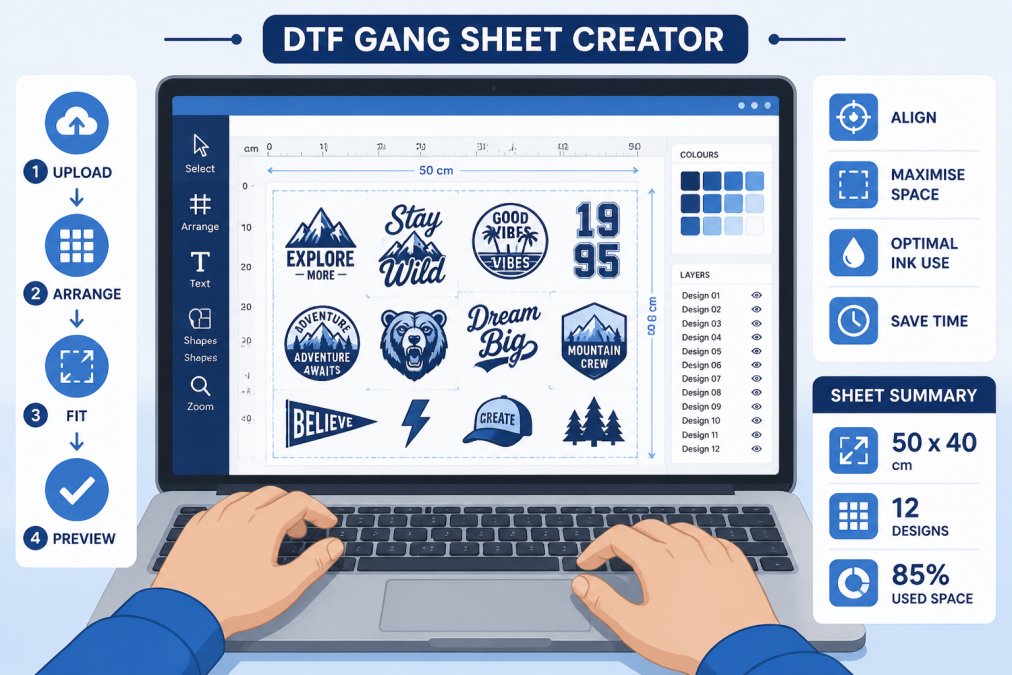
When uploading, specify the transfer size, quantity, and any special requirements. Check the preview carefully, it shows exactly how your design will appear on the transfer sheet. BB5wholesale's gang sheet builder allows you to arrange multiple designs on a single transfer sheet, maximising material efficiency and reducing per-unit costs.
Selecting Quantity and Delivery Options
Most online DTF services offer pricing breaks at common thresholds: 10 units, 25 units, 50 units, and 100+ units. Standard delivery takes 5-7 working days from order confirmation. Express delivery compresses this to 2-3 working days at higher cost. Many UK-based DTF providers offer next-day delivery for orders placed before midday.
Check shipping cost before finalising your order, as some services include delivery in the quoted price while others add it at checkout.
Using a DTF Gang Sheet Creator for Efficiency
A gang sheet is a single transfer sheet containing multiple different designs arranged together. Instead of printing ten separate sheets for ten designs, you print one gang sheet with all ten designs, then cut and apply them individually.
What Makes Gang Sheets Save Time
Printing ten individual sheets means ten separate print jobs, ten separate powder applications, and ten separate curing cycles. A single gang sheet consolidates all of that into one run. A standard A4 transfer sheet accommodates 6-12 small designs depending on size. By arranging designs efficiently, you pay for one sheet instead of two or three. For a business running 50-100 orders monthly, this compounds into significant savings and cuts production time by 40-60% compared to individual transfers.
Design Optimization for Gang Sheets
Arrange designs by size and shape to minimise waste. Leave at least 5mm of clear space around each design to prevent bleeding during cutting. Use a DTF gang sheet creator tool to visualise your layout before uploading and flag spacing issues, preventing costly mistakes.
Best File Formats for DTF Printing
Getting your file format right is crucial for print quality. The wrong format results in pixelation, colour shifts, or loss of detail.
Supported Formats and Resolution Requirements
Vector formats, Adobe Illustrator (AI), Encapsulated PostScript (EPS), and PDF, are the gold standard for DTF printing. These scale infinitely without quality loss. Raster formats like PNG, TIFF, and JPEG are acceptable if your artwork is photographic or hand-drawn, but require a minimum of 300 DPI at your final print size. A design intended to print at 10cm × 10cm needs to be 1181 × 1181 pixels at 300 DPI.
PNG files with transparent backgrounds are preferred over JPEG because they preserve transparency, allowing the transfer to blend seamlessly with garment colour.
Artwork Requirements: Colour Mode and Transparency
Always save artwork in CMYK colour mode, not RGB. RGB includes colours that cannot be reproduced in print, and conversion during production causes colour shifts. By working in CMYK from the start, you see exactly what will print.
Transparent backgrounds are essential for DTF transfers. If your design sits on a white background, that white will print as part of the transfer and show as a white box around your design on dark garments. Remove backgrounds entirely and save as PNG with transparency enabled. Text smaller than 8pt often becomes illegible when printed and cut. Fine lines thinner than 0.5mm may break or disappear entirely.
How to Apply DTF Transfers With a Heat Press
Application technique determines whether your DTF transfers last 5 washes or 50. The process is straightforward but requires attention to temperature, pressure, and timing.
Heat Press Settings and Temperature Guide
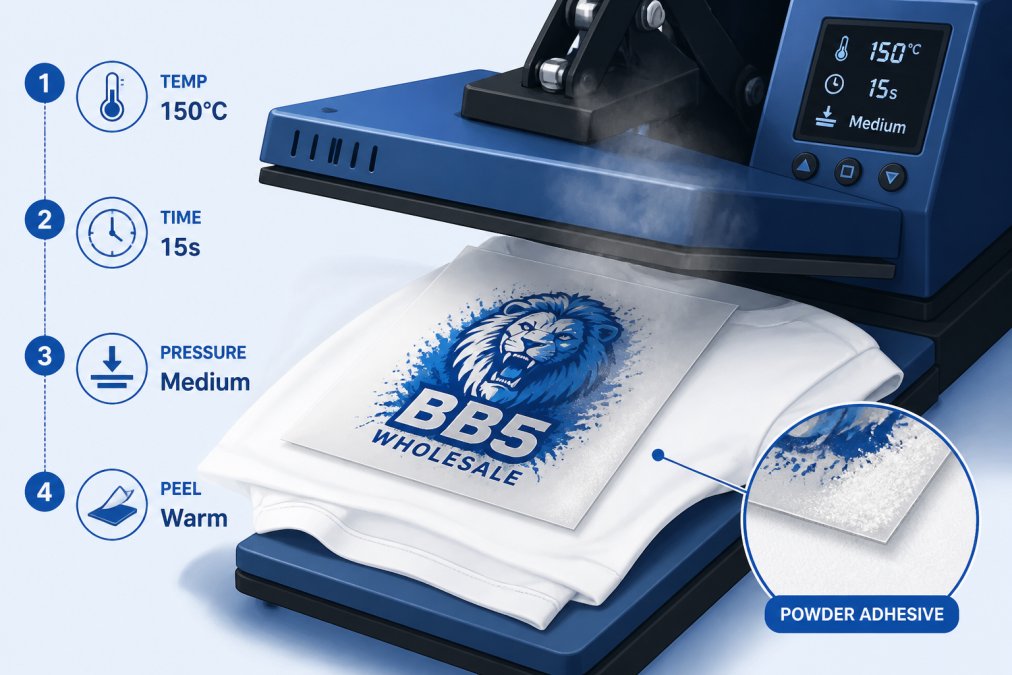
Set your heat press to 160°C. This temperature balances proper adhesion with fabric protection. Apply medium pressure, typically 3-4 bar on a pneumatic heat press. Dwell time is typically 10-15 seconds for cotton and cotton-blend fabrics. Polyester often requires slightly less time, 8-12 seconds, because it conducts heat more efficiently. Thicker fabrics like fleece or towelling may need 15-20 seconds. Test a sample on your specific fabric before running a full production batch.
Cold Peel vs Hot Peel and Curing Process
Most DTF transfers use cold peel, meaning you remove the transfer sheet after the garment cools slightly, typically 3-5 seconds after the press releases. After peeling, allow the garment to cool completely before handling, at least 5 minutes. Full curing takes 24-48 hours. Most DTF transfers withstand 50+ home washes (cold water, gentle cycle) without cracking, fading, or peeling.
Fabric Compatibility: Cotton, Polyester and Blends
DTF transfers bond reliably to cotton, polyester, and cotton-polyester blends. The powder adhesive works by melting into fabric fibres, which all three materials support equally well. Cotton garments require standard 160°C application for 10-15 seconds. Polyester conducts heat differently and often requires slightly shorter dwell times, 8-12 seconds. Avoid applying DTF transfers to 100% synthetic fabrics like nylon or acrylic, which don't bond well with the powder adhesive.
Custom DTF Printing UK Turnaround Times and Shipping
Standard and Express Delivery Options
Standard production takes 3-5 working days from order confirmation. Express production compresses the timeline to 1-2 working days, typically at a 20-40% premium. Shipping within the UK typically takes 2-3 working days via standard courier.
Wash Durability and Quality Assurance
DTF transfers applied correctly withstand 50+ home washes (cold water, gentle cycle, inside out) without cracking, fading, or peeling. Quality assurance during production includes colour accuracy checks, design positioning verification, and adhesion testing. When your transfers arrive, inspect them before applying to customer garments. The transfer sheet should feel sticky to the touch, and designs should be crisp with no visible ink smudging or colour banding.
Troubleshooting Common DTF Transfer Application Failures
Peeling, Cracking and Adhesion Problems
If your transfer peels away during application, you've removed the transfer sheet too quickly. The powder adhesive needs 8-10 seconds after pressing to begin bonding with fabric. Solution: wait longer before peeling and ensure your heat press maintains consistent temperature throughout the dwell time.
Cracking typically appears after several washes and indicates incomplete curing or insufficient pressure during application. Solution: ensure you're applying 3-4 bar pressure and allowing 24-48 hours curing time before washing. If cracking persists, increase dwell time by 2-3 seconds.
Poor adhesion to polyester often results from temperature being too low. Solution: verify your heat press temperature with a calibrated thermometer and increase dwell time slightly for polyester.
Powder Adhesive and Substrate Issues
Visible white powder residue on the transfer sheet after peeling indicates excess adhesive. This is cosmetic and doesn't affect durability. Solution: use slightly less pressure or reduce dwell time by 1-2 seconds.
Adhesion failures on dark or heavily textured fabrics (fleece, towelling) often result from the powder not reaching the fabric surface. Solution: increase pressure and dwell time by 2-3 seconds, and consider using a Teflon sheet between the transfer and press to distribute heat more evenly.
Why Choose BB5wholesale for Your DTF Transfer Orders
BB5wholesale offers a complete DTF solution designed around the needs of small businesses, Etsy sellers, and independent print shops. The gang sheet builder stands out as a practical efficiency tool. Instead of manually arranging designs in design software, you upload individual design files and the builder positions them automatically on a standard transfer sheet. This saves hours of layout work and ensures optimal material usage.
24/7 customer support means you have access to help whenever you need it. BB5wholesale supports more than 10 different secure payment methods, protecting your financial information and giving you flexibility in how you pay. Fast door-to-door delivery means your transfers arrive quickly, letting you fulfil customer orders without extended delays.
| Feature | Standard | Express |
|---|---|---|
| Production Time | 3-5 working days | 1-2 working days |
| UK Shipping | 2-3 working days | Next business day |
| Total Timeline | 5-8 days | 1-3 days |
| Cost Premium | Baseline | +20-40% |
| Best For | Regular production | Urgent orders |
Frequently Asked Questions
What file format should I use when I order custom DTF transfers online?
PNG and PDF files with transparent backgrounds work best for DTF printing. Ensure your artwork is in CMYK colour mode and at least 300 dpi for high-resolution output. Vector files (AI, EPS) are ideal because they scale without quality loss. Avoid JPEG files with white backgrounds, as they'll print the white area onto your garment. Always check your supplier's specific format requirements before uploading.
How long does it take to receive custom DTF transfers in the UK?
Turnaround times vary depending on order volume and your chosen delivery option. Standard processing typically takes 3-5 working days, with next-day delivery available for urgent orders. Shipping to most UK addresses takes 1-3 working days once your order ships. Express services cost more but guarantee faster receipt. Always check current turnaround times on the supplier's website, as production schedules can change during peak periods.
Why do my DTF transfers peel after a few washes?
Peeling usually results from incorrect heat press settings, insufficient curing time, or poor powder adhesive application. Ensure your transfer is fully cured (cooled completely) before washing. Use the correct temperature and pressure for your specific fabric type. Wash garments inside-out in cool water and air-dry to extend durability. Quality DTF transfers should withstand 50+ wash cycles. If peeling persists, check that your supplier uses proper powder adhesive and high-quality film.
Can I use a DTF gang sheet builder if I only have 10-15 orders a month?
Yes. Gang sheet builders are designed for businesses of all sizes, including small Etsy shops and part-time sellers. By combining multiple small designs on one sheet, you reduce waste and lower per-unit costs, making it especially valuable for low-volume orders. You'll only pay for the space your designs use, not for a full sheet. This approach helps small businesses compete on price while maintaining quality. Check your supplier's minimum order quantities to confirm they suit your monthly volume.
[EXTERNAL_LINK: Textile printing standards and best practices | britextile.org.uk]
[EXTERNAL_LINK: UK small business manufacturing guides | fsb.org.uk]
[EXTERNAL_LINK: Direct-to-garment and heat transfer printing technical specifications | printingindustry.co.uk]
This article was written using GrandRanker