


Best DTF Transfers for Small Business in 2026

Table of Contents
- What Are DTF Transfers and Why They Matter for Small Business
- Quick Comparison Table: Top DTF Transfer Options
- 1. BB5wholesale: Intuitive Gang Sheet Builder with 24/7 Support
- 2. UltraColour MAX Heat Transfers: No Minimum Order, Same-Day Dispatch
- 3. DTF Pro UK: Durable Transfers with Gang Sheet Builder
- 4. DTF Factory UK: Premium Quality with Expert Artwork Review
- DTF Transfer Pricing Guide: Understanding Costs for Your Budget
- How to Apply DTF Transfers: Step-by-Step Process
Last Updated: August 5, 2026
What Are DTF Transfers and Why They Matter for Small Business
Direct-to-film (DTF) transfers let small businesses produce custom apparel without investing £4,000-£8,000 in dedicated equipment. The process prints your design onto special film using CMYK inks plus white, adds adhesive powder, cures the print, and ships ready-to-press transfers. You apply them using a heat press, producing vibrant, durable prints that survive repeated washing.
The real advantage is scalability: a 10-order month costs nearly the same per unit as a 100-order month when outsourcing. Your supplier handles gang sheet optimization, arranging multiple designs on a single sheet to minimize waste. According to research from Statista report on custom apparel production trends, small businesses switching to outsourced DTF transfers reduced per-unit production costs by 20-30% compared to in-house DTG printing.
Quick Comparison Table: Top DTF Transfer Options
| Supplier | Minimum Order | Starting Price | Key Strength | Best For |
|---|---|---|---|---|
| BB5wholesale | No minimum | Check quote | Gang sheet builder + 24/7 support | Serious small businesses |
| UltraColour MAX | 1 sheet | £5.25/A4 sheet | Same-day dispatch from UK | Urgent orders & testing |
| DTF Pro UK | 1 sheet | £2.00/10cm sheet | Durable transfers (60+ washes) | Print-on-demand shops |
| DTF Factory UK | No minimum | From £6.95/metre | Expert artwork review | Quality-focused brands |
1. BB5wholesale: Intuitive Gang Sheet Builder with 24/7 Support
BB5wholesale's gang sheet builder eliminates manual design arrangement. Upload multiple designs, arrange them on a virtual sheet, and see exactly how much you're paying per square inch before committing. This saves hours monthly for businesses juggling 15-20 orders.
24/7 support matters when you hit edge cases: artwork files too small, fabric type requiring special handling, or tight delivery deadlines. Having someone available at 2 AM when troubleshooting an urgent order is valuable.
BB5wholesale's security model protects small business concerns. More than 10 secure payment methods mean you're not locked into one gateway. If your preferred processor has an outage, you've got alternatives.
Shipping is consistent and fast, allowing you to promise realistic turnaround times and build customer trust.
2. UltraColour MAX Heat Transfers: No Minimum Order, Same-Day Dispatch
UltraColour MAX excels when you need transfers fast without bulk commitments. Same-day dispatch for orders placed by 8 AM is a genuine differentiator. The no-minimum-order policy lets you test a single A4 sheet (roughly 4-6 small designs) for £5.25 before committing to larger volumes.
Print quality is vibrant with full-colour, detailed prints preserving nuance in gradients and photographic designs. UltraColour MAX manufactures in-house in Braintree, Essex, so you're working directly with the producer, not a middleman.
Per-sheet pricing for small quantities is higher than bulk rates elsewhere. If ordering 100+ sheets monthly, other suppliers undercut them significantly.
3. DTF Pro UK: Durable Transfers with Gang Sheet Builder
DTF Pro UK transfers withstand at least 60 washes, crucial for workwear and sportswear. The included gang sheet builder (no extra fees) aligns with how small businesses actually work. Pricing starts at £2.00 for a 10cm x 10cm sheet, letting you calculate exact per-square-inch costs.
A free sample pack lets you test quality and validate durability claims before production orders.
Royal Mail Next-Day Tracked and 48-hour Tracked options give you control over delivery speed versus cost. Calculate total landed cost, not just transfer price, when comparing suppliers, delivery charges can add 25-40% to your order.
4. DTF Factory UK: Premium Quality with Expert Artwork Review
DTF Factory UK reviews artwork before shipping, flagging issues like low resolution or colour space mismatches. This is valuable if you're new to DTF printing or working with inexperienced designers.
Transfers arrive cured and ready to apply, eliminating curing delays. Pricing starts from £6.95 per metre. The per-metre model requires understanding efficient design arrangement, wasted space increases per-unit costs.
No minimum order quantity lets you test single designs or fulfill one-off orders. The downside is that per-metre pricing requires more calculation than flat per-sheet models.
DTF Transfer Pricing Guide: Understanding Costs for Your Budget
Per-sheet pricing models (UltraColour MAX, DTF Pro UK) are straightforward: you pay X pence per A4 or A3 sheet. Most suppliers drop prices 20-30% moving from 10 sheets monthly to 50 sheets monthly.
Per-metre pricing models (DTF Factory UK) require calculating how efficiently you arrange designs. A metre of film is roughly 1m x 60cm. If your average design is 20cm x 20cm, you fit roughly 12-15 designs per metre. Divide per-metre price by realistic fit count to get per-design cost.
Gang sheet builders (BB5wholesale, DTF Pro UK) show costs before ordering, removing guesswork.
Delivery costs vary significantly. Some suppliers include delivery; others charge separately. A £15 transfer order with £6 delivery costs 40% more than the transfer price alone.
How to Apply DTF Transfers: Step-by-Step Process
Applying DTF transfers correctly ensures professional results and durability. Temperature, dwell time, and peel method directly impact longevity.
What You'll Need Before Starting
A commercial heat press is essential, consumer-grade presses don't reach required temperatures uniformly. A commercial heat press costs £300-£800 and lasts years. You'll also need blank garments, a heat-resistant surface, and a heat-resistant glove or tool for peeling.
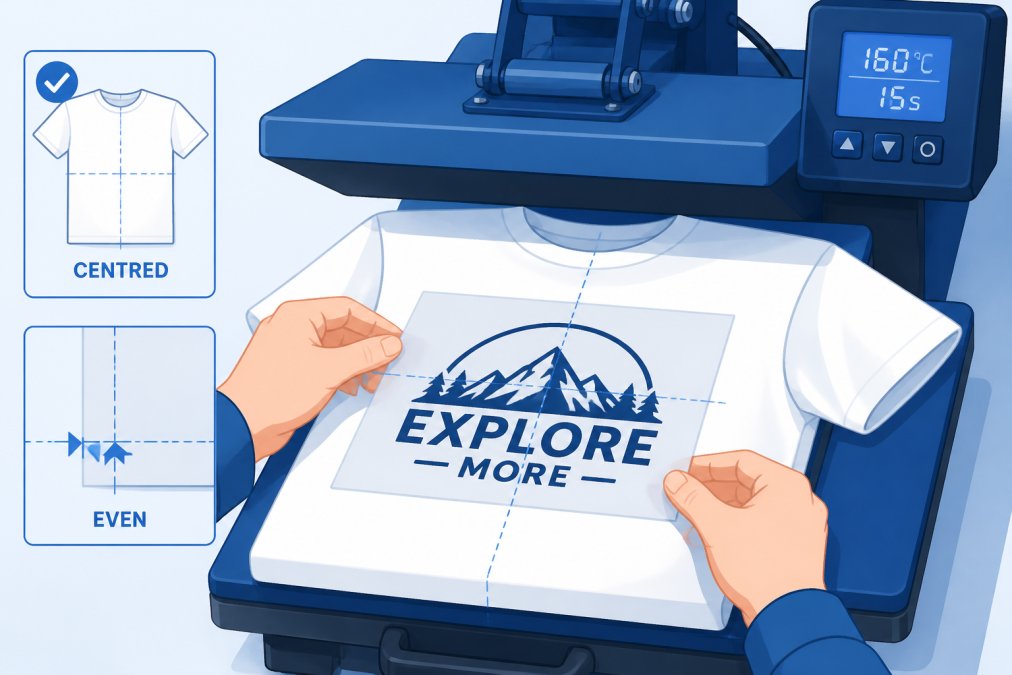
Temperature accuracy matters. Most DTF transfers require 160-180°C. Your heat press should have a thermostat with digital readout for reliability.
Application Steps and Heat Press Settings
Step 1: Prepare the garment. Lay the garment flat on the heat press platen and smooth out wrinkles. Position the design area flat and centered.
Step 2: Place the transfer. Position the DTF transfer with the printed side facing down. Use alignment guides to position correctly.
Step 3: Set heat press parameters. Temperature: 160-180°C (check your supplier's specification). Dwell time: typically 10-15 seconds for cotton, 12-18 seconds for polyester blends. Pressure: medium to firm.
Step 4: Press. Close the heat press and hold for the full dwell time. Don't open early, adhesive powder needs time to melt and bond with fabric fibres.
Step 5: Peel the transfer. Some suppliers recommend hot peel (removing while warm, around 60-80°C); others recommend cold peel (waiting for complete cooling). Check your supplier's instructions. Peel slowly at a shallow 45-degree angle. If the film resists, let it cool further.
Step 6: Cure (optional). Some suppliers recommend a second, lighter press after peeling to set adhesive fully. A 5-10 second press at 140-150°C can improve durability on polyester or performance fabrics.
Common Application Mistakes to Avoid
Insufficient dwell time is the most common failure. Transfers that aren't cured long enough peel partially or fail after a few washes. If you're seeing peeling issues, increase dwell time by 2-3 seconds.
Uneven pressure causes patchy adhesion. Check your heat press platen for flatness. If warped, have it serviced.
Wrong temperature is equally destructive. Too cold, and adhesive powder won't melt. Too hot, and the film can scorch. Use a temperature gun to verify accuracy.
Peeling too early risks pulling the film off before adhesive sets. Follow your supplier's peel timing exactly.
Pressing wrinkled garments creates voids under the transfer, compromising adhesion. Always smooth the garment first.
Fabric Compatibility and Special Considerations
DTF transfers work on cotton, polyester, cotton-polyester blends, and some performance fabrics. The key variable is how the fabric accepts adhesive powder and retains the print after washing.
Cotton is the easiest substrate. Fabric fibres accept adhesive powder readily, producing consistent, durable results.
Polyester requires slightly higher temperature and longer dwell time. Synthetic fibres don't absorb adhesive powder the same way cotton does. If you're seeing poor adhesion, increase dwell time first.
Blends (cotton-polyester mixes) usually work fine with standard DTF settings. Higher polyester percentages benefit from polyester settings.
Performance fabrics (moisture-wicking synthetics) can be problematic. Special finishes sometimes repel adhesive powder. Some suppliers offer blockout DTF transfers specifically for these fabrics.
Dark or heavily dyed fabrics can cause dye migration, discolouring the print. Blockout transfers solve this. Test before committing to large orders on dark garments.
Storage and Shelf-Life Management
DTF transfers have a shelf life. Store in a cool, dry place (below 25°C, below 60% humidity). Excess heat or moisture degrades adhesive powder and can warp film.
Transfers typically remain viable for 6-12 months from manufacturing. Check the date printed on the sheet. Use transfers within 3-4 months for safety.
Once you've peeled a transfer from its backing, use it immediately. Exposed adhesive powder begins degrading as soon as it's exposed to air.
Troubleshooting Common DTF Transfer Problems
Transfer peeling after washing: Almost always a dwell time or temperature issue. Increase dwell time by 3-5 seconds and test on scrap garment. Check your heat press temperature with a temperature gun, it might be running cooler than the dial suggests.
Patchy or incomplete adhesion: Uneven pressure is the culprit. Check your heat press platen for flatness. If damaged, have it serviced.
Colour fading or discolouration: On dark fabrics, this is dye migration, use blockout transfers. On light fabrics, fading usually means excessive heat during pressing or storage.
Film tearing during peel: You're peeling too aggressively or the transfer isn't fully cured. Slow down, use a shallow peel angle, and let the transfer cool slightly.
Adhesive powder residue: Normal in small amounts and brushes off. Heavy residue suggests dwell time too short or pressure too light.
Transfer not sticking to polyester: Try 170-180°C with 15-18 seconds dwell. If it still doesn't stick, consider blockout transfers.
Document your settings for each fabric type to avoid troubleshooting the same issue twice.
Making the DTF Transfer Decision for Your Business
Choosing between outsourcing and buying a printer depends on order volume, margins, and growth trajectory. Most small businesses find outsourcing cost-effective up to 100+ orders monthly.
For 10-15 orders monthly, outsourcing is almost certainly cheaper. Per-unit costs are lower, you have no equipment investment, and you avoid managing consumables and maintenance.
For 200+ orders monthly, owning a printer becomes economically viable. Per-unit costs drop below outsourced pricing, and you gain control over turnaround time.
The 50-150 order range requires calculating your actual costs: supplier pricing, delivery, labour for gang sheet arrangement, versus printer cost, consumables, and labour for in-house production.
Choosing the right DTF transfer supplier hinges on print quality, reliability, and cost alignment with your order volume. BB5wholesale combines an intuitive gang sheet builder with 24/7 support and secure payment options, making it a strong choice for small businesses valuing efficiency and responsive service. The gang sheet builder alone saves hours monthly on design arrangement. For serious small business owners looking to grow custom apparel production without equipment investment, BB5wholesale delivers value without compromising quality. Upload your gang sheet today to see how much you can save on your next batch of transfers.
Frequently Asked Questions
What makes DTF transfers better than screen printing for small businesses?
DTF transfers offer faster setup, no minimum order quantities, and vibrant full-colour prints without screen separation costs. You can print complex, multi-colour designs immediately and start selling in days rather than weeks. Screen printing requires separate screens for each colour, making it cost-effective only at higher volumes. For small batches and custom designs, DTF transfers provide better value and production efficiency.
How do I choose between buying a DTF printer and outsourcing DTF transfers?
Buying a DTF printer (typically £4,000+) makes sense if you produce 50+ transfers weekly and want full control over quality and turnaround. Outsourcing is better for businesses doing fewer than 30 orders monthly because you avoid equipment costs, maintenance, and consumable expenses. Most small Etsy sellers and event organisers find outsourcing more cost-effective initially, allowing them to test demand before investing in equipment.
How long do DTF transfers last after washing?
Quality DTF transfers from established UK suppliers typically withstand 60+ domestic washes without significant fading or peeling when applied correctly. Durability depends on application temperature, dwell time, and fabric type. Polyester and performance fabrics may show slightly longer durability than cotton. Proper curing and using the correct heat press settings ensure transfers remain vibrant and flexible through regular wear and washing.
What's the typical turnaround time for DTF transfers in the UK?
Most UK-based DTF suppliers offer same-day or next-day dispatch for orders placed by mid-morning. Delivery typically takes 1-2 working days via tracked Royal Mail services. Rush options are available but may incur additional fees. Planning ahead and using gang sheets maximises efficiency and keeps costs low for small businesses managing multiple customer orders.
Do I need a commercial heat press for professional DTF transfer application?
A commercial heat press is ideal for consistent results and durability, but a quality domestic heat press works for small volumes if you maintain proper temperature (typically 160-180°C), dwell time (10-15 seconds), and pressure settings. Commercial models offer better heat distribution and faster recovery between presses, improving production speed and transfer quality. For businesses processing more than 10 orders weekly, investing in a commercial heat press reduces application failures and improves profitability.
This article was written using GrandRanker