


Best DTF Printing for Corporate Apparel: 2026 Guide

Table of Contents
- What Is DTF Printing and Why It Works for Corporate Apparel
- DTF vs Embroidery for Workwear: Which Suits Your Business
- Best Blank Garments for DTF Printing
- DTF Printing Durability for Uniforms and Corporate Wear
- Top DTF Printing Solutions for Corporate Orders
- Cost-Effectiveness and Turnaround Times for Corporate Orders
- Design Considerations for Corporate Brand Consistency
- Conclusion
Last Updated: August 10, 2026
What Is DTF Printing and Why It Works for Corporate Apparel
Direct-to-film (DTF) printing transfers full-colour designs onto garments using a heat press. The process involves printing designs onto special PET film, applying adhesive powder, curing, and heat-pressing the transfer onto fabric. DTF delivers vibrant, durable results across cotton, polyester, and blended fabrics without the limitations of traditional embroidery or screen printing.
For corporate uniforms, DTF reproduces full-colour artwork, logos, and photographs with sharp detail, something embroidery cannot achieve with photographic images or gradients. Unlike direct-to-garment (DTG) printing, DTF works equally well on light and dark fabrics without pre-treatment. BB5wholesale specializes in high-quality DTF printing solutions with an intuitive gang sheet builder that simplifies production for businesses of all sizes.
When properly cured and applied, DTF transfers resist fading, cracking, and peeling through repeated washing, critical for workwear maintaining brand appearance over months of use. The soft-hand feel of modern DTF transfers also appeals to employees wearing branded uniforms all day, unlike screen printing which can feel stiff.
DTF vs Embroidery for Workwear: Which Suits Your Business
Embroidery and DTF serve different corporate needs. Embroidery excels at creating a premium, tactile feel; DTF excels at reproducing intricate artwork, photographs, and multi-colour gradients that embroidery cannot achieve without excessive stitch density.
For corporate workwear, embroidery works best for a single, simple logo on limited garments. A company ordering 20 branded jackets with a small chest logo might choose embroidery for its professional appearance and longevity. DTF becomes the better choice when your design is complex or volume is higher. A corporate client needing 200 polo shirts with a full-colour gradient logo, team names on the back, and employee names on sleeves would find embroidery impractical, the stitch count would be enormous, making the garment stiff and uncomfortable.
Embroidery thread, properly stitched, lasts indefinitely. DTF transfers, when properly cured and applied, are equally durable through standard workplace laundering, though they can fail if garments are washed in extremely hot water or dried at high heat. For corporate uniforms, this durability is sufficient because most organisations have laundering standards to protect branded apparel.
Cost-effectiveness shifts with volume. Embroidery has higher per-unit costs for small runs but lower setup costs. DTF has lower per-unit costs at scale but requires investment in either in-house equipment or outsourcing. For 50+ units of the same design, DTF typically costs less per garment.
Best Blank Garments for DTF Printing
Not all fabrics perform equally with DTF. The best blank garments for corporate apparel are those with sufficient polyester content to accept the adhesive powder and cure properly under heat.
Cotton-polyester blends (65/35 or 50/50) are the industry standard for DTF corporate wear. These blends combine the comfort and breathability of cotton with the durability and heat-setting properties of polyester. Pure 100% cotton is technically printable but requires slightly higher heat and pressure to cure properly, and the transfer may feel stiffer than on a poly-blend.
Polyester-dominant blends (85/15 polyester-cotton) and pure polyester work exceptionally well with DTF. They cure faster, accept the adhesive powder more readily, and produce vibrant colours. These fabrics are ideal for performance wear, athletic polos, or outdoor workwear where durability and colour vibrancy matter most.
Nylon blends are printable but less common for corporate apparel. Avoid 100% cotton garments if possible, unless you're willing to adjust heat press settings and accept slightly longer cure times. Avoid heavily textured fabrics like fleece or terry cloth, the uneven surface prevents consistent transfer contact.
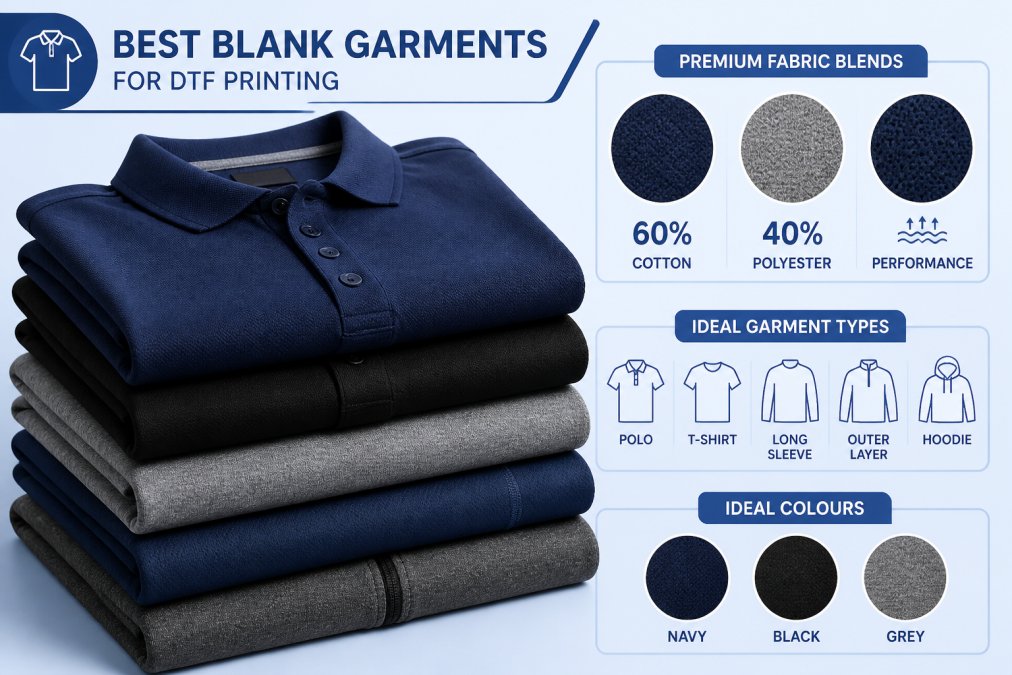
For corporate clients, specify 50/50 or 65/35 cotton-polyester blends as the default. These offer the best balance of employee comfort, DTF adhesion, colour vibrancy, and durability.
DTF Printing Durability for Uniforms and Corporate Wear
Durability is the primary concern when corporate clients invest in branded uniforms. A DTF transfer that peels or fades after three months damages brand perception and wastes the initial investment.
Properly executed DTF transfers are extremely durable. The process cures the adhesive powder under heat, creating a chemical bond between the transfer film and the fabric fibres. This is fundamentally different from a heat transfer decal, which sits on top of the fabric. When the film is removed after curing, the dye remains bonded to the fibres.
A DTF transfer on a 65/35 cotton-poly blend, cured at the correct temperature for 60 seconds, will survive at least 50 industrial or home washes without visible fading or cracking. Real-world corporate uniforms typically see 20-40 washes before retirement, so DTF durability is well above the required threshold.
The critical failure point is improper curing. If the transfer is under-cured, the adhesive powder doesn't fully bond, and the transfer peels during the first few washes. A professional DTF provider (or in-house operator) follows strict time-temperature protocols to ensure consistent curing.
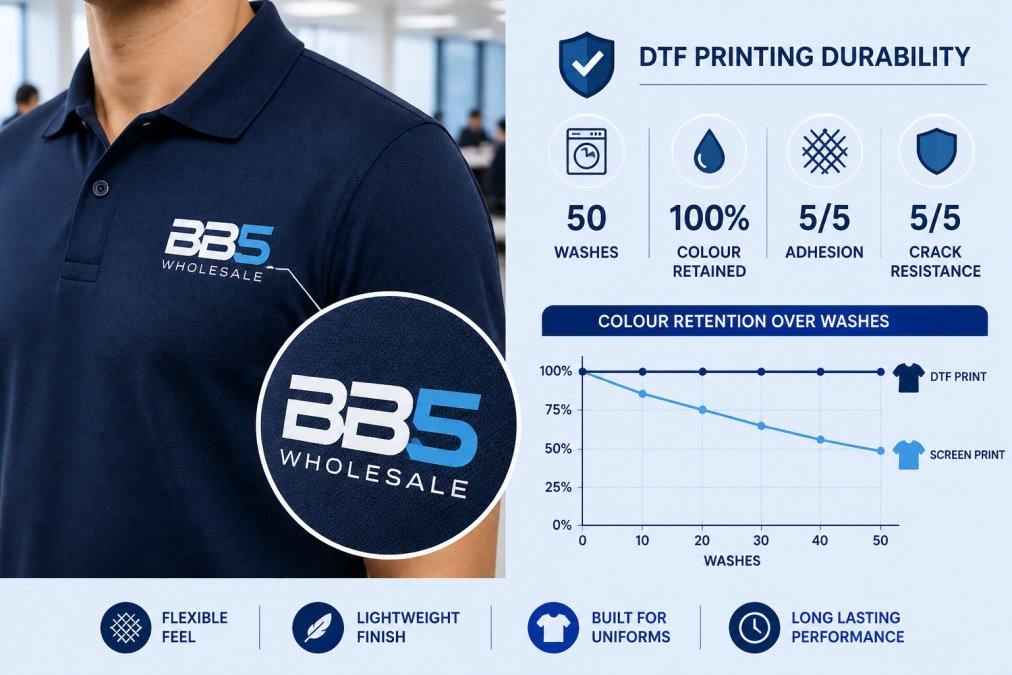
DTF inks are formulated to resist fading under UV exposure and repeated laundering. A well-cured DTF transfer on polyester will retain 95%+ of its original colour vibrancy after 50 washes. On cotton blends, colour retention is slightly lower (90%+) but still well within acceptable limits for corporate wear.
The soft-hand feel of DTF transfers is preserved because the dye bonds directly to fabric fibres rather than sitting on top. This is a significant advantage over screen printing, which can feel stiff or plastisol-like after curing.
Top DTF Printing Solutions for Corporate Orders
Corporate apparel businesses have two primary options: in-house DTF printing or outsourcing to a DTF service provider. Each approach has distinct advantages depending on your volume, budget, and production timeline.
In-House DTF Printers for High-Volume Production
In-house DTF printing makes sense when you're producing 500+ units per month or need rapid turnaround times. The upfront equipment investment is significant, but per-unit costs drop dramatically at scale.
The Mimaki TxF150-75 at £8,995 plus VAT is a professional-grade entry point. It prints at 75cm width, handles CMYK plus white ink, and delivers professional colour quality with automated maintenance features. The Oeko-Tex ECO PASSPORT certification means the ink is safe for children's clothing.
The Roland VersaSTUDIO BN-20D, priced around £5,699, combines DTF printing with vinyl cutting in a single machine, valuable if your business also handles vinyl decals. It produces excellent colour quality and requires minimal maintenance.
The Epson SureColor SC-F2200, available for £8,995 (printer only) or £9,995 (with cure oven bundle), offers hybrid DTG and DTF capability. This flexibility is valuable if your corporate clients occasionally request direct-to-garment printing on light fabrics.
The Procolored P13, starting from £2,699, is an affordable in-house option, designed for home-based or small businesses.
For in-house production, budget for consumables: DTF film (rolls can range from £41.99 to £195.00), adhesive powder (1kg bags can range from £8.38 to £25.00), and DTF ink (500ml bottles can range from £10.00 to £14.99 per colour, or 1L bottles for £79.00 to £89.00). A heat press (£500-2,000) is essential for transferring the cured film to garments. The Adkins DTF Inline Compact 600 Shaker Cure Unit, priced at £3,385, automates powder application and curing, reducing labour and improving consistency at higher volumes.
DTF Transfer Services for Smaller Businesses
Outsourcing to a DTF service provider is the practical choice for businesses producing under 200 units per month or those without capital for equipment investment. You upload your design and gang sheet, the provider prints and cures the transfers, and you receive ready-to-apply transfers or finished garments.
BB5wholesale offers high-quality DTF transfers with an intuitive gang sheet builder that maximises efficiency. The platform handles technical complexity, colour management, film curing, and powder application, so you focus on design and customer service. With 24/7 customer support and fast door-to-door delivery, BB5wholesale is built for businesses that need reliable, consistent results without equipment overhead.
Service providers typically charge per transfer or per square inch, with volume discounts. Minimum order quantities are usually low. Turnaround is typically 3-5 business days, though expedited options exist for rush orders.
The trade-off with outsourcing is loss of control over timing and minor quality variations between batches. However, reputable providers maintain strict quality standards.
Cost-Effectiveness and Turnaround Times for Corporate Orders
Cost-effectiveness for corporate apparel depends on volume, design complexity, and whether you're printing in-house or outsourcing.
At low volumes (under 50 units), outsourcing to a DTF service provider is most cost-effective. You avoid equipment investment and only pay for what you produce. Most providers offer tiered pricing where per-unit costs drop as volume increases.
At mid-volumes (50-200 units per month), outsourcing remains cost-effective unless you're producing the same design repeatedly. Consistent designs favour in-house production because you amortise equipment costs across many units.
At high volumes (500+ units monthly), in-house production becomes essential for cost control. Equipment investment is recouped within 6-12 months through lower per-unit costs.
Turnaround times vary significantly. In-house production can deliver same-day or next-day results, critical for urgent corporate events. Outsourced DTF services typically require 3-5 business days for standard orders, though expedited options exist for premium fees. BB5wholesale's fast door-to-door delivery reduces waiting time.
Design complexity affects cost and timing. A simple solid-colour logo is cheaper and faster than a photographic image with gradients. A gang sheet with 20 different designs (personalised names or departments) costs more per unit than 20 identical designs, but allows corporate clients to create truly customised uniforms.
For corporate clients, transparency on costs is essential. Provide a cost breakdown: per-garment printing cost, setup fees (if any), delivery, and any customisation charges.
Design Considerations for Corporate Brand Consistency
Corporate brand consistency is non-negotiable. A DTF-printed logo must match the official brand colour across all garments, batches, and orders.
Pantone colour matching is the standard for corporate branding. If the client specifies a brand colour as "Pantone 286 C" (a specific blue), the DTF transfer must reproduce that colour consistently. DTF inks use CMYK to simulate Pantone colours, so exact matching requires colour profiling and test prints. A professional DTF provider maintains colour profiles for common Pantone colours and can produce test transfers to verify colour accuracy before full production.
Vector artwork is essential for corporate logos. Raster images (photographs, JPEGs) can be printed, but they don't scale cleanly. Corporate clients should provide logos as vector files (AI, EPS, PDF) so they print sharp at any size.
Small text legibility is a common concern. DTF can reproduce text down to 6-point size, but legibility depends on font choice and contrast. Sans-serif fonts (Arial, Helvetica) are more legible than script fonts at small sizes. Recommend a minimum of 8-point for body text and 12-point for small accent text.
Full-colour gradients and photographic images are DTF's strength. Unlike embroidery or screen printing, DTF reproduces smooth gradients and photograph-quality detail.
Fabric colour affects how printed colours appear. A vibrant blue logo prints differently on white, grey, and navy fabric. Recommend test transfers on each garment colour the client is using. DTF can adjust ink density or use white underbase for better colour pop on dark garments.
Provide care instructions for employees. DTF transfers perform best when garments are washed in warm water (not hot), dried at medium heat (not high), and turned inside-out before washing. Many corporate clients appreciate this touch, showing you care about the longevity of their branded apparel.
Establish minimum order quantities, lead times, and delivery schedules upfront. If you're outsourcing to BB5wholesale or another provider, confirm their capacity for your client's volume before committing.
Choosing the right DTF solution for corporate apparel depends on your production volume, budget, and need for control. For businesses under 200 units monthly, outsourcing to a reliable provider like BB5wholesale eliminates equipment costs and complexity whilst delivering professional results. For higher volumes, in-house equipment like the Mimaki TxF150-75 or Epson SC-F2200 provides cost advantages and rapid turnaround. Regardless of your approach, prioritise colour consistency, design clarity, and durable transfers, corporate clients judge you on how their branded apparel looks and performs over time. Upload your gang sheet to BB5wholesale and experience how intuitive design management and 24/7 support transform your corporate apparel production.
Frequently Asked Questions
Is DTF printing durable enough for daily corporate wear and frequent washing?
Yes. DTF printing creates wash-fast transfers that resist fading, cracking, and peeling through regular laundering. The adhesive powder bonds the ink to the fabric at the molecular level, making DTF transfers suitable for uniforms and workwear worn daily. Proper curing and using quality consumables, such as EN71-3 certified inks and adhesive powders, ensures garments retain colour vibrancy and print integrity after 50+ wash cycles. Care instructions matter: recommend cold water washing and avoiding high heat to extend garment life.
How does DTF printing compare to embroidery for corporate workwear?
DTF printing and embroidery each suit different needs. DTF excels at full-colour gradients, photographic detail, and small text legibility, ideal for complex logos and multi-colour branding. Embroidery offers a premium tactile feel and unmatched durability for heavy-duty workwear. DTF is faster and cheaper for bulk orders; embroidery costs more per unit but delivers a luxury aesthetic. For corporate apparel blending cost and visual impact, DTF wins. For high-end uniforms prioritising durability and prestige, embroidery is superior.
What are the best blank garments for DTF printing?
Cotton-polyester blends (65/35 or 50/50) are ideal for DTF. They provide excellent colour vibrancy, durability, and wash-fastness. Pure polyester performs well for performance wear and moisture-wicking apparel. Cotton works but requires slightly longer curing times. Avoid 100% cotton blends if you need maximum wash durability. Nylon and denim also accept DTF well for branded merchandise. Pre-treat garments according to fabric content; blends require minimal treatment, while pure cotton benefits from pre-washing to remove sizing.
How do I choose between buying a DTF printer or using a DTF transfer service?
Buy a printer if you produce 500+ units monthly or need consistent, proprietary branding control. Printers (ranging from £3,000 to £9,000+) suit established apparel businesses and print shops. Use a transfer service if you produce fewer than 500 units monthly, operate seasonally, or want zero equipment investment. Services offer flexibility, expert gang sheet creation, and fast turnaround without maintenance. Many small businesses and Etsy sellers find services more cost-effective because they avoid upfront capital and consumable waste.
Can DTF printing handle detailed multi-colour artwork and Pantone colour matching for corporate branding?
DTF handles full-colour artwork excellently, printing CMYK profiles with vibrant gradients and fine detail. However, exact Pantone matching requires professional colour management. Work with your DTF supplier to profile their CMYK output against your brand colours, most UK providers offer colour proofs before bulk production. Vector artwork (not raster) ensures sharpest results for logos and text. For consistent corporate branding across orders, request colour-matched test transfers and maintain documented CMYK settings with your supplier.
This article was written using GrandRanker