


DTF Printing for Promotional Products: A 2026 Guide

Table of Contents
- What Is DTF Printing and How Does It Work for Promotional Items?
- Best Promotional Products for DTF Printing
- DTF vs Screen Printing for Merchandise: Which Suits Your Business?
- Durability, Wash Resistance, and Long-Term Performance
- How to Apply DTF Transfers to Promotional Items
- Cost-Efficiency and ROI for Small-Batch Promotional Campaigns
- Sustainability and Environmental Impact of DTF Production
- Troubleshooting Common DTF Print Failures
Last Updated: August 11, 2026
What Is DTF Printing and How Does It Work for Promotional Items?
Direct to film (DTF) printing is a digital transfer technology that prints full-colour designs directly onto a special PET film, then applies them to fabric using a heat press. Unlike screen printing, which requires separate screens for each colour, DTF allows you to produce vibrant, multi-colour graphics on demand with minimal setup.
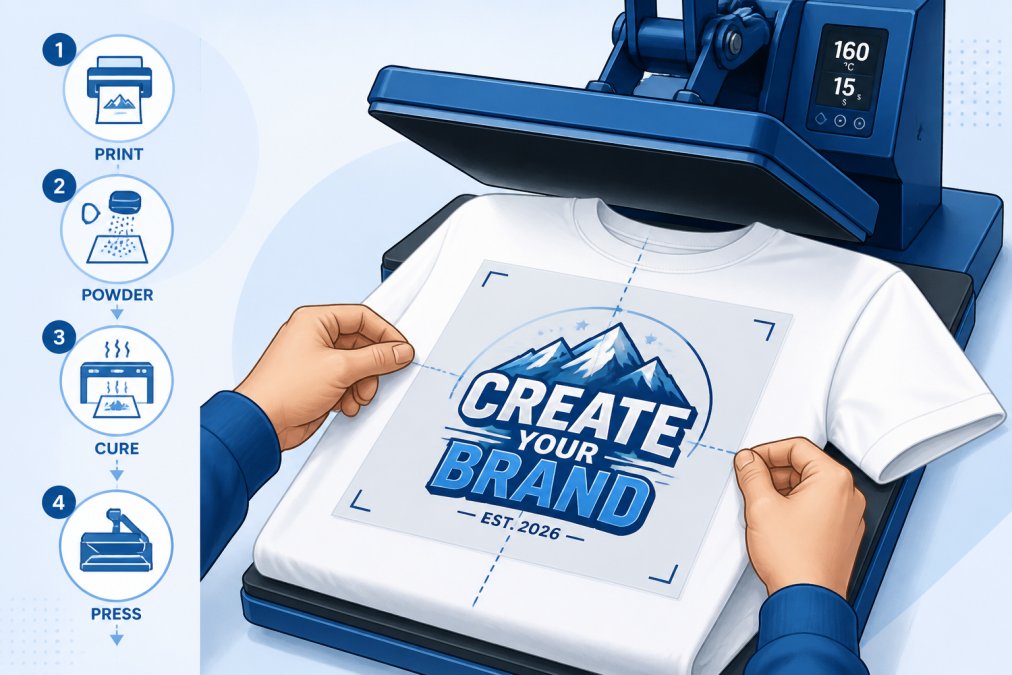
The process works in three stages. First, your design is printed onto a water-based textile ink film using a specialised DTF printer. Second, adhesive powder is applied to the wet ink, creating a sticky layer that bonds to fabric. Third, the cured transfer is heat-pressed onto your promotional item, t-shirts, hoodies, tote bags, caps, where the design becomes permanent.
What makes this valuable for small businesses and event organisers is the elimination of expensive setup costs. You can print one custom t-shirt or one hundred without changing your workflow. According to Textile Technology International's 2026 analysis of print methods, DTF has become the fastest-growing segment in custom apparel production for businesses producing fewer than 500 units per run.
DTF transfers deliver high-resolution output with vibrant graphics and sharp detail that rivals screen printing for durability. The colour vibrancy and design versatility make DTF the obvious choice for branded merchandise where visual impact matters.
Best Promotional Products for DTF Printing
The ideal candidates for DTF printing are items with smooth, flat surfaces where the transfer can make full contact with the substrate. Cotton and cotton-blend apparel, t-shirts, polo shirts, sweatshirts, and hoodies, accept DTF transfers exceptionally well.
Beyond basic apparel, DTF excels on merchandise demanding high visual impact. Tote bags, drawstring bags, and canvas items work for brand identity. Baseball caps and beanies work when the design is positioned on the front panels or back. Aprons, chef coats, and workwear benefit from durable DTF transfers that withstand repeated commercial washing.
For event-specific merchandise, DTF shines. Conference attendees appreciate branded t-shirts with vibrant event graphics. Festival organisers can produce custom merchandise at scale without massive minimum orders. Gang sheets, multiple designs on a single production run, make personalised merchandise with names or unique designs perfect for events.
Hard surface items like mugs, water bottles, and phone cases require UV DTF, a specialised variant that cures under ultraviolet light. This opens possibilities for corporate gift programmes.
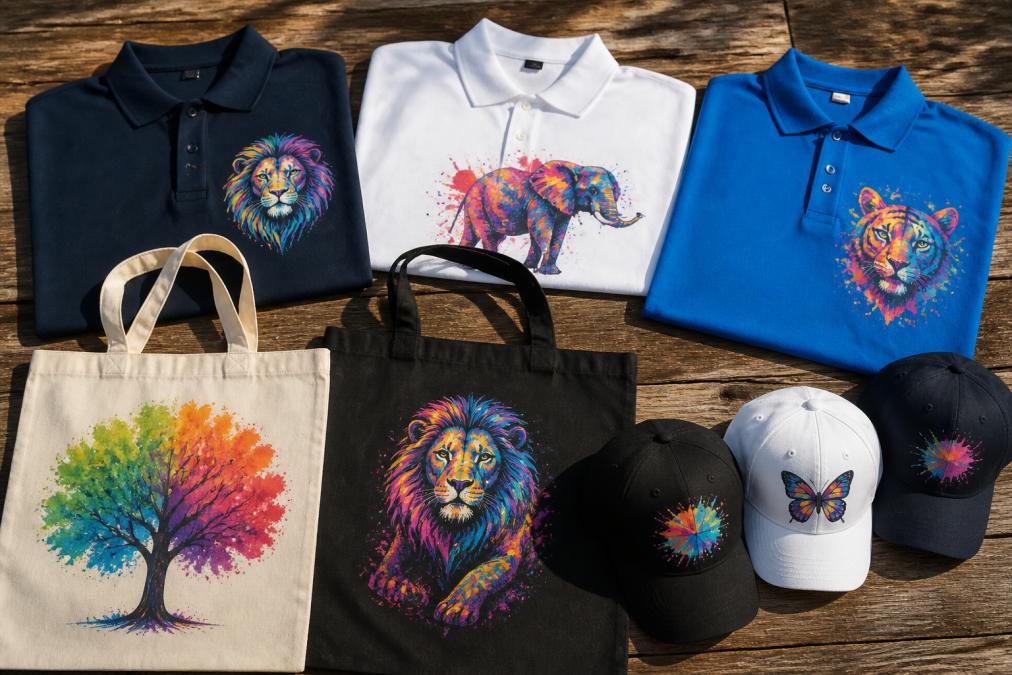
Synthetic materials like polyester require different curing temperatures and may not achieve the same wash resistance as cotton. Dark fabrics work, but transfers show best on lighter backgrounds. BB5wholesale's gang sheet builder lets you test different fabric combinations before committing to full production.
DTF vs Screen Printing for Merchandise: Which Suits Your Business?
Screen printing and DTF represent two fundamentally different production models, each with distinct advantages depending on your volume and timeline.
Screen printing requires creating separate screens for each colour. For a four-colour logo, you need four screens. Setup costs are substantial and fixed. However, once screens are made, per-unit cost drops dramatically with volume. A business printing 500 identical t-shirts finds screen printing economical.
DTF operates on opposite economics. There is no screen setup. Your first shirt costs nearly the same as your hundredth. This makes DTF rational for small-batch production, custom orders, and gang sheets where multiple designs share a single run.
Durability and wash resistance are comparable when DTF is applied correctly. Both methods produce transfers surviving 30+ wash cycles without significant fading. Screen printing has a slight edge in extreme commercial laundry applications, but for promotional merchandise, the difference is negligible.
Turnaround time favours DTF dramatically. Screen printing requires days to prepare screens. DTF transfers can be produced and ready to apply within hours.
| Criteria | DTF Printing | Screen Printing |
|---|---|---|
| Setup costs | Minimal | High |
| Best for volume | 1-100 units | 100+ identical units |
| Turnaround time | Hours | Days |
| Colour vibrancy | Excellent | Excellent |
| Design complexity | Unlimited | Limited by screen count |
| Per-unit cost (small batch) | Lower | Higher |
| Wash resistance | 30+ cycles | 30+ cycles |
If you're running a promotional product business where clients request different designs, DTF is superior. If you're producing branded merchandise in large, identical batches, screen printing may offer better economics at scale.
Durability, Wash Resistance, and Long-Term Performance
DTF transfer durability depends on three factors: ink adhesion, curing temperature, and substrate compatibility. When optimised, the transfer becomes part of the fabric.
Proper curing is critical. The adhesive powder must be fully melted into the ink during heat-pressing. Insufficient heat or pressure leaves the transfer vulnerable to peeling after the first few washes. This is the most common complaint and almost always a curing issue.
Water-based textile inks used in DTF are inherently wash-resistant. Modern inks bond chemically to cotton fibres when cured correctly. The transfer gradually softens over 30-50 wash cycles depending on water temperature and detergent. Cold-water washing extends life significantly.
Fabric composition matters more than most realise. Pure cotton accepts DTF transfers better than polyester blends. Cotton-polyester blends work well when cotton content exceeds 50 per cent. High-polyester garments require lower curing temperatures, which can compromise ink adhesion if not calibrated precisely. BB5wholesale understands substrate compatibility across different fabric weights, adjusting curing parameters accordingly.
Pilling and shrinkage are fabric issues, not DTF issues. A low-quality t-shirt will pill and shrink regardless of transfer method. The transfer itself remains durable as long as the underlying garment holds together.
How to Apply DTF Transfers to Promotional Items
The application process is straightforward but precision matters.
Step 1: Prepare Your Equipment and Materials
Set your heat press to 160-180°C for cotton apparel. Allow the press to reach full temperature and stabilise for at least 10 minutes. Preheat the garment by closing the press without the transfer for 3-5 seconds to remove moisture and ensure even heat distribution.
Step 2: Position the Transfer
Peel the backing film away from the DTF transfer carefully. Position the transfer exactly where you want it to appear. Use a ruler or alignment guide if precision is critical. This is where small batch production shines: you can position each transfer individually.
Step 3: Apply Heat and Pressure
Close the heat press and apply firm, even pressure across the entire transfer. The standard setting is 160-180°C for 10-15 seconds, though exact timing depends on your equipment and transfer thickness. Underpressing is the most common error.
Step 4: Cool and Cure
Open the press and allow the garment to cool for at least 30 seconds. Full cure takes 24 hours. Avoid washing or heavy use during this window.
Step 5: Quality Check
Once cooled, gently try to lift the transfer edge. It should not peel. If it does, your heat or pressure was insufficient. Make notes and adjust for the next batch.
Gang sheet production eliminates manual positioning errors. Multiple designs are arranged on a single sheet and applied simultaneously, reducing labour time dramatically.
Cost-Efficiency and ROI for Small-Batch Promotional Campaigns
For a small Etsy seller producing 10-15 orders per month, outsourcing to a DTF supplier like BB5wholesale makes sense. You avoid equipment investment and pay per transfer.
For a promotional product manager running corporate events, the economics shift. A mid-range DTF printer and heat press represent capital investment, but once acquired, per-unit cost becomes predictable.
Gang sheet production delivers the real efficiency gain. Instead of pressing one transfer at a time, you arrange multiple designs on a single sheet and press simultaneously. This reduces labour time by 60-70 per cent. For event organisers producing 200 personalised shirts with different names, gang sheets transform economics from barely viable to highly profitable.
Inventory management improves dramatically. With DTF, you produce merchandise on demand. Unsold inventory doesn't accumulate, and you can respond to requests within days.
Most teams find DTF equipment pays for itself within 6-12 months of regular production at 20+ orders per month. Below that volume, outsourcing remains more cost-effective.
Sustainability and Environmental Impact of DTF Production
DTF printing's environmental footprint is lower than screen printing in several measurable ways.
Water usage is significantly reduced. Screen printing requires washing screens between colour changes, consuming hundreds of litres daily. DTF uses minimal water, primarily for cooling equipment and cleaning nozzles.
Chemical waste is lower with DTF. Screen printing generates spent emulsion, screen-cleaning chemicals, and ink waste. DTF produces no screen waste and uses water-based inks less hazardous than traditional screen printing inks. The PET film backing is recyclable.
Energy consumption is comparable or slightly lower. DTF printers use less energy than screen printing setups requiring exposure units and washout stations.
The real sustainability advantage is production efficiency. DTF eliminates overproduction. With screen printing, you produce minimum quantities that often exceed demand. With DTF's on-demand model, you produce only what's needed, reducing waste significantly.
The most sustainable approach is choosing DTF for small-batch, on-demand production rather than screen printing large quantities speculatively.
Troubleshooting Common DTF Print Failures
Most DTF problems stem from three sources: curing issues, substrate incompatibility, or design file errors.
Transfer Peeling After Washing
This is almost always underpressing. The adhesive powder wasn't fully melted into the ink. Solution: increase heat press temperature by 5-10°C and extend dwell time by 2-3 seconds. Test on a sample before running a full batch. If peeling persists, check that your heat press temperature sensor is accurate.
Colour Fading or Dullness
Faded colours usually indicate incorrect ink profiles during printing or substrate issues. If the transfer looks dull immediately after pressing, your design file used incorrect colour space settings. Solution: ensure your design file is in CMYK colour space before sending to the printer.
Ink Bleeding or Smudging
Bleeding occurs when the transfer is pressed onto wet fabric. Solution: ensure garments are completely dry before pressing. Smudging usually means the transfer shifted during pressing; use firm, even pressure and avoid moving the transfer once the press closes.
Adhesive Powder Not Sticking to Ink
This is a DTF printer issue. The powder coating station may be malfunctioning or the ink may not be wet enough when powder is applied. Solution: contact your DTF supplier for printer diagnostics.
Cracking or Flaking After Wear
Cracking indicates the transfer is too rigid for the fabric's flexibility. This happens when curing temperature is too high or when applied to stretchy fabric. Solution: reduce curing temperature slightly and test on a sample.
Transfer Not Adhering to Certain Fabrics
Polyester and synthetic blends require lower curing temperatures than cotton. If your standard settings work on cotton but fail on polyester, your temperature is too high. Solution: test polyester items at 10°C lower than your cotton setting.
Record your settings for each fabric type and keep notes on what works. BB5wholesale's support team can help diagnose failures based on your specific setup and material combinations.
DTF printing for promotional products has matured into a reliable, cost-effective method for businesses needing flexibility and speed. The technology eliminates setup costs and long lead times that make screen printing impractical for small batches. Whether you're running a custom apparel shop, managing corporate event merchandise, or producing Etsy orders, DTF scales with your business without massive capital investment.
BB5wholesale specialises in high-quality DTF transfers with an intuitive gang sheet builder that simplifies your workflow. The platform's 24/7 customer support, secure payment options, and fast door-to-door delivery remove friction from production. Upload your gang sheet today and experience how professional DTF production should work.
Frequently Asked Questions
What types of promotional products work best with DTF printing?
DTF printing works on cotton, cotton-blend, and polyester apparel. Common promotional items include t-shirts, hoodies, polo shirts, tote bags, and baseball caps. For hard surfaces like mugs and phone cases, UV DTF technology is the better choice. The key is ensuring the substrate has enough surface area and appropriate texture for the adhesive powder to bond effectively during the curing process.
Is DTF printing more durable than screen printing for merchandise?
DTF printing offers excellent wash resistance when properly applied, with transfers remaining vibrant through 30+ wash cycles. Screen printing has a longer track record in durability, but DTF has closed the gap significantly. The difference lies in the curing process and ink adhesion quality. For promotional products requiring extreme durability, both methods perform well; your choice depends on design complexity and batch size. Small batches favour DTF due to lower setup costs.
How much does DTF printing cost for promotional items?
Pricing for DTF printing depends on order quantity, transfer size, design complexity, and delivery speed. Small batches (10-50 units) are cost-effective with DTF due to minimal setup costs, making it ideal for Etsy sellers and small businesses. Larger volumes may shift the cost-per-print advantage, but DTF remains competitive for customisation. For current pricing and quotes tailored to your volume, contact your DTF supplier directly to get accurate figures for your specific needs.
What makes DTF transfers resistant to peeling compared to other methods?
DTF durability depends on three factors: water-based textile inks, proper adhesive powder application, and correct heat press curing. The adhesive powder bonds the ink directly to the fabric fibres during the thermal transfer process. Peeling typically occurs when transfers are under-cured, applied to incompatible fabrics, or washed in hot water immediately after production. Quality suppliers ensure precise curing times and adhesion protocols. Always allow transfers to cool fully before washing, and follow care instructions for maximum longevity.
This article was written using GrandRanker