


DTF Printing for Etsy Sellers: A Complete 2026 Guide

Table of Contents
- Why DTF Printing Works for Etsy Sellers
- DTF vs Vinyl for T-Shirts: Which Suits Your Shop
- Understanding Gang Sheets and Setup
- Cost of DTF Printing Per Unit and Profit Margins
- How to Press DTF Transfers: Settings and Best Practices
- Choosing a DTF Transfer Supplier in the UK
- Scaling Your DTF Business on Etsy: From Side Hustle to Sustainable Income
- Conclusion
Last Updated: August 9, 2026
Why DTF Printing Works for Etsy Sellers
DTF printing for Etsy sellers has transformed custom apparel production. Direct-to-film technology bypasses traditional screen printing, allowing you to print full-colour designs directly onto fabric with minimal setup and no minimum order quantities.
The appeal is straightforward: design, print, ship. No inventory risk, no waste, no setup fees. For Etsy sellers doing 10 to 50 orders monthly, the ink bonds during heat-press curing, creating prints that withstand repeated washing without cracking or peeling, with colour vibrancy rivalling traditional methods. The real advantage is testing designs with real customers before committing to large runs, offering customisation without factory negotiation, and scaling gradually while reinvesting profits.
DTF vs Vinyl for T-Shirts: Which Suits Your Shop
Direct-to-film and vinyl transfers solve the same problem differently, depending on your production model and design complexity.
Vinyl transfers cut designs from coloured sheets and heat-press them onto fabric. Vinyl excels at single-colour designs and bold graphics with lower equipment costs, but handles only solid colours well. Gradients, photographic images, and multi-colour artwork with fine detail don't work.
DTF transfers handle unlimited colours, photographic detail, and gradients without additional setup. The same DTF printer handles a simple two-colour logo or a photorealistic image without changing anything except the file. Both methods produce washable prints when applied correctly, though DTF transfers are more forgiving because ink locks into fabric fibres rather than sitting on the surface.
For Etsy sellers, the deciding factor is design variety. If your shop sells mostly simple text or bold graphics, vinyl is cheaper and faster. If customers want photographic prints, complex artwork, or custom colour matching, DTF is the only realistic option.
Understanding Gang Sheets and Setup
A gang sheet arranges multiple designs on a single large transfer sheet, printed at once and cut apart after curing. This reduces ink waste, speeds production, and lowers cost per unit.
A standard A3 gang sheet (420 × 297 mm) holds roughly 4 to 12 designs depending on size. BB5wholesale's gang sheet builder arranges designs optimally automatically.
Real efficiency comes from batching. Instead of printing five orders of one design each, print ten designs on one sheet, cut them apart, and pack into five different orders. One press cycle, five orders out the door.
Some DTF suppliers require ordering by the sheet (4 to 12 designs minimum). Others, like BB5wholesale, let you print exactly what you need. File preparation requires high-resolution designs (at least 300 DPI at final print size), CMYK colour format, and proper layering if using transparency. Vector files work best because they scale without losing quality.
Cost of DTF Printing Per Unit and Profit Margins
Understanding costs per unit determines whether you're building a business or subsidising a hobby.
DTF costs break into three categories: the transfer itself, labour to press and pack, and shipping. Transfer cost depends on design size and ink coverage. A skilled operator presses 15 to 25 shirts per hour, roughly 2.5 to 4 minutes per shirt. At £12 per hour, that's 50 pence to £1.60 per shirt in labour, plus another 30 to 60 pence for packing and labelling.
Shipping is the wild card. Royal Mail special delivery for a single t-shirt runs £5 to £8. If your average order is one shirt, shipping costs exceed profit margin. If your average order is three shirts, shipping cost per unit drops to £1.70 to £2.70, which is manageable.
Many Etsy sellers price based on competitor rates, not actual costs. If you're paying £2 for transfer, £1 for labour, 50 pence for packing, and £6 for shipping, your total cost is £9.50 per shirt. Selling for £15 leaves £5.50 gross profit, before Etsy fees (6.5%), payment processing (3%), and platform costs. You're left with roughly £4 actual profit per order.
Profit margins improve dramatically with order size. A customer ordering five shirts with the same design spreads shipping across five units. The most profitable Etsy sellers focus on designs commanding premium pricing: niche artwork, licensed designs, highly customised pieces where customers expect £25 to £40 per shirt.
How to Press DTF Transfers: Settings and Best Practices
Heat press settings vary by fabric type, transfer size, and specific transfer film. Start with your supplier's recommended settings, these are the result of testing hundreds of batches.
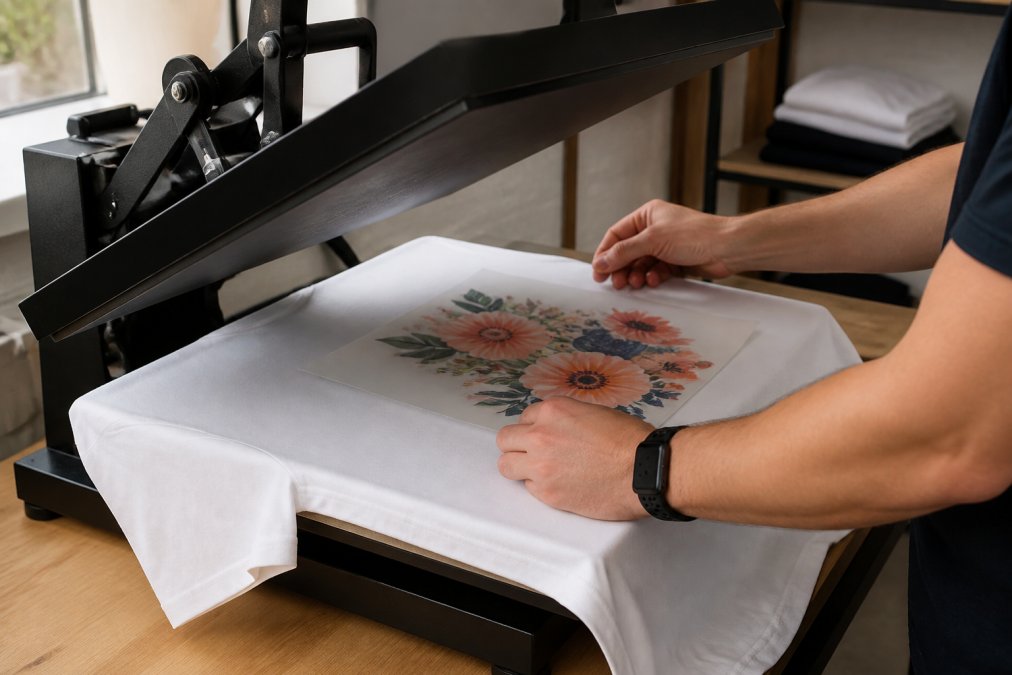
Standard settings for polyester and cotton blends are typically 160 to 170 degrees Celsius, moderate to firm pressure (around 3 to 4 on most scales), for 12 to 15 seconds. Preheat the heat press for at least 5 minutes before your first press. Place the garment on the press, position the transfer carefully, and lower the platen slowly to avoid shifting.
Pressure is the most common mistake. Too little and the transfer doesn't bond properly; too much flattens the fabric, creating visible imprints. After pressing, let the garment cool for at least 30 seconds before peeling away the transfer film.
Common failures: if the transfer peels within the first few washes, you didn't press long enough or hard enough. If the design looks dull, your temperature was too low. If the fabric is scorched, your temperature was too high or you pressed too long.
Choosing a DTF Transfer Supplier in the UK
Your supplier choice affects quality, cost, turnaround time, and your ability to scale.
Quality is non-negotiable. A DTF transfer that peels after a few washes generates refunds and negative reviews. Test their product before committing to volume orders.
Turnaround time matters for Etsy sellers. If your supplier takes two weeks to deliver transfers, you can't promise customers fast turnaround. Look for suppliers offering 3 to 5 business day turnaround with expedited options. BB5wholesale offers fast and convenient door-to-door delivery.
Minimum order quantities determine profitability at small scale. Some suppliers require ordering by the sheet (4 to 12 designs minimum). Others let you order a single transfer. For Etsy sellers doing custom work, flexibility is essential.
Pricing transparency matters. Get written quotes from at least two suppliers to compare actual total cost, factoring in your typical order size. Communication and support are underrated, if something goes wrong, you need a supplier that responds quickly. BB5wholesale offers 24/7 customer support and supports more than 10 different secure payment methods.
Scaling Your DTF Business on Etsy: From Side Hustle to Sustainable Income
Most Etsy sellers start as a side project: a few orders per week, printed on demand, shipped from home. Scaling beyond that requires systems, not just more effort.
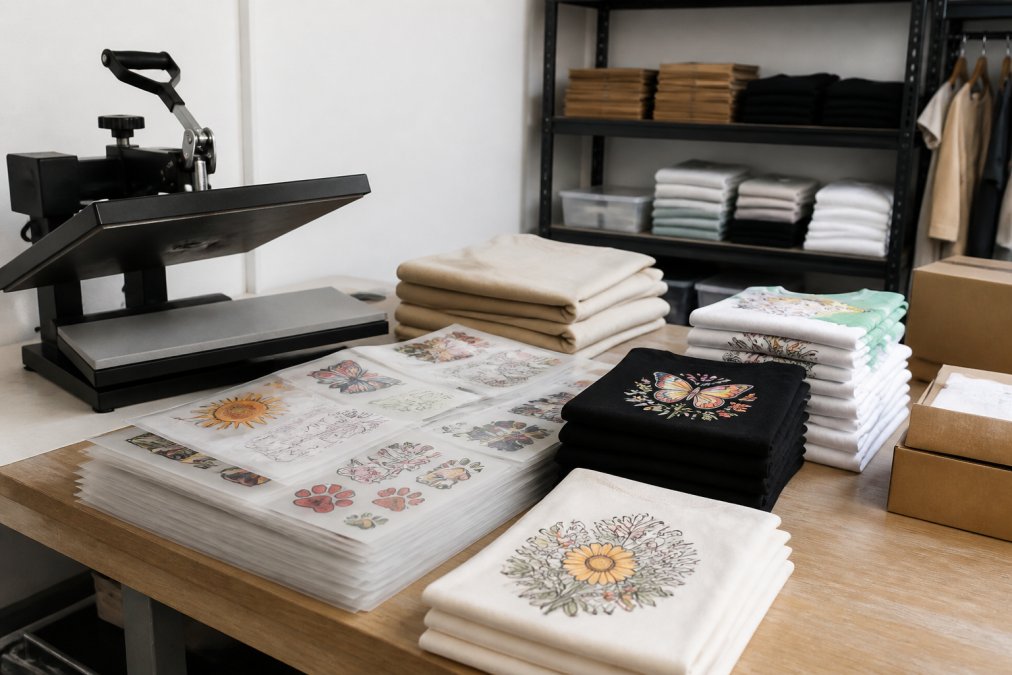
The first bottleneck is usually pressing capacity. One heat press handles roughly 15 to 25 shirts per hour. If you're getting 50 orders per week with an average of two shirts per order, that's 100 shirts, five hours of pressing time plus design work, packing, and shipping.
Beyond 100 orders per week, you need a second heat press. This doubles pressing capacity without requiring new skills or workflow changes. Gang sheet efficiency compounds as you scale. When printing 20 orders per week with 20 different designs, gang sheets don't help much. When printing 100 orders per week with 30 designs, you can batch similar designs together and dramatically reduce cost per unit.
Niche selection affects scaling potential. A seller making generic t-shirt designs competes on price and speed. A seller making niche designs, specific hobbies, professions, inside jokes, can charge premium prices and build loyal customers. The shift from side hustle to sustainable income usually happens around 100 to 150 orders per month.
A solo operator with one heat press can realistically handle 200 to 300 orders per month. Two presses and some help, 500 to 800 orders per month.
Scaling a DTF business on Etsy is fundamentally about removing bottlenecks as they appear. Start with one heat press and on-demand printing. Add a second press when pressing becomes your limiting factor. Optimise gang sheets when you have enough design volume to benefit.
The businesses that fail try to scale everything at once, buying expensive equipment before they have order volume to justify it. The businesses that succeed start small, measure what works, and scale deliberately. They find their niche, build a reputation for quality, and let growth happen naturally. DTF printing makes this possible because there's no minimum order requirement, no inventory risk, and no long setup times.
BB5wholesale's gang sheet builder and 24/7 support are designed for exactly this journey, helping you start small and scale efficiently without wasting money on features you don't need yet.
Frequently Asked Questions
Is selling DTF prints profitable on Etsy UK?
Yes, DTF printing can be profitable for Etsy sellers, especially when targeting niche markets. Profit margins depend on your cost per unit, pricing strategy, and order volume. Small batches using gang sheets reduce waste, and the durability of DTF transfers, which withstand multiple washes, encourages repeat customers and positive reviews. Many sellers report sustainable income from 10-15 orders monthly by focusing on specific niches (gaming, pet lovers, hobby communities) rather than competing on generic designs.
What type of prints sell best on Etsy?
Niche-specific designs consistently outperform generic products on Etsy. Best-sellers include gaming apparel, pet-themed merchandise, hobby-related clothing, personalised gifts, and community or event-specific designs. DTF transfers excel here because they deliver vibrant, durable colour on small runs without minimum order quantities. Personalisation, adding names, dates, or custom details, also drives higher prices and customer satisfaction, particularly for birthdays, anniversaries, and corporate events.
What equipment do I need to start DTF printing at home?
At minimum, you need a heat press (clamshell or swing-away), a reliable DTF transfer supplier, and a workspace for design preparation and pressing. A basic heat press costs between £200-£600 depending on size and quality. You'll also need design software (free options like Canva or Inkscape work), a printer for labels if needed, and packaging materials. Many Etsy sellers start by outsourcing DTF transfer production to a UK supplier and handling pressing and fulfilment themselves, this reduces upfront capital investment.
How do I choose a reliable DTF transfer supplier in the UK?
Evaluate suppliers on turnaround time, print quality, gang sheet flexibility, payment security, and customer support availability. Check for 24/7 support options, multiple payment methods, and transparent pricing without hidden fees. Request samples before committing to larger orders. Reliable UK suppliers offer consistent colour vibrancy, durable transfers that withstand multiple washes, and efficient gang sheet builders that save time on design arrangement. Read reviews from other Etsy sellers and test with a small order before scaling.
This article was written using GrandRanker