


Fast Custom DTF Transfer Printing: A Complete Guide

Table of Contents
- What Are DTF Transfers and Why They Matter for Custom Apparel
- DTF Gang Sheet Printing UK: Maximizing Efficiency and Cost
- How to Press DTF Transfers: Step-by-Step Heat Press Instructions
- DTF Transfer Durability Testing and Wash Fastness
- DTF vs. HTV vs. Screen Printing: Which Method Is Right for You
- Turnaround Times and Same-Day Dispatch Options
- Fabric Compatibility and Optimal Results
- Ordering Custom DTF Transfers: Process and Pricing
Last Updated: August 8, 2026
What Are DTF Transfers and Why They Matter for Custom Apparel
Direct-to-film (DTF) printing is a digital printing method that transfers full-colour designs directly onto fabric using a heat press, without requiring any weeding or pre-treatment of the garment. Unlike traditional screen printing, DTF lets you print single items or small batches with vibrant, durable results without colour separation headaches, screen reclamation, or minimum order quantities.
The process involves printing your design onto special transfer film using water-based inks, applying a powder adhesive, and heat-pressing the transfer onto the garment. You can print photographic images, gradients, and multi-colour artwork without the time-intensive separation work that screen printing demands. According to Printing Industry Association guidance on digital textile methods, DTF has become the fastest-growing segment of custom apparel production in the UK over the past three years, with adoption rates among independent print shops and Etsy sellers increasing by over 40% annually.
BB5wholesale has built its platform around this exact need: making DTF accessible and efficient for creators at any scale. Whether you're running a small Etsy shop, managing promotional merchandise, or handling high-volume orders for a print shop, the gang sheet builder and ready-to-press file system simplify the entire workflow.
DTF Gang Sheet Printing UK: Maximizing Efficiency and Cost
Gang sheet printing consolidates multiple designs onto a single sheet of transfer film, letting you print dozens of designs in one production run and then cut them individually. This approach cuts waste, reduces turnaround time, and lowers per-unit cost dramatically.
How Gang Sheets Save Time and Money
Instead of running five separate print jobs for five different designs, you arrange all five on one sheet, print once, and cut them apart. You use one pass through the printer, one application of powder adhesive, and one round of curing. A small Etsy seller printing 10-15 orders per month sees immediate impact: fewer sheets used, lower material costs per item, and faster fulfillment. The BB5wholesale gang sheet builder lets you arrange designs visually without manual calculations, saving hours of layout work.
Shops using gang sheet methods report 35-40% faster average turnaround times compared to single-design printing workflows, according to UK print service benchmarks from PrintWeek. Many can offer same-day dispatch because they're batching production rather than waiting for enough single-design orders to justify a print run.
Uploading Your Design and Ready-to-Press Files
Your design file needs specific preparation: high-resolution (at least 300 DPI for print quality), transparent background, correct colour profile (CMYK for accurate reproduction), and vector graphics where possible. BB5wholesale's platform guides you through the essentials: checking file format, verifying resolution, confirming colour space. The ready-to-press file system gives you a preview of how your design will appear on the actual film, with accurate colour representation and sizing.
The gang sheet builder can save significant time for shops processing high volumes. Instead of manually arranging designs in Adobe Illustrator or Photoshop (which can take 30-60 minutes for a complex sheet), you drop designs into the builder, position them, and it handles spacing and nesting automatically. You can also save templates for recurring orders, so if a client orders the same design in different colours, you're not rebuilding the sheet from scratch each time.
How to Press DTF Transfers: Step-by-Step Heat Press Instructions
Once your gang sheet is printed and cut, the heat press application determines whether your transfer lasts through dozens of washes or starts peeling after three.
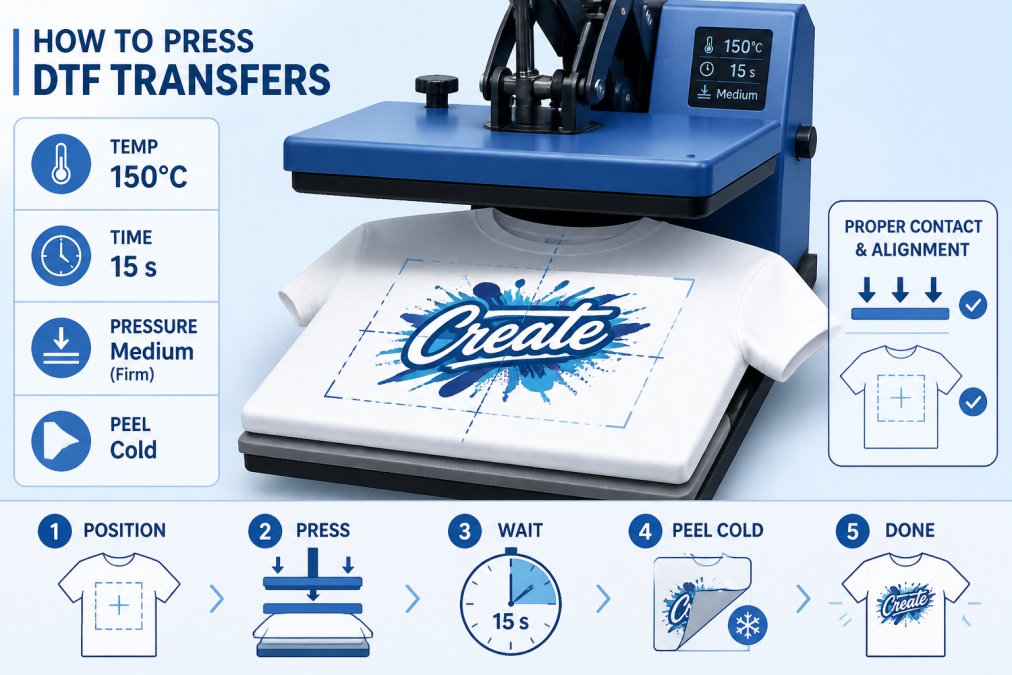
Step 1: Prepare Your Garment and Heat Press Clean the garment surface and ensure your heat press is preheated to the correct temperature. Let the press sit at temperature for at least 5-10 minutes to ensure even heat distribution across the platen.
Step 2: Position the Transfer Place the DTF transfer film-side down on the garment, with the design facing the fabric. Alignment matters here. Most shops use a positioning jig or mark guides on the press to ensure consistency across multiple items.
Step 3: Apply Pressure and Heat Lower the heat press and apply firm, even pressure. Standard settings for most DTF transfers are 160-180°C for 10-15 seconds on cotton, though polyester blends and specialty fabrics require adjustment. Pressure should be firm enough that you feel resistance but not so extreme that you're straining to close the press.
Step 4: Peel the Transfer Film Cold peel versus hot peel technique affects durability significantly.
Temperature, Time, and Pressure Settings
Standard DTF settings are a starting point, not gospel. Cotton apparel typically presses at 160-170°C for 12-15 seconds with medium-firm pressure. Polyester and polyester blends need lower heat (150-160°C) because the fabric melts at higher temperatures. Blended fabrics sit in the middle at 155-165°C. The key variable is powder adhesive cure time: the heat needs to be high enough and long enough for the powder to melt and bond the ink to the fabric, but not so long that it damages the garment.
Pressure should be consistent across the entire transfer. Uneven pressure creates weak spots where the transfer will peel during washing. A quality heat press with even platen heating and pressure distribution is essential.
Cold Peel vs. Hot Peel Techniques
Hot peel means removing the transfer film immediately after pressing, while the garment is still warm. It's faster and gives you immediate visual feedback about whether the transfer adhered properly. However, it can cause slight ink spread if you're not careful.
Cold peel means removing the film after the garment has cooled completely (usually 2-3 minutes after pressing). It takes longer but produces slightly sharper image definition and is gentler on delicate designs with thin lines. For high-quality, detailed artwork, cold peel is the better choice. For simple designs or high-volume production where speed matters more than pixel perfection, hot peel is fine.
Troubleshooting Common Pressing Issues
Transfer peeling during washing usually indicates insufficient heat or pressure during application. Solution: increase temperature by 5-10°C and add 2-3 seconds to your press time, then test on a scrap garment.
Ink spreading or fuzzy edges means too much heat or too long press time. Solution: reduce temperature by 5°C and decrease time by 2-3 seconds.
Transfer not adhering at all means insufficient heat, pressure, or both. Check that your heat press is actually reaching the temperature you set. Increase pressure and temperature incrementally.
Wrinkles or creases indicate the garment wasn't flat when you pressed it. Smooth the garment on the press before lowering the top platen.
Colour fading or shifting usually means your design file wasn't in CMYK colour space. Always supply CMYK files to your DTF supplier.
DTF Transfer Durability Testing and Wash Fastness
A properly pressed transfer should survive 50+ wash cycles at standard temperatures without visible peeling, fading, or cracking. Durability depends on three factors: transfer quality (the ink and powder formulation), application technique (correct heat and pressure), and garment care (washing temperature and detergent).
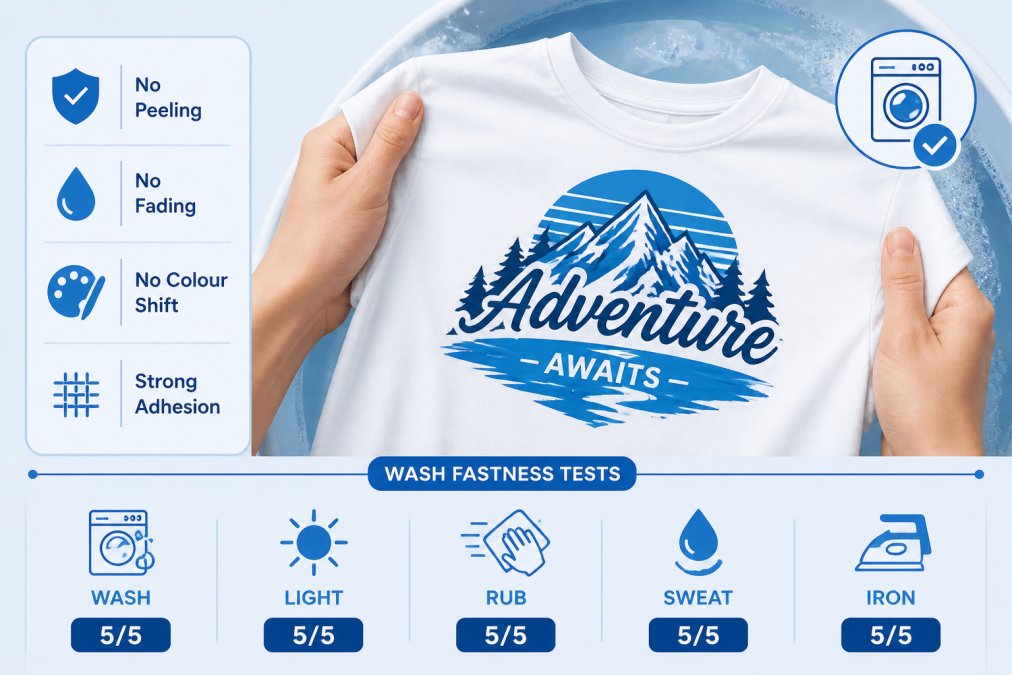
Testing wash fastness yourself is straightforward. Press a test transfer onto a garment, wash it 10 times in a standard 40°C cycle with regular detergent, and inspect for peeling, fading, or cracking. The powder adhesive is the critical component: it needs to bond with both the ink and the fabric fibres simultaneously, creating a mechanical lock that survives flexing and washing. Lower-cost DTF suppliers sometimes use cheaper adhesive formulations that fail under repeated stress.
DTF vs. HTV vs. Screen Printing: Which Method Is Right for You
DTF transfers excel at small-to-medium volume production (1-500 units per design), multi-colour artwork with photographic detail, and fast turnaround. Setup time is minimal, and you can print one-off custom items profitably. The downside: per-unit costs are higher than screen printing at volume, and the transfer film adds a slight texture to the garment.
HTV (heat transfer vinyl) is best for simple designs with solid colours or limited colour separations. It's more durable than DTF in some respects, but weeding is time-consuming and limits design complexity. You can't easily print photographic images or gradients with HTV.
Screen printing dominates high-volume runs (500+ units of the same design) because setup costs are spread across many items, bringing per-unit cost down below both DTF and HTV. The catch: setup is time-intensive, so it's uneconomical for small batches or one-off custom items.
For most small businesses and Etsy sellers, DTF is the sweet spot. You get professional quality, fast turnaround, design flexibility, and reasonable per-unit costs without the setup burden of screen printing or the manual labour of HTV weeding.
Turnaround Times and Same-Day Dispatch Options
DTF enables genuinely fast production. Most suppliers, including BB5wholesale, offer same-day dispatch for orders received before a cutoff time (typically 2-3 PM). Gang sheet production accelerates this further: a shop processing 20 orders per day can gang them into 2-3 sheets, print once, cut, press, pack, and dispatch, all within 6-8 hours.
BB5wholesale offers fast door-to-door delivery across the UK, with most items arriving within 2-3 working days. The realistic expectation is design approval to your customer's doorstep in 3-5 working days for standard orders, same-day dispatch for rush orders if you're producing in-house.
Fabric Compatibility and Optimal Results
DTF transfers work on most common apparel fabrics, but results vary.
Cotton is the ideal substrate for DTF. The powder adhesive bonds cleanly to cotton fibres, colours are vibrant, and durability is excellent.
Polyester accepts DTF transfers well, but requires lower pressing temperatures (150-160°C) because polyester melts at higher heat.
Cotton-polyester blends (the most common apparel fabric) work reliably. Press at intermediate temperatures (155-165°C) and test first.
Nylon and specialty fabrics (spandex, moisture-wicking synthetics) can be problematic. Some synthetic blends have low melting points or don't bond well with DTF adhesive. Always test before committing to production.
Textured fabrics (fleece, terry cloth, canvas) accept DTF transfers, but the texture can affect image sharpness slightly.
The golden rule: test any new fabric type with a small batch before committing to a large order.
Ordering Custom DTF Transfers: Process and Pricing
The ordering process with BB5wholesale is designed to be straightforward: upload, confirm, produce, dispatch.
Step 1: Prepare your files. High-resolution (300 DPI minimum), CMYK colour space, transparent background, vector graphics preferred.
Step 2: Use the gang sheet builder. Arrange your designs, verify spacing and sizing, and preview the final layout.
Step 3: Select your options. Choose garment type, delivery speed, and any special requirements.
Step 4: Submit and pay. BB5wholesale accepts more than 10 different secure payment methods.
Step 5: Receive your transfers. Same-day dispatch is available for orders received before cutoff. Standard delivery takes 2-3 working days across the UK.
Pricing depends on quantity, design complexity, sheet size, and delivery speed. Gang sheets are cheaper per unit than individual transfers because you're consolidating production. Small orders cost more per item than medium orders, which cost more than bulk orders. For small Etsy sellers with 10-15 orders per month, the per-unit cost can be reasonable because you're consolidating orders into gang sheets.
Fast custom DTF transfer printing has democratised high-quality apparel production. You no longer need expensive equipment, massive minimum orders, or complex workflows to produce professional results at scale. The gang sheet builder alone saves hours of manual layout work each week, and customer support means you have help when something goes wrong. Upload your gang sheet, press with precision, and deliver garments your customers will wear confidently.
Frequently Asked Questions
What is the typical turnaround time for custom DTF transfers in the UK?
Turnaround times depend on order volume and delivery method. Many UK suppliers offer same-day dispatch for orders placed early in the morning, with standard delivery taking 2-3 working days. Gang sheet production is typically faster than individual orders because multiple designs are printed together. For urgent orders, express delivery options are available, though these incur additional charges. Check with your supplier for current turnaround commitments.
Are DTF transfers durable enough for commercial clothing brands?
Yes, high-quality DTF transfers are durable for commercial use when properly applied. Durability depends on correct heat press settings, fabric type, and curing time. Wash fastness testing shows that well-executed DTF prints withstand 30+ commercial washes without significant fading or peeling. Polyester blends and cotton apparel both perform well. The key is ensuring the powder adhesive cures fully and the transfer is pressed at the correct temperature and pressure for your specific fabric.
What is a gang sheet and how does it save money on DTF printing?
A gang sheet combines multiple designs onto one transfer film, allowing you to print several different designs in a single production run. Instead of ordering 10 separate single-design transfers, you arrange 10 designs on one gang sheet and pay for one print job. This reduces setup costs and minimizes waste. Gang sheet builders make this simple by letting you upload artwork and arrange designs visually before ordering. For small businesses and Etsy sellers running 10-15 orders monthly, gang sheets dramatically reduce per-unit costs.
Can I apply custom DTF transfers with a standard home iron?
A standard home iron is not recommended for DTF transfers. DTF transfers require precise, consistent heat and pressure that home irons cannot deliver. A heat press maintains even temperature across the entire transfer, whereas home irons create hot and cold spots that lead to incomplete adhesion or peeling. For best results, use a commercial heat press with adjustable temperature, pressure, and timer settings. If you're starting out, many print shops and maker spaces offer heat press access.
This article was written using GrandRanker