


DTF Transfer Wash Test Results: Durability Guide

Table of Contents
- DTF Transfer Wash Test Results: What the Data Shows
- Factors Affecting DTF Transfer Durability
- DTF Transfer Care Instructions for Maximum Longevity
- How to Prevent DTF Cracking and Peeling
- DTF Wash Test Methodology and Standards
- Signs of Print Degradation and When to Replace
- Conclusion
Last Updated: August 14, 2026
DTF Transfer Wash Test Results: What the Data Shows
DTF transfer wash test results reveal how well direct-to-film transfers hold up under real-world laundry conditions. Durability depends on fabric composition, water temperature, detergent chemistry, mechanical agitation, and curing quality. A transfer that cracks after five washes damages your reputation; one that holds for 50+ washes builds loyalty.
Below, we'll break down the factors that determine wash durability, show you how to test transfers yourself, and explain the signs that indicate when a print has reached the end of its lifespan.
Factors Affecting DTF Transfer Durability
DTF transfer durability results from how multiple systems interact during printing, curing, pressing, and washing. Get one variable wrong, and even excellent transfers can fail prematurely.
Fabric composition and adhesion
The substrate matters significantly. Cotton, polyester, and cotton-polyester blends behave differently under heat and mechanical stress. Cotton fibres are more absorbent and hold adhesive powder effectively, while polyester creates a smoother surface requiring precise heat application for proper polymer adhesion.
The ink binder and adhesive powder must form a flexible bond with fabric fibres. If the polymer layer is too rigid, it cracks when the garment moves. If too loose, it peels during washing. Natural fibres allow the adhesive to penetrate, creating mechanical interlocking. Synthetic fabrics rely on thermal bonding. Blended fabrics offer a middle ground.
Testing fabric compatibility before full production runs prevents costly failures.
Water temperature and detergent chemistry
Hot water accelerates polymer degradation and increases mechanical agitation intensity. Cold water washes preserve print integrity far better than warm or hot cycles.
Detergent chemistry plays a crucial role. Surfactants break down oils and lift dirt, but also attack the polymer binder. Harsh detergents with high alkalinity weaken adhesion faster than gentle, pH-neutral options. Enzyme-based detergents are particularly aggressive because they break down protein-based contaminants that can damage the ink binder.
Bleach and oxygen-based stain removers cause colour shift and fading. Chlorine bleach can cause complete colour loss within a single wash. Water hardness also affects durability; hard water deposits interfere with adhesion, while soft water produces better wash durability.
Mechanical agitation and wash cycles
Washing machines apply significant mechanical stress through tumbling and friction. Delicate cycles reduce agitation and lower failure risk. Heavy-duty cycles designed for heavily soiled work clothes create the most stress.
The number of wash cycles is the most straightforward durability metric. A transfer surviving 50 washes in a standard cycle is more durable than one failing after 20. Industrial laundry environments apply even more stress through higher temperatures, stronger detergents, and more aggressive agitation.
Testing under multiple cycle intensities, delicate, standard, and heavy-duty, gives you a complete picture of how a transfer performs across different customer care scenarios.
DTF Transfer Care Instructions for Maximum Longevity
How customers care for printed garments after purchase determines real-world durability. Even excellent transfers fail if washed in hot water with bleach and dried on high heat.
Inside-out washing and temperature control
Turning garments inside-out before washing is the single most effective care practice for preserving DTF prints. This protects the printed surface from direct contact with detergent, mechanical agitation, and friction against other garments.
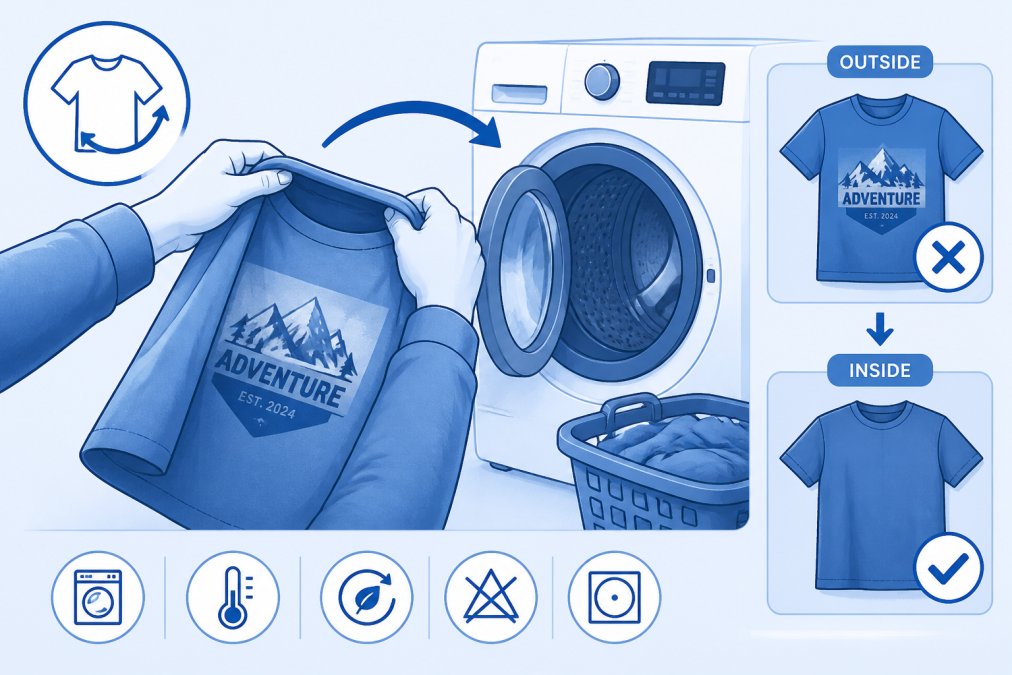
Inside-out washing reduces wear and tear on the print surface by up to 40% compared to normal washing. Water temperature control is equally critical. Cold water washes preserve print integrity far better than warm or hot cycles. The polymer binder has limited thermal stability; exposure above 40°C begins to soften the adhesive layer.
Customers should wash printed garments separately from items with zippers, buttons, or rough seams that can snag the transfer surface.
Drying methods and heat sensitivity
Air drying is the most transfer-friendly drying method. Tumble dryers apply high heat that softens the polymer layer and can cause cracking. If customers must use a dryer, the lowest heat setting significantly extends print lifespan.
Heat-sensitive transfers require special care. Customers should always check care labels and follow manufacturer guidance on drying methods.
How to Prevent DTF Cracking and Peeling
Cracking and peeling are the two most common failure modes in DTF transfers, both resulting from poor adhesion between the print and fabric substrate.
Pre-treatment and curing impact
Pre-treatment of fabric before DTF transfer application improves adhesion significantly. Polyester and synthetic blends benefit from light pre-treatment that opens the fibre structure and allows better polymer penetration.
Curing requires adequate heat and dwell time, typically 3-5 seconds at 160-180°C depending on fabric type. Temperature consistency during curing is critical; uneven heat application creates weak spots that become failure points during the first few washes. Industrial heat presses with consistent platen temperature and pressure produce far more reliable results.
High-quality DTF films with consistent coating thickness cure more evenly than lower-grade alternatives.
Edge lifting and substrate preparation
Edge lifting occurs when transfer edges separate from the fabric substrate, typically starting at corners or areas with thin ink coverage.
Substrate preparation prevents edge lifting. Fabric should be clean and free of finishes, sizing, or residues that interfere with adhesion. Proper pressure during heat application ensures the adhesive powder makes full contact with the fabric. Insufficient pressure leaves air gaps that become failure points.
The design itself affects edge durability. Transfers with thin, delicate edges or small isolated elements are more prone to edge lifting than solid, well-supported designs.
Testing small sample batches before full production runs identifies edge lifting issues early.
DTF Wash Test Methodology and Standards
Standardised wash testing allows you to compare transfer durability objectively and make informed sourcing decisions.
Industry testing protocols and quality control
The British Standards Institution and international textile standards define wash test protocols that measure print durability. Standard wash tests typically involve 20, 30, or 50 cycles using controlled water temperature, detergent concentration, and mechanical agitation.
Professional testing laboratories measure tensile strength, how much force is required to separate the transfer from the fabric. Prints with high tensile strength resist peeling and edge lifting far better than weak adhesion. Testing also measures flexibility by folding the fabric and counting cracks that appear.
Quality control during production involves spot-checking transfers from every batch to ensure they meet durability specifications before shipping.
Home versus industrial laundry comparison
Home washing machines apply moderate mechanical stress at water temperatures between 20-40°C. Standard wash cycles last 30-45 minutes with intermittent agitation.
Industrial laundry equipment applies significantly more stress through higher water temperatures (often 60°C or higher), stronger detergents, and more aggressive agitation. A single industrial wash cycle is roughly equivalent to 3-5 home wash cycles in terms of stress on the print.
Testing transfers under both home and industrial conditions gives you a complete picture of durability.
| Test Condition | Water Temperature | Detergent Type | Agitation Level | Typical Cycles Before Failure |
|---|---|---|---|---|
| Home wash (cold) | 20°C | Gentle | Standard | 50+ |
| Home wash (warm) | 40°C | Standard | Standard | 30-40 |
| Home wash (hot) | 60°C | Standard | Standard | 15-25 |
| Industrial wash | 60-75°C | Heavy-duty | Aggressive | 10-15 |
Signs of Print Degradation and When to Replace
Understanding what degradation looks like helps you identify when a garment has reached the end of its print lifespan.
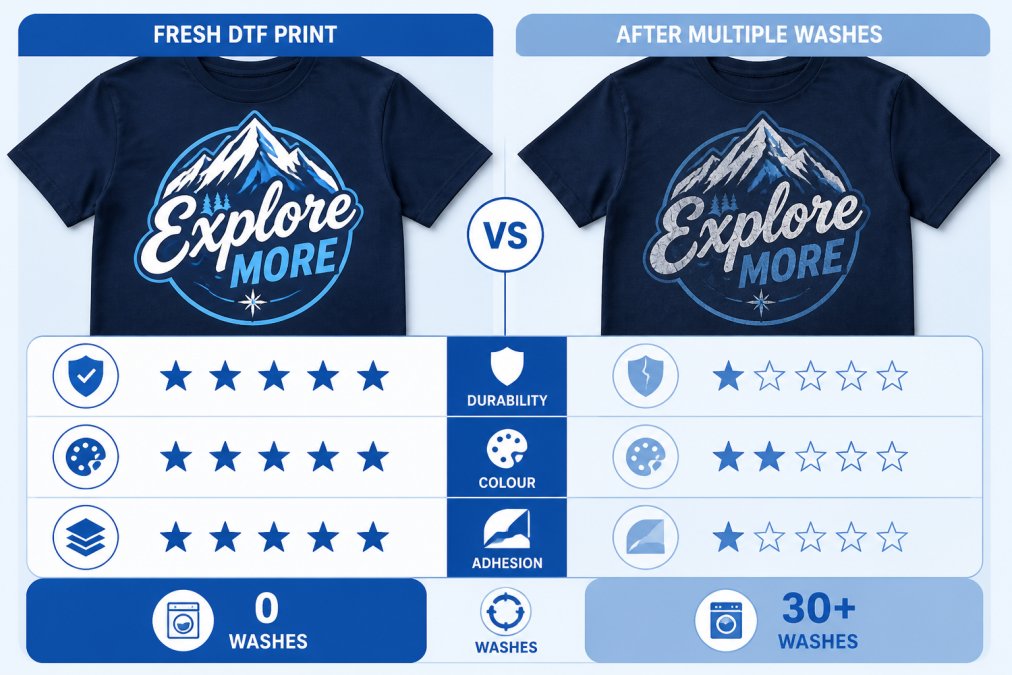
Cracking appears as fine lines spreading across the print surface, usually starting at edges or areas with thin ink coverage. Early cracking is cosmetic but indicates the adhesive layer is becoming brittle.
Peeling occurs when the transfer separates from the fabric substrate, typically starting at edges and progressing inward. Once peeling begins, failure accelerates rapidly as moisture penetrates under the separated layer.
Colour shift and fading indicate ink pigments are degrading from UV exposure, repeated washing, and heat. Edge lifting is a specific form of peeling where edges curl away from the fabric, exposing the underside to moisture and mechanical stress.
Most quality DTF transfers remain wearable for 50-100 home washes depending on care practices. Industrial washing reduces this to 10-30 cycles. Once significant cracking, peeling, or colour loss becomes visible, the garment is approaching the end of its print lifespan.
DTF transfer durability depends on quality transfers, proper application, and customer care practices. When sourcing DTF transfers, ask your supplier for wash test data. Transfers tested under standardised textile testing protocols give you confidence in durability claims. Understanding the variables that affect wash fastness, fabric composition, water temperature, detergent chemistry, and curing quality, helps you make informed decisions about which transfers will perform best for your specific applications.
Upload your gang sheet to BB5wholesale and access transfers designed for durability, backed by rigorous quality standards and 24/7 support when you need it.
Frequently Asked Questions
How many washes do DTF transfers typically survive?
Quality DTF transfers generally withstand 50 to 100+ washes when properly cared for. The exact number depends on fabric type, wash temperature, detergent chemistry, and whether garments are washed inside-out. Cotton and cotton-blend fabrics typically achieve better durability than 100% polyester. Pre-treatment during curing and avoiding high heat drying significantly extend wash fastness. Testing on your specific fabric and using recommended care methods will give you the most accurate durability expectation for your transfers.
What's the best way to wash DTF transfer garments to prevent cracking?
Always wash DTF transfers inside-out in cold or warm water (not hot). Use a gentle detergent without bleach or optical brighteners, which can degrade the ink binder and polymer adhesion. Select a delicate or gentle wash cycle to minimise mechanical agitation. Avoid tumble drying on high heat; instead, air dry flat or hang dry. If machine drying is necessary, use a low-heat setting. These practices reduce thermal stress, maintain ink flexibility, and prevent the edge lifting and cracking that occur when transfers experience excessive heat or agitation.
How does DTF wash test methodology work, and what standards apply?
DTF wash test methodology typically involves washing printed samples at set intervals (10, 25, 50 washes) under controlled conditions to assess colour retention, cracking, peeling, and fading. Quality control standards evaluate tensile strength and ink binder adhesion to the substrate. Tests measure wash fastness using standardised cycles with specific water temperatures, detergent types, and mechanical stress levels. Some suppliers conduct ISO or industry-equivalent testing; others use home laundry simulation. Understanding the testing protocol your supplier uses helps you predict real-world durability and compare quality across different DTF transfer providers.
What factors have the biggest impact on DTF transfer durability?
Fabric composition is critical; natural fibres like cotton provide better ink adhesion than synthetics. Water temperature significantly affects durability: cold water preserves the ink binder and polymer flexibility, while hot water accelerates degradation. Detergent chemistry matters too; harsh detergents break down the adhesion layer faster. Pre-treatment and proper curing during production ensure the transfer film bonds securely to the garment. Wash cycle intensity, tumble drying heat, and how often the garment is washed all contribute to how long prints remain vibrant and crack-free.
This article was written using GrandRanker