


How to Organize DTF Gang Sheets: A Step-by-Step Guide

Table of Contents
- Why Organizing DTF Gang Sheets Matters for Your Business
- Step 1: Set Up Your Physical Storage Space
- Step 2: Arrange Transfers for Easy Access
- Step 3: Create a Labeling System That Works
- Step 4: Select the Best Software for DTF Gang Sheets
- DTF Gang Sheet Layout Tips for Maximum Efficiency
- Step 5: Maintain Long-Term Durability and Shelf Life
- Common Mistakes to Avoid When Organizing Gang Sheets
Last Updated: August 22, 2026
Why Organizing DTF Gang Sheets Matters for Your Business
Disorganized DTF gang sheets waste time, money, and customer satisfaction. When designs are scattered across multiple files or stored haphazardly, production grinds to a halt. You waste hours searching for files, reprint designs you already have, and miss deadlines.
Most businesses treat gang sheet organization as an afterthought, investing in quality equipment but storing everything in a cardboard box. This works until you're running 20+ orders a month. Proper organization directly impacts your bottom line: faster retrieval means quicker fulfillment, reduced waste means higher margins, and clear labeling prevents costly reprints.
This guide walks you through organizing DTF gang sheets professionally, regardless of scale. Whether you're running an Etsy shop or a small print facility, the principles remain the same: physical storage, logical arrangement, clear labeling, digital tracking, and maintenance. You'll have a replicable system that saves time, reduces waste, and keeps transfers print-ready for months.
Step 1: Set Up Your Physical Storage Space
Your storage environment determines whether DTF transfers stay print-ready or deteriorate. Temperature, humidity, light exposure, and container choice all matter.
Choosing the right containers and materials
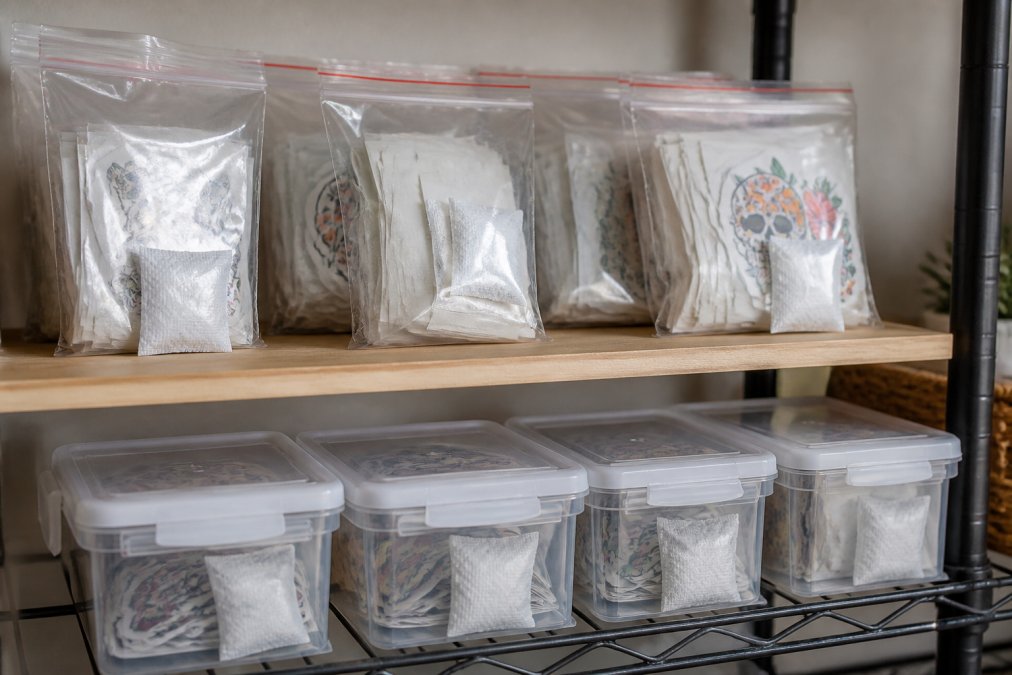
DTF transfers need protection from dust, light, and air exposure. Airtight containers are superior to resealable bags for anything longer than a few weeks. Use opaque or dark-tinted containers that block UV light; clear plastic allows degradation even when closed.
Plastic folders work for active projects you're working on now, offering quick visual access and efficient stacking. Use them for current work, and airtight containers for long-term inventory.
Include desiccant packs inside every sealed container to absorb moisture that damages adhesive powder. Replace them every 3-6 months (as recommended by [EXTERNAL_LINK: public health guidance on storage | gov.uk/government/publications/guidance-on-storage-of-medicines]). Label every container clearly before filling it with the date, design name, and quantity.
Maintaining DTF transfer storage temperature and humidity
DTF transfers perform best between 15-25°C and below 50% humidity (based on [EXTERNAL_LINK: industry best practices for material storage | printwearandpromotion.co.uk]). Excessive heat degrades adhesive powder and warps transfer film. High humidity weakens the adhesive bond.
Most homes naturally fall within acceptable ranges, but basements, attics, and unheated areas can be problematic. If your storage space experiences temperature swings or seasonal humidity changes, consider a small dehumidifier or climate-controlled cabinet.
Avoid storing transfers near heat sources, direct sunlight, or damp areas. A shelf in a temperature-stable room is ideal. Airtight containers with desiccant packs compensate for minor environmental fluctuations.
Step 2: Arrange Transfers for Easy Access
How you physically arrange gang sheets determines how quickly you can find them. The right arrangement system lets you locate any design in seconds.
Flat storage versus vertical organisation
Flat storage is the gold standard for DTF transfers. Stacking horizontally minimizes stress on adhesive powder and transfer film, distributes weight evenly, and lets you see what you have at a glance.
Vertical storage works if space is limited, but transfers experience uneven pressure and adhesive powder can shift. Use rigid dividers if storing vertically.
A combination approach works best: keep active projects in flat stacks for quick access, and store archived designs flat in sealed containers on shelves.
Sorting by design type, project, or customer order
Choose your primary sorting method based on how you work. If printing for multiple customers simultaneously, organize by customer order. If building a reusable design library, sort by design type: logos, patterns, seasonal graphics, custom text.
A third approach is organizing by batch or production date, useful for high-volume orders and stock rotation. Pick the method matching your workflow; you can adjust later as your business grows.
Step 3: Create a Labeling System That Works
A labeling system nobody understands is worse than no system. Your labels need to communicate essential information quickly and consistently.
What information to include on each label
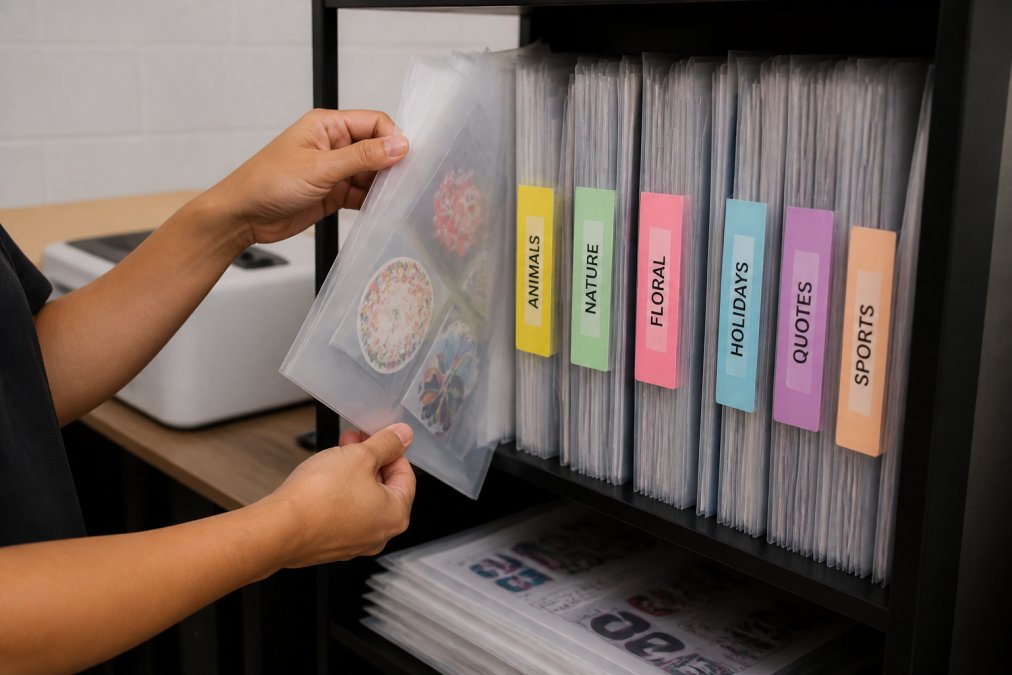
Every label should include: design name, date created or received, quantity of transfers, and any relevant customer or project code. Add a brief description if the design name alone doesn't clarify contents. "Geometric Pattern A, Blue and White" is clearer than "Geometric Pattern A."
If storing transfers long-term, add a review date. DTF transfers don't have a hard expiration, but adhesive powder gradually loses tackiness. A review date reminds you to test samples every 6-12 months.
Colour-coding and batch identification
Colour-coding accelerates retrieval. Assign each customer, project type, or product category a colour using coloured labels, marker dots, or tape. Your brain processes colour faster than text.
Batch identification helps when printing multiple versions of the same design. Label each batch uniquely: "Design X, Batch 1," "Design X, Batch 2."
Keep a master reference sheet explaining your colour system and batch codes. This is essential if others access your inventory or if you take a break and return months later.
Step 4: Select the Best Software for DTF Gang Sheets
Physical organization keeps transfers accessible. Digital organization keeps files findable, version-controlled, and backed up.
Digital asset management for gang sheet files
A digital asset management system stores gang sheet files, tracks versions, and lets you search by design name, date, customer, or project. Simple folder structures work for 50-100 designs, but become unwieldy quickly.
Dedicated digital asset management tools let you tag files, search by multiple criteria, store metadata like colour profiles and print settings, and maintain version history. You'll know exactly which version you printed last and instantly find all designs tagged "customer:acme" or "type:logo."
BB5wholesale's gang sheet builder integrates design creation with file organization, making it simple to build, store, and retrieve gang sheets in one platform.
Inventory tracking systems
An inventory tracking system tells you how many transfers you have, where they're stored, and when they were made. This prevents overstock and alerts you when running low on popular items.
A spreadsheet is the minimum viable option with columns for design name, quantity on hand, location, date created, and last printed. Update it every time you store or retrieve transfers.
Dedicated inventory software automates this process. You scan a barcode or enter a design code, and the system logs quantity, location, and timestamp. Over time, it shows which designs sell fastest and which sit unused.
For small businesses, a simple spreadsheet is enough to start. As inventory grows, invest in software integrating with your sales system.
DTF Gang Sheet Layout Tips for Maximum Efficiency
How you arrange designs on a gang sheet affects waste, print quality, and production speed. A well-planned layout maximizes transfer film use while minimizing scrap.
Minimizing waste and optimizing design placement
Plan your gang sheet layout to match your heat press size. If your heat press is 40cm wide, your gang sheet shouldn't exceed that width.
Group designs by similar size and shape. Placing a large 30cm design next to a tiny 5cm design wastes space. Group large designs together, then fill remaining space with smaller designs.
Leave minimal spacing between designs, just enough for clean cuts. Most DTF equipment needs 3-5mm spacing. Tighter spacing means more designs per sheet, but too tight and your cutter will struggle.
Consider the final garment when placing designs. A design for a shirt front needs different placement than one for a sleeve or back panel.
Avoiding common layout mistakes
Don't mix designs with different ink coverage on the same gang sheet. A design that's 80% coverage requires more curing time than one that's 20% coverage (as commonly understood in [EXTERNAL_LINK: print industry guidelines | fespa.com]). Separate heavy and light designs into different sheets.
Ignore your transfer film's orientation at your peril. Check your film's specifications and ensure all designs run in the same direction.
Don't assume all gang sheets print at the same speed. A sheet packed with small designs takes longer to cure than one with a single large design.
Reuse layouts that worked well. Consistency is more efficient than redesigning every time you get a new order.
Step 5: Maintain Long-Term Durability and Shelf Life
DTF transfers aren't consumables with a hard expiration date, but performance degrades over time without proper storage. A transfer stored correctly for a year performs nearly as well as the day it was printed.
Protecting transfers from moisture and humidity damage
Moisture is the primary enemy of DTF transfers. It dissolves adhesive powder, weakens the bond between transfer film and powder, and causes powder to clump or separate.
Seal transfers in airtight containers with desiccant packs, and keep them in a room with humidity below 50%. Run a dehumidifier if your climate is naturally humid.
Check desiccant packs regularly; they change colour when saturated. Replace them every 3-6 months or more frequently in damp environments.
If you notice condensation inside a sealed container, open it immediately and replace desiccant packs. Spread transfers out to dry before resealing.
Rotating stock and managing expiration
Use older stock before newer stock (FIFO principle). Label each container with creation date and rotate accordingly.
Every 6-12 months, test a sample transfer from your oldest stock. Print it, heat press it, and wash it to confirm performance. If adhesive powder is tacky, the bond is strong, and colours are vibrant, you're fine. If powder is dusty, the bond is weak, or colours have faded, use or discard that batch.
Keep a log of when you test each batch and results. This helps identify patterns in how storage conditions affect transfers.
Dispose of degraded transfers responsibly. DTF waste contains plastic film and adhesive powder. Check local regulations or contact your waste management provider.
Common Mistakes to Avoid When Organizing Gang Sheets
Mixing different design types in the same container. This forces you to open multiple containers to find what you need. Keep designs organized by a consistent method.
Storing transfers in clear containers in direct sunlight. Light fades colours and degrades film. Use opaque or dark-tinted containers away from windows.
Skipping labels or using illegible labels. Invest five seconds per container in a clear, consistent label.
Storing transfers in humid basements or damp closets. Moisture ruins transfers fastest. Store them in a temperature-stable, dry area with desiccant packs.
Forgetting to rotate stock. Establish a FIFO system and follow it.
Printing gang sheets without a clear layout plan. Random design placement wastes film and creates scrap. Plan your layout to maximize coverage.
Storing transfers without tracking quantity or location. Use a simple inventory system, spreadsheet, software, or notebook, to track what you have and where it is.
Ignoring humidity and temperature. Monitor your storage environment, especially for long-term transfers. A small dehumidifier is cheap insurance against degradation.
Organizing DTF gang sheets properly transforms your operation from chaotic to efficient. You'll spend less time searching for designs, print faster, waste less material, and deliver orders on schedule.
BB5wholesale's gang sheet builder and intuitive platform make it simple to design, organize, and track your transfers. With 24/7 customer support and secure payment options, you get the tools and backing to scale your custom apparel business confidently. Upload your gang sheet today and experience how the right system transforms your workflow.
| Component | Purpose | Key Detail |
|---|---|---|
| Airtight containers | Long-term storage protection | Include desiccant packs; replace every 3-6 months |
| Resealable bags | Short-term or active project storage | Use for designs you'll print within weeks |
| Colour-coded labels | Fast visual identification | Assign one colour per customer or design type |
| Desiccant packs | Moisture control | Replace when saturated; monitor regularly |
| Storage environment | Preservation of transfer quality | Keep 15-25°C and below 50% humidity |
| Digital inventory system | Track quantity and location | Use spreadsheet or dedicated software |
| Layout planning | Minimize waste and maximize efficiency | Group similar sizes; match heat press dimensions |
| Stock rotation (FIFO) | Prevent degradation of old transfers | Use older stock first; test annually |
Frequently Asked Questions
How should I store DTF gang sheets to prevent damage?
Store DTF gang sheets flat in airtight containers or resealable bags to protect against moisture and humidity damage. Keep them in a cool, dry space with consistent DTF transfer storage temperature between 15-25°C. Use desiccant packs inside containers to absorb excess moisture. Avoid stacking heavy items on top, and keep transfers away from direct sunlight. Proper storage extends shelf life significantly and maintains print quality.
What's the best way to organize DTF gang sheets for quick retrieval?
Combine physical and digital organization: label each gang sheet with design type, customer name, and date created, then use colour-coding for different projects. Store them flat or vertically in labelled plastic folders. Pair this with digital asset management software that tracks file locations and order details. This dual system reduces order fulfillment time and minimizes the risk of using outdated transfers or losing designs.
How long can I store DTF transfers before they degrade?
DTF transfers typically maintain usable quality for 6-12 months when stored correctly in airtight containers at proper temperature and humidity levels. Adhesive powder can lose effectiveness over time, especially if exposed to moisture or temperature fluctuations. Check older transfers before use by testing on scrap fabric. Rotating stock using a FIFO (first in, first out) system helps ensure you use transfers before they reach the end of their shelf life.
What software should I use to organize gang sheet files?
The best software for DTF gang sheets depends on your business size. Small operations can use spreadsheets with file naming conventions and folder structures. Growing businesses benefit from dedicated inventory management systems that track gang sheet designs, quantities, customer orders, and storage locations. Digital asset management platforms help organize high-resolution artwork and prevent duplicate designs. Choose software that integrates with your ordering system for seamless workflow.
This article was written using GrandRanker