


Best DTF Transfer Suppliers for Small Businesses UK

Table of Contents
- What Small Businesses Should Look For in a DTF Transfer Supplier
- Custom DTF Gang Sheets UK: Build, Upload and Save
- How to Press DTF Transfers for a Professional Finish
- UV DTF vs Standard DTF: Which One Do You Need?
- Cost-Per-Unit Analysis for Startups and Etsy Sellers
- Troubleshooting Common DTF Application Errors
- Sustainability and Eco-Friendly Certifications in DTF Printing
- Conclusion
- Frequently Asked Questions
Last Updated: September 11, 2026
What Small Businesses Should Look For in a DTF Transfer Supplier
Finding the best DTF transfer suppliers for small businesses UK means judging seven things: print quality, pricing honesty, minimum order policy, turnaround and shipping, fabric compatibility, wash durability, and reachable technical support. This guide shows how to test each before committing a pound.
Direct to film printing changed what small apparel operations can offer: no screen setup costs, no minimum runs in the hundreds. One gang sheet carries dozens of designs, so a single Etsy seller can offer forty variations without holding stock.
But the supplier market is uneven. Some deliver vibrant, wash-durable transfers; others send film that cracks after three cycles. The difference is rarely price, it is whether the supplier has done the boring work on ink chemistry, powder adhesion and quality control.
Quality Checks That Actually Matter
Ask any supplier for three things before ordering: a wash testing record, a stretchability sample, and their output resolution. A transfer that looks sharp but fails after five washes costs a refund, a replacement, and a customer.
Look for high-resolution graphics, colour accuracy against a CMYK colour profile, and a soft feel that does not stiffen the garment. The Textile Printing Guidance from the British Standards Institution outlines durability expectations for decorated textiles, which gives you a benchmark to hold suppliers against.
A practical wash-test protocol: press a scrap transfer onto an offcut of the exact blank you sell, wait 24 hours, then wash five times at 40°C inside out and tumble dry on low (iso.org). Check for edge lift, cracking and colour fade. Survive five cycles without lifting and it will usually survive thirty, the first wash is where poor adhesion shows up.
Fabric Compatibility: What Bonds and What Does Not
Not every transfer suits every blank; mismatches cause returns.
| Fabric | Standard DTF | Notes |
|---|---|---|
| 100% cotton | Excellent | The easiest substrate; strong bond, soft feel |
| Polyester | Good | Lower press temperature to avoid dye migration |
| Cotton-poly blends | Excellent | Best all-round choice for small sellers |
| Tri-blends | Good | Use a pressing pillow on seams and hems |
| Nylon | Poor | Adhesion is unreliable; test before committing |
| Coated or waterproof fabrics | Poor | Coating prevents the adhesive bonding |
Dye migration is the trap with polyester and dark synthetics: garment dye sublimates into the transfer under heat and dulls the print. A low-bleed film or lower press temperature (around 140-150°C) reduces the risk. If you sell mostly polyester activewear, ask whether their film is low-bleed before buying in bulk.
Pricing, Minimums and Hidden Costs
The headline price per sheet rarely tells the full story. Watch for setup fees, artwork handling charges, and minimums that force you to buy more than you need.
| Cost Factor | What to Check | Red Flag |
|---|---|---|
| Per-sheet price | Cost at your actual volume | Price only quoted at 50+ sheets |
| Minimum order | Whether single sheets are allowed | Forced bulk commitment |
| Artwork fees | Charges for file prep | Per-design setup charges |
| Shipping | Door-to-door or depot pickup | Slow dispatch times |
| Payment | Secure options available | Card details over email |
Wholesale pricing should reward volume, not punish small batch production. A supplier who cannot serve a ten-order-per-month seller profitably is not built for small businesses.
Turnaround, Shipping and Support
Turnaround is where small sellers lose customers. A realistic UK benchmark is dispatch within one to two working days and tracked delivery within two to three. Anything slower than five working days from order to doorstep is risky for made-to-order marketplace listings with a stated handling time.
Ask three questions before you commit:
- Is dispatch same-day for orders placed before a stated cut-off?
- Is delivery tracked and door-to-door, or depot pickup only?
- Is there a named contact or a support channel that answers outside office hours?
Technical support matters more than most buyers expect. When a transfer lifts on a customer's garment, you need an answer within hours, not days. A supplier who publishes heat press settings, fabric guidance and troubleshooting help saves you money.
A Simple Supplier Scorecard
Score each supplier out of five on wash durability, fabric range, minimum order flexibility, turnaround, and support responsiveness. Anything below three on wash durability or turnaround is not worth a second order, however cheap the sheet. Run this against two or three suppliers, and keep a backup on file, a single-source DTF operation is a single point of failure.
Custom DTF Gang Sheets UK: Build, Upload and Save
A gang sheet is one transfer film carrying multiple designs arranged to fill the space. The gang sheet builder is where your margins are won or lost.
BB5wholesale's Build Your Gang Sheet tool at £8.00 lets you upload multiple designs, arrange them across one sheet, and use every centimetre. Fit ten logos on one sheet and your cost per unit drops. Transfers print at high resolution with a soft, stretchable finish and arrive ready to press, no weeding required.
For single designs, DTF Transfers By Size starts at £2.95 and covers pocket logos through to full back prints. Order only the size you need.
How to Press DTF Transfers for a Professional Finish
Pressing a DTF transfer takes under a minute, but the settings matter more than most guides admit. Get temperature, pressure and timing right and the print survives repeated washing; get them wrong and you will be replacing orders.
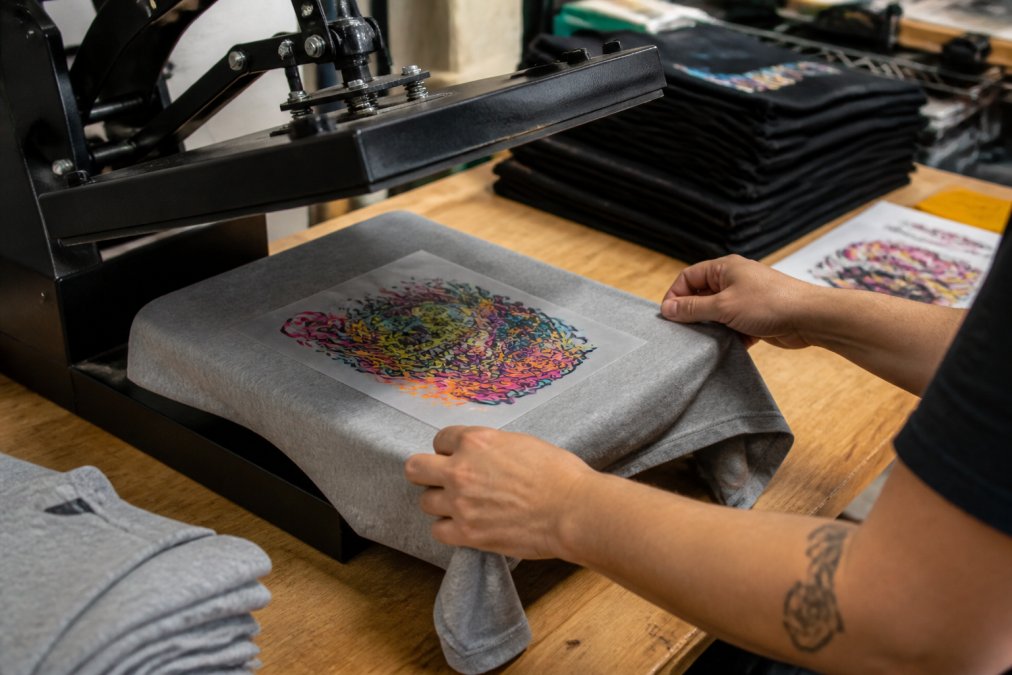
The standard process runs as follows:
- Pre-press the garment for 5 seconds to remove moisture
- Position the transfer and press at 150-160°C for 10-15 seconds
- Let the transfer cool completely, then peel
- Re-press for 5 seconds to lock the finish
Pressure should be firm and even, medium to firm on a manual press, where the platen resists but the handle still closes smoothly. Peeling while the film is warm pulls the adhesive powder before it bonds, the single biggest cause of edges lifting after the first wash.
Fabric-Specific Press Settings
One temperature does not suit every blank. Start here and adjust from your own wash tests.
| Fabric | Temperature | Time | Peel |
|---|---|---|---|
| 100% cotton | 160°C | 15 sec | Cold |
| Polyester | 140-150°C | 10-12 sec | Cold |
| Cotton-poly blend | 150-160°C | 12-15 sec | Cold |
| Tri-blend | 150°C | 12 sec | Cold |
| Canvas and denim | 160°C | 15-20 sec | Cold |
Always cold peel for standard DTF. Warm peeling is the fastest route to lifted edges and returned orders. If a supplier says hot peel, test it on a scrap before trusting it across a batch.
Pressure, Pillows and Problem Areas
Seams, zips, collars and hems create uneven surfaces where the platen cannot apply even pressure. A pressing pillow, a firm foam block that raises the area, solves most of this. Without one, transfers on seams lift within a few washes because the adhesive never fully bonded.
For garments with a zip or button placket, press around the hardware rather than over it. Metal conducts heat and can scorch the fabric or damage the platen.
Wash Testing and Longevity
Before selling a single garment, wash test the exact blank you use: press a scrap transfer, wait 24 hours, wash five times at 40°C inside out, tumble dry on low, and check for edge lift, cracking and colour fade each cycle.
A correctly pressed DTF transfer on cotton should survive thirty or more domestic washes when washed inside out at 40°C and tumble dried on low. Longevity drops sharply if customers wash at 60°C, use fabric softener on the print, or iron over it. A short care card in every parcel, wash inside out, cool wash, do not iron the print, cuts returns more than any other step.
UV DTF vs Standard DTF: Which One Do You Need?
The choice between UV DTF and standard DTF comes down to substrate: standard DTF bonds to fabric, UV DTF adheres to hard surfaces.
Standard DTF suits cotton, polyester, cotton-poly blends, tri-blends, canvas and denim. UV DTF suits glass, metal, wood, acrylic, hard plastic, ceramics and leather, and needs no heat press: clean the surface, peel the backing, press firmly, then remove the top film slowly.
BB5wholesale's UV DTF Gang Sheet Builder at £3.75 handles detailed, multi-colour artwork with a high-gloss finish that resists scratching and water. For pre-built sheets, the UV DTF gang sheet starts at £3.95.
UV DTF decorated items should not go in a dishwasher or microwave. High heat and harsh washing cycles break down the adhesive and dull the finish, and customers will blame your product, not their cleaning habits.
Cost-Per-Unit Analysis for Startups and Etsy Sellers
Cost per unit is where most new sellers misjudge pricing. The transfer is only one line in the calculation.
Work through this formula before setting a retail price:
- Transfer cost (per design on the sheet)
- Garment cost
- Packaging and labels
- Payment processing fees
- Your time at an hourly rate you would actually accept
A seller fitting eight designs onto an £8.00 gang sheet pays £1.00 per transfer. Add a £4.00 garment and £1.50 of packaging and fees, and the true cost sits near £6.50 before labour. Price at £18.00 and you have a business. Price at £9.00 and you have an expensive hobby.
Small batch production changes the maths in your favour: the more designs per sheet, the lower your transfer cost, which is why gang sheet efficiency matters more than headline pricing.
Troubleshooting Common DTF Application Errors
Most DTF failures trace back to four causes: insufficient pressure, wrong temperature, peeling too early, or a garment that was not pre-pressed. Each has a clear fix.
| Problem | Likely Cause | Fix |
|---|---|---|
| Edges lifting after washing | Peeled while warm | Cool fully before peeling |
| Cracking across the print | Too little pressure | Increase press pressure |
| Patchy, dull colour | Temperature too low | Verify 150-160°C with a probe |
| Transfer will not release | Over-pressed or scorched | Reduce time, check heat platen |
| Poor adhesion on seams | Uneven surface | Use a pressing pillow |
Stretchability problems usually come from over-stretching the garment during pressing, not a film fault. Keep the fabric flat and let the transfer do the work.
Sustainability and Eco-Friendly Certifications in DTF Printing
Sustainability in DTF printing comes down to two things: the chemistry of inks and powders, and how much film you waste. Neither is well regulated, so supplier claims deserve scrutiny.
Ask whether the adhesive powder is TPU-based and whether the inks are water-based or solvent-based. Request material safety data sheets for anything you handle regularly, since these are standard documentation rather than a special favour. Under UK REACH chemical regulations, substances placed on the market must meet registration and safety requirements, and a supplier who cannot produce basic documentation is a supplier to avoid.
Waste reduction is the more immediate win. Gang sheets cut film waste directly: ten designs on one sheet instead of ten separate sheets removes nine sheets of waste per order, which adds up quickly for a regular producer.
Look for suppliers who publish their material sourcing and disposal guidance rather than leaning on vague green language.
Conclusion
The DTF supplier market rewards buyers who ask hard questions about wash durability, minimums and true cost per unit. Get those three right and the rest follows.
BB5wholesale builds for exactly that buyer. The gang sheet builder packs designs efficiently to cut per-unit cost, secure payment options protect your details, 24/7 customer support is there when an order is due, and door-to-door delivery keeps turnaround predictable.
Upload your gang sheet with BB5wholesale and start producing transfers that survive the wash.
Frequently Asked Questions
What factors should small businesses consider when choosing a DTF transfer supplier?
Focus on four things: print quality (wash testing, colour accuracy and stretchability), pricing structure including any minimum order quantity, turnaround time from order to delivery, and the level of technical support available. A supplier that offers a gang sheet builder lets you fit multiple designs on one sheet, which lowers your cost per unit. Always request a sample before committing to a bulk order, and check whether the supplier provides clear heat press settings for their specific transfer film.
What is the difference between UV DTF and standard DTF transfers?
Standard DTF transfers are designed for fabrics: cotton, polyester, blends, canvas and denim. They require a heat press and produce a soft, stretchable finish that survives repeated washing. UV DTF transfers use UV-cured ink and a protective varnish to bond to hard surfaces such as glass, metal, wood, acrylic and leather. UV DTF needs no heat press, just a firm press by hand, but decorated items should not go in a dishwasher or microwave. Choose based on your product, not on price alone.
How do I prepare files for professional DTF printing?
Supply high-resolution graphics at 300 DPI in PNG or vector format, using a CMYK colour profile for the most accurate colour reproduction. Remove any background you do not want printed, and leave a small transparent margin around each design. If you are building a gang sheet, arrange designs with at least 5mm between them so the cutter and press have clean edges. Double-check that text is legible at the final print size before uploading, because DTF transfers reproduce fine detail faithfully.
Are there UK-based suppliers that offer gang sheet builders?
Yes. BB5wholesale provides an online gang sheet builder where you upload multiple designs, arrange them on one sheet and pay per sheet rather than per design. A Build Your Gang Sheet starts at £8.00, and UV DTF gang sheet options start from £3.75. This model suits small businesses running 10-15 orders a month because you only pay for the space you use. The builder removes manual layout work and reduces waste, which directly lowers your cost per finished garment.