


UV DTF for Tumblers vs Vinyl Wraps: Which Wins?

Table of Contents
- UV DTF for Tumblers vs Vinyl Wraps: The Key Differences
- UV DTF Durability on Drinkware: Dishwasher and Scratch Tests
- How to Apply UV DTF Cup Wraps: Step-by-Step
- UV DTF vs Vinyl Cost Comparison for Small Shops
- Surface Compatibility and Tumbler Types
- Troubleshooting Common Application Failures
- Environmental Impact and Waste
- Conclusion
- Frequently Asked Questions
Last Updated: September 12, 2026
UV DTF for Tumblers vs Vinyl Wraps: The Key Differences
UV DTF for tumblers vs vinyl wraps comes down to one structural fact: UV DTF is a cured ink layer bonded to a transfer film, while vinyl is a cut plastic film you weed and layer by hand. That difference drives everything else, from how long a design survives a dishwasher to how many units you can produce in an afternoon. This guide from BB5wholesale breaks down durability, cost, application and waste so you can pick the right method for your shop.
UV DTF printing is a digital process that jets UV-curable ink onto a laminated film, cures it instantly under UV light, and produces a ready-to-apply transfer for hard goods. Vinyl wrapping is a subtractive process: you cut a shape from a coloured sheet, remove the waste, and press it onto the substrate.
The distinction matters commercially. Craft suppliers sell vinyl as a cheap entry point, but the labour per unit is where small shops lose margin. UV DTF transfers arrive pre-printed, so a full-colour graphic with gradients and fine detail applies in one pass.
UV DTF Durability on Drinkware: Dishwasher and Scratch Tests
Most guides assert that UV DTF is "dishwasher safe" and leave it there. That claim is only useful if you know what actually fails, when it fails, and how to test it yourself. This section sets out a repeatable torture test you can run on your own stock, plus the mechanisms behind each failure mode.
How to run a dishwasher torture test
You do not need a lab. You need two identical tumblers, one UV DTF transfer and one cast vinyl decal, and a domestic dishwasher.
- Apply both designs to separate powder-coated stainless steel tumblers using the standard clean-position-press method. Let both cure for 24 hours before the first wash.
- Run them together on a normal 60°C cycle with a standard tablet detergent. No pre-rinse, no hand wash in between.
- After every 10 cycles, inspect both tumblers under a bright light. Photograph the edges, the centre of the design and any high-curvature areas.
- Record the first cycle at which you see edge lift, colour fade, cloudiness or full detachment.
- Repeat on a second pair washed at 50°C to see how much temperature alone shifts the result.
Treat those as indicative ranges from your own test, not fixed guarantees, because detergent type, water hardness and cycle temperature all move the number.
Why UV DTF fails later than vinyl
The mechanism is structural. A UV DTF transfer is a cured ink layer with no exposed adhesive edge. Water and detergent have nothing to creep under, so the main attack is surface abrasion from other items in the rack and gradual UV-driven colour shift over months of use.
Vinyl is a pressure-sensitive adhesive film. Hot water softens the adhesive, detergent breaks down its tack, and the bond fails from the edges inward. Once a corner lifts, water gets underneath and the decal peels progressively. A "dishwasher safe" vinyl label usually means the film will not dissolve, not that the adhesive will hold indefinitely.
Scratch and abrasion resistance
UV DTF's cured top layer resists scuffing from keys, coins and stacking. Vinyl is softer and shows scratches as a dull, whitened line where the pigment layer is scored. On gloss tumblers this is the first cosmetic failure most users notice, well before any peeling.
Where vinyl still wins on durability
On flat or gently curved surfaces with a simple single-colour logo, a quality cast vinyl can last years with hand washing and costs very little per unit. If your customer will hand wash and the design is simple, vinyl durability is not the limiting factor.
How to Apply UV DTF Cup Wraps: Step-by-Step
Applying UV DTF cup wraps is a heat-free, three-stage process: clean, position, press. Total time is roughly two to three minutes per tumbler once you have a rhythm.
- Clean the tumbler with isopropyl alcohol and a lint-free cloth; let it dry fully.
- Peel the transfer sheet from its backing, keeping the design on the carrier film.
- Position the wrap on the tumbler, starting at the seam and working around the curve.
- Press firmly with a squeegee, working from the centre outward to push out air.
- Peel the carrier film back slowly at a low angle.
- Inspect the edges and re-press any lifted sections.
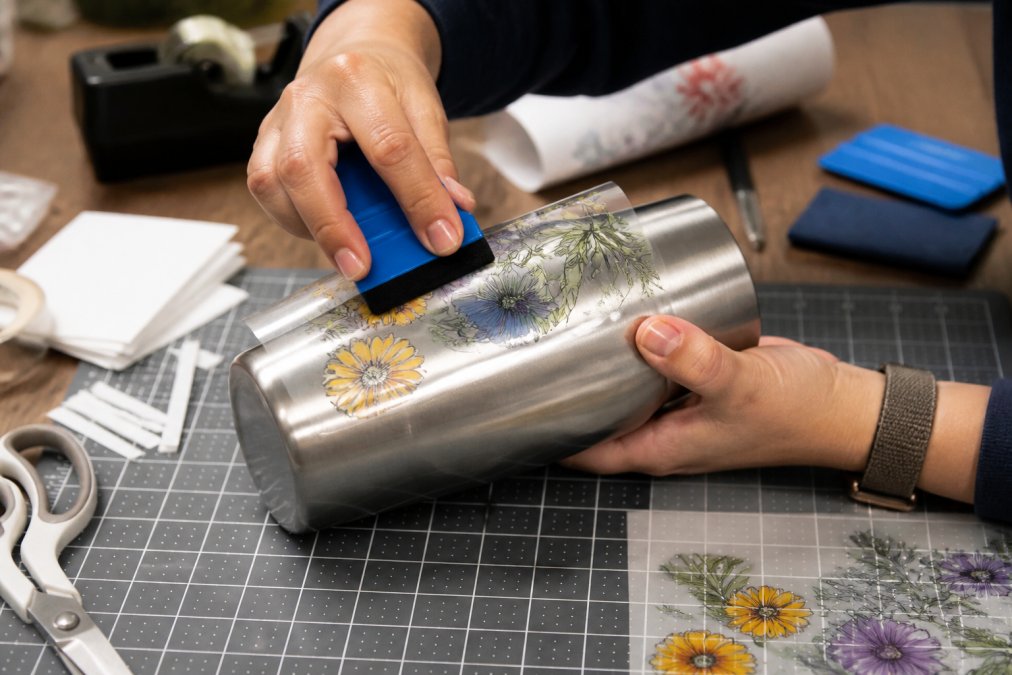
Expected result: a smooth, glossy finish with no trapped air and no visible transfer sheet edges. If you see silvering or bubbles, the surface was not clean or you peeled too fast.
The gang sheet format changes the economics here. Instead of printing one design at a time, you arrange multiple cup wraps on a single sheet, which cuts material waste and setup time. BB5wholesale's UV DTF Gang Sheet Builder lets you lay out artwork before ordering, so you are not paying for empty film.
UV DTF vs Vinyl Cost Comparison for Small Shops
Material price is the least useful number in this comparison. What decides your margin is cost per finished unit, and that includes labour, waste and rework. This section gives you a framework to calculate it for your own shop rather than quoting a headline figure that will not match your workflow.
The cost-per-unit formula
Use the same formula for both methods so the comparison is honest:
Cost per unit = (material cost per unit + labour cost per unit + waste cost per unit + rework cost per unit)
- Material cost per unit, divide the sheet or roll price by the number of usable designs you get from it.
- Labour cost per unit, your hourly rate divided by 60, multiplied by the minutes the method takes per unit.
- Waste cost per unit, the value of material you discard, spread across the units you actually sell.
- Rework cost per unit, the labour and material spent redoing failed applications, spread across sellable units.
Worked example: a 10 to 15 order per month shop
Take a shop charging an hourly rate of £15 for its own time (gov.uk).
Vinyl, multi-colour logo:
- Material: a few pence to around £1 per decal depending on film and size.
- Labour: weeding, layering and transfer tape commonly take 8 to 15 minutes on a multi-colour design. At £15/hour that is £2.00 to £3.75.
- Waste: offcuts and weeded vinyl are largely unrecoverable, so add a modest allowance.
- Rework: thin bridges and shifted layers push the reject rate up, and each reject costs the full labour again.
UV DTF transfer:
- Material: BB5wholesale's UV DTF gang sheet starts at £3.95, and the gang sheet builder option starts at £3.75. Divide that by the number of cup wraps you nest on the sheet to get your per-unit material cost.
- Labour: clean, position, squeegee and peel typically runs two to three minutes. At £15/hour that is £0.50 to £0.75.
- Waste: no weeding waste, and tight nesting on a gang sheet raises material utilisation.
- Rework: far fewer failure points, so the rework allowance is smaller.
The pattern is consistent: vinyl wins on the material line and loses on the labour line. Once labour per unit exceeds the difference in material cost, UV DTF is the cheaper method per finished tumbler.
The break-even question
You do not need a spreadsheet to make the call. Ask one question: how many minutes of weeding and layering does this design take, and what is that time worth to you? If the answer is more than the material cost gap, UV DTF wins on that job. For simple single-colour logos the gap is small and vinyl can still be the right choice. For detailed multi-colour artwork the gap is large and UV DTF wins clearly.
Gang sheets change the economics
The gang sheet format is the main lever on UV DTF cost per unit. Instead of printing one design at a time, you arrange multiple cup wraps on a single sheet, which cuts material waste and setup time. BB5wholesale's UV DTF Gang Sheet Builder lets you lay out artwork before ordering, so you are not paying for empty film. The more designs you nest per sheet, the lower your per-unit material cost falls, and that is the number that should drive your pricing.
Pricing your work
Once you have a cost per unit, price from it rather than from the material receipt. A common mistake is quoting vinyl jobs on material cost alone, which undercharges for the shop's own time and quietly loses money on every multi-colour order.
Surface Compatibility and Tumbler Types
UV DTF bonds to hard, non-porous substrates; vinyl needs a smooth surface with enough flat area for the adhesive to grip. Substrate compatibility is where the two diverge most sharply.
UV DTF transfers work well on:
- Stainless steel and powder-coated tumblers
- Glass and acrylic drinkware
- Hard plastic, metal and wood
- Leather and some coated surfaces
Vinyl struggles on heavily curved or textured surfaces, where the film cannot conform without creasing. On a tapered tumbler, a flat vinyl wrap tends to lift at the base. UV DTF handles curvature better because the transfer film is more pliable during squeegee application.
Powder-coated tumblers are the sweet spot for both. They give a slightly textured surface that improves mechanical grip, which is why custom branding on powder-coated drinkware holds up well.
Troubleshooting Common Application Failures
Most UV DTF application failures trace back to surface contamination or peeling technique, not the transfer itself. Fix those two variables and your reject rate drops sharply.
Common problems and their fixes:
| Problem | Likely Cause | Fix |
|---|---|---|
| Bubbles under the design | Dirty surface or fast peel | Re-clean, squeegee from centre out |
| Lifted edges | Oils from handling | Wipe with alcohol, re-press edges |
| Design tears on peel | Peeling at too steep an angle | Peel back slowly at a low angle |
| Cloudy finish | Trapped moisture | Let the tumbler dry fully first |
| Adhesive residue | Vinyl left too long | Remove sooner, clean with alcohol |
For vinyl specifically, the weeding process is the main failure point. Thin bridges snap, small counters fall out, and layered designs shift during squeegee application. UV DTF removes that entire class of error.
Environmental Impact and Waste
UV DTF produces less waste per finished unit than vinyl in most small-shop workflows. Vinyl generates offcuts from every cut job, plus backing paper and transfer tape, and weeded waste is usually not recyclable because it mixes adhesive with PVC (gov.uk).
UV DTF's waste profile is different: the carrier film and backing are the main discard, and because gang sheets let you nest designs tightly, material utilisation is higher. There is no weeding waste at all.
That said, neither method is waste-free. Both use plastic-based films, and neither breaks down quickly in landfill. The practical lever is nesting efficiency, not material choice. Arranging more designs per sheet is the single biggest reduction you can make.
For shops marketing themselves on sustainability, the honest position is that UV DTF reduces waste volume through better nesting, not that it eliminates plastic.
Conclusion
The choice between UV DTF and vinyl comes down to volume, design complexity and how much of your own time you can afford to spend. Vinyl suits simple single-colour work at very low volume. UV DTF wins for detailed, full-colour graphics, curved drinkware and any shop where weeding hours are eating into margin.
Frequently Asked Questions
Is UV DTF better than vinyl for tumblers?
UV DTF transfers offer a heat-free application and a glossy, scratch-resistant finish that vinyl decals often lack. They bond permanently to hard surfaces like stainless steel, glass, and acrylic. Vinyl remains cheaper for simple one-colour designs, but UV DTF handles full-colour graphics without weeding. For small shops producing detailed, multi-colour drinkware, UV DTF usually delivers a more professional result with less manual prep.
How long do UV DTF cup wraps last on drinkware?
UV DTF durability on drinkware depends on surface preparation and washing habits. Applied correctly to a clean, dry tumbler, UV DTF wraps resist scratching and fading for months of daily use. Hand washing extends the life significantly. Dishwasher exposure at high temperatures gradually weakens the adhesive edge, so top-rack washing on a gentle cycle is safer. Avoid abrasive sponges, which dull the glossy finish over time.
Are UV DTF cup wraps dishwasher safe?
They survive occasional dishwasher cycles, but repeated high-heat washing shortens their lifespan. The laminated film protects the print from water and detergent, yet sustained heat and steam can lift edges. For tumblers that will be washed daily, hand washing with mild soap keeps the UV DTF transfer looking new for longer. If you must use a dishwasher, choose a low-temperature cycle and avoid the heated drying setting.
Can UV DTF transfers be applied to all tumbler types?
UV DTF works on most hard, smooth surfaces including stainless steel, glass, acrylic, and hard plastic. Powder-coated tumblers need a slightly firmer squeegee pass because the texture reduces initial contact. Silicone sleeves and soft-grip surfaces are not suitable because the adhesive cannot form a permanent bond. Always test a small transfer on a new tumbler style before committing to a full production run.
If your order book is growing and hand-weeding is the bottleneck, the material is not your problem, the workflow is. BB5wholesale supplies UV DTF gang sheets built for hard-surface branding, with an intuitive gang sheet builder, 24/7 customer support, more than ten secure payment methods, and fast door-to-door delivery. Get started with BB5wholesale and turn a full-colour tumbler order around in an afternoon instead of a week.