


What Is DTF Printing Technology? A 2026 Guide

Table of Contents
- What Is DTF Printing and How Does the Process Work?
- DTF vs Sublimation: Which Transfer Method Fits Your Work?
- How to Use Custom DTF Transfers: A Step-by-Step Guide
- DTF Printing Durability: How Long Do Prints Actually Last?
- DTF Gang Sheet Printing: Cut Costs Without Cutting Quality
- Where DTF Printing Works Beyond T-Shirts
- Frequently Asked Questions
Last Updated: September 10, 2026
What Is DTF Printing and How Does the Process Work?
DTF printing is a digital garment decoration method that prints a design onto a PET film, coats it with hot melt adhesive powder, cures it, then transfers it onto fabric with a heat press. Unlike older methods, it needs no weeding, no pretreatment, and no colour-limited screen setup. This flexibility is a main reason small apparel businesses are moving to direct-to-film production. The process works across cotton, polyester blends, and hard-to-print fabrics that trip up other techniques. Below, we break down exactly how a DTF transfer moves from digital file to finished garment.
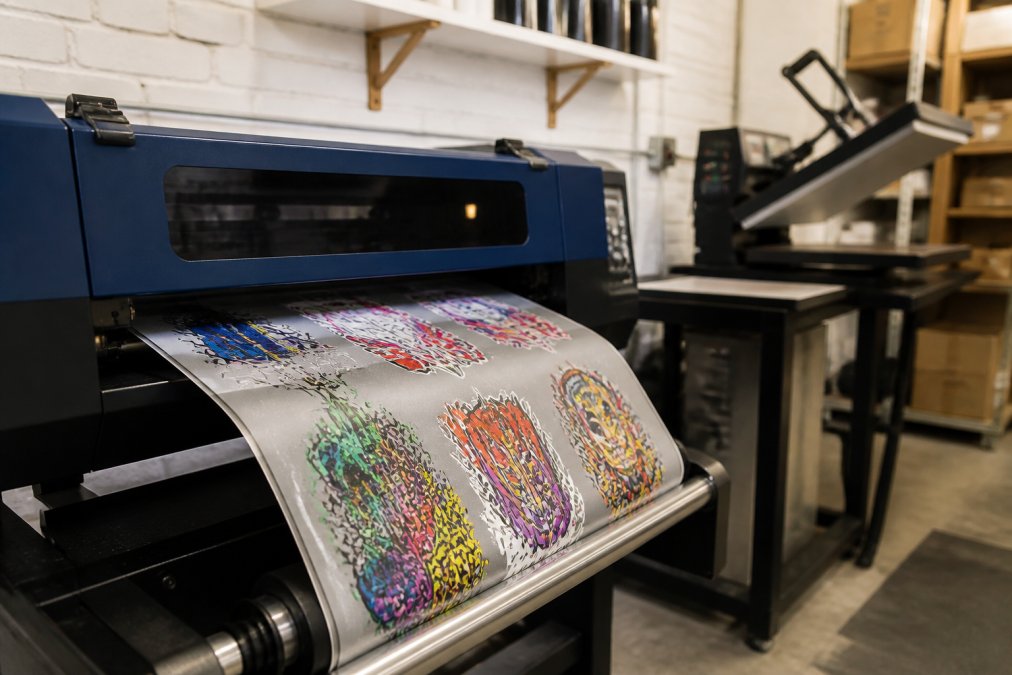
The Five Stages of a DTF Transfer
Every DTF transfer follows the same five stages:
- Print the design onto PET film using pigment ink, laying down CMYK plus a white ink layer for opacity on dark garments.
- Powder the wet print with hot melt adhesive powder, then shake off the excess.
- Cure the powdered film in an oven or under heat until the adhesive melts and sets.
- Press the transfer onto the substrate at the correct temperature, pressure, and dwell time.
- Peel the film away, using either a cold peel or hot peel method depending on the film.
Get any stage wrong and durability suffers. The curing process, in particular, is where most beginners lose wash longevity.
DTF vs Sublimation: Which Transfer Method Fits Your Work?
DTF wins on fabric range; sublimation wins on polyester-only softness. Sublimation dyes the fabric directly, so it only bonds properly with polyester and light-coloured synthetic blends. DTF sits on top of the fabric as an adhesive layer, which means it handles cotton, polyester blends, and dark colours without a white underbase problem. If your work is mostly cotton tees and mixed-fabric custom apparel, DTF is the more forgiving choice.
| Factor | DTF Printing | Sublimation |
|---|---|---|
| Compatible fabrics | Cotton, polyester blends, most textiles | Polyester and synthetic blends only |
| Dark garments | White ink layer handles them | Needs light fabric or special coating |
| Feel on fabric | Slight adhesive layer | Dyes into fabric, very soft |
| Setup | Printer, powder, curing, heat press | Printer, heat press |
| Best for | Mixed-fabric custom apparel | All-over polyester sportswear |
The trade-off is feel. Sublimation prints disappear into the fabric; DTF adds a thin layer you can feel if you run a finger across it. For most garment decoration work, that is an acceptable price for the fabric freedom.
How to Use Custom DTF Transfers: A Step-by-Step Guide
Using custom DTF transfers is straightforward once your equipment is dialled in. The whole press cycle takes under a minute per garment, which is why print-on-demand sellers favour it. Here is the workflow we recommend to anyone moving from manual arranging to a proper production line.
What You'll Need Before You Start
- A heat press with accurate temperature control
- Your DTF transfer sheets, cut to size
- A lint roller or cloth to clean the garment surface
- Heat-resistant tape or parchment paper for positioning
- A stopwatch or the press timer
Common Mistakes to Avoid
A common mistake is guessing the transfer temperature and dwell time. Every film and powder combination has its own sweet spot, and pressing too cool leaves the adhesive under-cured, so the print lifts in the wash. Pressing too hot scorches the film or yellows the white ink layer. Always run a test press on scrap fabric first.
Build your gang sheet through BB5wholesale's gang sheet builder to arrange multiple designs on one sheet and cut wasted film.
DTF Printing Durability: How Long Do Prints Actually Last?
A correctly produced DTF transfer will typically outlast the garment it sits on. In practice, most commercial print shops report that a properly cured and pressed transfer survives 50+ domestic wash cycles before any visible cracking, fading, or edge lift appears. The number is not a guarantee, it is a ceiling that only holds when three variables are controlled: adhesive cure, press parameters, and laundry behaviour.
What Actually Determines Wash Longevity
Durability is decided long before the first wash. Four mechanisms drive almost every failure:
- Adhesive cure completeness. If the hot melt powder is under-cured at the oven stage, the adhesive never fully cross-links. The print may look perfect off the press and still delaminate after two or three washes. This is the single most common cause of premature failure.
- Press pressure and dwell time. Insufficient pressure leaves the adhesive sitting on top of the fabric weave rather than penetrating it. Too much pressure flattens the ink layer and causes a shiny, cracked finish. Most films specify a window, typically 150-165°C for 10-15 seconds at medium pressure, but the correct setting is the one that passes a stretch test on your specific fabric (cricut.com).
- Fabric type. Cotton and cotton-rich blends hold DTF transfers best because the adhesive mechanically locks into the fibre. Smooth synthetics such as nylon and some performance polyesters offer less mechanical grip, so edge lift appears sooner. Stretch fabrics need a transfer that can move with the garment, a rigidly pressed print on a stretch jersey will crack at the first pull.
- Laundry behaviour. Heat is the enemy. Tumble drying on high heat accelerates adhesive breakdown more than any other single factor.
A Simple Wash-Test Protocol
Rather than trusting a supplier's claim, run your own test before committing a production run:
- Press a sample transfer onto the exact fabric you intend to sell.
- Wash it inside out at 30°C on a normal cycle, with a standard detergent (no fabric softener, softener leaves a residue that attacks the adhesive) (cleaninginstitute.org).
- Tumble dry on low, or air dry.
- Repeat five times, checking after each cycle for edge lift, cracking, and colour shift.
- Stretch the print gently across the grain after the fifth wash. If it moves with the fabric without splitting, the cure and press settings are correct.
A transfer which passes this five-cycle test can indicate good durability in real-world use.
Care Instructions to Pass to Your Customers
The durability of a DTF print is partly in your customer's hands. Include a care card with every order:
- Wash inside out at 30°C or cooler.
- Do not use fabric softener or bleach.
- Tumble dry low or hang dry.
- Iron on the reverse only, never directly on the print.
- Avoid dry cleaning.
The Sustainability Angle Most Guides Skip
Durability and sustainability are linked, and almost no DTF guide addresses it. A print that lasts the life of the garment is inherently the more sustainable choice, it delays replacement and keeps textile waste out of landfill. But the process itself carries an environmental cost that buyers should understand:
- PET film waste. Every transfer consumes a carrier film that is typically single-use. Offcuts from gang sheet nesting should be collected and sent to a film recycling stream where your local authority or waste contractor offers one, rather than going into general waste.
- Hot melt powder handling. Adhesive powder is a fine particulate. Wear a mask when shaking off excess, work in a ventilated area, and sweep up rather than washing residue down a drain.
- Ink and curing emissions. Pigment inks are water-based in most modern DTF systems, which is a meaningful improvement over solvent alternatives, but the curing oven still releases VOCs (the EPA). Extraction or adequate ventilation is good practice in any setting.
- Wash water. Advise customers to wash full loads at low temperature, the biggest environmental lever in garment care is not the print, it is the laundry cycle.
A DTF operation that manages film waste, ventilates curing, and educates customers on low-temperature washing can be a more sustainable alternative. This is a story worth telling on product pages.
DTF Gang Sheet Printing: Cut Costs Without Cutting Quality
Gang sheet printing is the single biggest cost lever in DTF production, and it is also the point where most small shops either become profitable or quietly bleed margin. Understanding the economics, not just the mechanics, is what separates a hobby press from a business.
Why Gang Sheets Change the Maths
A single-design DTF transfer is priced by the sheet area it consumes, regardless of how much of that sheet is actually printed. If your design occupies a quarter of an A3 sheet, you still pay for the whole sheet. Gang sheet printing solves this by nesting multiple designs onto one film so that almost every square centimetre is used.
The effect is straightforward: your cost per print falls roughly in proportion to how tightly you nest. A sheet that holds eight designs instead of one can cut the per-unit transfer cost by a factor of several, without changing ink, powder, or press time per garment.
A Simple Break-Even Framework
You do not need accounting software to work out whether DTF is viable for your shop. Work through four numbers:
- Cost per transfer. Take your gang sheet price and divide it by the number of usable designs on the sheet. This is your true unit cost.
- Cost per garment. Add the blank garment cost, plus a small allowance for press time, labour, and electricity.
- Selling price. What the market will pay for the finished item.
- Gross margin per unit. Selling price minus cost per garment.
Your break-even point is simply your fixed monthly costs (printer lease or depreciation, software, workspace, insurance) divided by your gross margin per unit. If your fixed costs are £400 a month and you clear £4 gross margin per garment, you need 100 garments a month just to stand still. Everything above that is profit.
Most small DTF operations find that gang sheet nesting is what pushes the gross margin from marginal to workable, because it attacks the largest variable cost, the film itself.
Scaling Beyond the Hobby Press
Once gang sheet nesting is routine, the next constraints appear in a predictable order:
- Throughput. A single desktop DTF printer and one heat press can realistically produce a few dozen garments a day. Beyond that, you are the bottleneck, not the machine.
- Curing consistency. Manual powder shaking and oven timing introduce variation. A shaker unit and a proper curing oven are the first upgrades that pay for themselves through reduced reprints.
- Order mix. Small-batch custom work (Etsy-style, personalised gifts, team kits) suits gang sheets perfectly. Large single-design runs are better served by dedicated film or by moving to a different process entirely.
- Cash flow. Film, powder, ink, and blanks are all bought upfront. Gang sheet nesting improves cash flow because you buy film area once and monetise it across many orders.
Building a Gang Sheet That Actually Saves Money
A few practical rules keep nesting efficient:
- Group designs by size and rotate them to fill awkward gaps.
- Leave a small bleed between designs so cutting does not clip artwork.
- Keep a library of your best-selling designs pre-nested so repeat orders take minutes, not hours.
- Track your film utilisation, if you are consistently below about 80% coverage, your nesting is leaving money on the sheet.
Build your gang sheet through BB5wholesale's gang sheet builder to arrange multiple designs on one sheet and cut wasted film.
For single designs, DTF transfers by size start at £2.95, and UV DTF gang sheets for hard surfaces start at £3.95.
Where DTF Printing Works Beyond T-Shirts
DTF is not limited to cotton tees. The same transfer technology applies to tote bags, hoodies, caps, and workwear, and its UV DTF variant handles hard surfaces entirely. UV DTF transfers bond to glass, wood, metal, hard plastic, leather, and acrylic, which opens up branding on drinkware, signage, and packaging. That range is why promotional product managers increasingly spec DTF for corporate merchandise runs.
Frequently Asked Questions
What are the disadvantages of DTF printing?
DTF printing requires a heat press and careful temperature control, so it is not a casual at-home method. The feel of the print is slightly thicker than screen printing on large solid blocks of colour, and you need to manage ink, film and powder supplies. Setup costs for a printer, shaker and oven are significant. That said, for small batches and multi-colour designs, the trade-offs are usually worth it compared with screen printing.
Which one is better, DTF or sublimation?
It depends on your fabric. Sublimation bonds dye into polyester and needs a light-coloured, high-polyester garment to work well. DTF printing uses a hot melt adhesive powder and PET film, so it adheres to cotton, polyester blends and dark fabrics without pretreatment. If your customers order cotton tees or mixed-material apparel, DTF gives you more flexibility. For all-over sublimation on white polyester sportswear, sublimation still wins.
How long will a DTF print last?
A properly pressed DTF transfer on a good-quality garment can last 50 or more washes when cared for correctly. Wash inside out in cold water, avoid fabric softener and tumble drying on high heat, and the print keeps its colour and stretch. DTF printing durability depends heavily on press temperature, dwell time and pressure. Under-pressed transfers peel early, so follow your supplier's recommended settings exactly.
Is DTF printing better than screen printing for small batches?
For small batches, yes. Screen printing needs a separate screen for each colour, which makes low-volume, multi-colour jobs expensive. DTF gang sheet printing lets you place many designs on one film, print them in a single pass and press them as orders come in. There is no minimum order and no screen setup cost, so a ten-shirt run with six colours stays affordable.
What equipment is required to start DTF printing?
You need a DTF printer loaded with pigment ink, PET film, hot melt adhesive powder, a powder shaker or curing oven, and a heat press. RIP software manages colour profiles, ink limits and print resolution. A nozzle check and regular print head maintenance keep output consistent. If you would rather skip the hardware, order ready-to-press transfers by size from a supplier and press them yourself.
Can I use DTF transfers on fabrics other than cotton?
Yes. DTF printing works on cotton, polyester, cotton-poly blends, canvas, denim, linen and many other textiles. The hot melt adhesive powder bonds to the fabric fibres during pressing, so the substrate matters less than with sublimation. Stretchability and breathability vary with the fabric weight, but the transfer itself handles both light and dark garments without a white ink layer change.
How do I stop DTF transfers peeling after a few washes?
Peeling usually comes down to three things: insufficient pressure, the wrong temperature, or pressing on a damp garment. Pre-press the shirt for a few seconds to remove moisture, use medium-to-firm pressure, and follow the supplier's dwell time. Let the transfer cool before peeling if it is a cold-peel film. Storing transfers flat in a dry place also protects the adhesive layer.
Custom apparel is a competitive market, and the businesses that win are the ones that control production cost and turnaround without sacrificing print quality. BB5wholesale gives you an intuitive gang sheet builder, fast door-to-door delivery, more than ten secure payment methods, and 24/7 customer support, so a late-night order deadline never leaves you stuck. Upload your gang sheet with BB5wholesale and get professional DTF transfers without the guesswork.