


Custom UV DTF Stickers for Packaging Solutions

Table of Contents
- Why Packaging Branding Demands UV DTF Stickers
- UV DTF vs Vinyl Stickers for Branding: The Real Differences
- How Custom UV DTF Stickers Handle Different Packaging Surfaces
- Bespoke UV DTF Gang Sheet Printing for Small Businesses
- UV DTF Transfer Application Guide: From Sheet to Surface
- Cost-Benefit Analysis: What Custom UV DTF Stickers Actually Save You
- Conclusion: Upgrade Your Packaging with UV DTF Stickers
- Frequently Asked Questions
Last Updated: September 4, 2026
Why Packaging Branding Demands UV DTF Stickers
Custom UV DTF stickers for packaging solutions have become the default choice for brands that want a premium look without expensive moulds or large print runs. UV DTF is a direct-to-film method producing durable, vibrant decals for hard surfaces, a peel-and-stick alternative to traditional labelling. At BB5wholesale, we produce these transfers daily, and the shift from vinyl cutting toward UV DTF is striking, driven by demand for full-colour, photographic detail.
The core advantage: you get the finish of a screen-printed or pad-printed logo at a fraction of the setup cost, with no plates, dies, or minimum order quantities, ideal for small-batch launches, seasonal packaging, and personalised merchandise.
Below, we compare UV DTF with vinyl, which surfaces it sticks to, how to apply it without errors, and what it saves you in real terms.
UV DTF vs Vinyl Stickers for Branding: The Real Differences
Vinyl is a cut-and-weed process where each colour is a separate layer of adhesive film, so complex designs require multiple stacked layers that add thickness, registration errors, and production time. UV DTF prints the entire design in one pass onto a film, then applies a protective adhesive layer over the top.
That single-pass method delivers several practical benefits:
- Full-colour gradients and photographic images print cleanly, with no layering or cutlines visible
- A gloss finish and slight 3D effect come from the cured adhesive layer, which reads as a premium tactile detail
- Edge-to-edge colour means you can print white ink beneath transparent areas, so the design pops on dark packaging
Vinyl still wins for simple, single-colour lettering in bulk, especially for die-cut shapes in the thousands. But for custom branding that needs to look like a printed logo, UV DTF is stronger: the cured ink and adhesive layer resist scratching and water far better than exposed vinyl edges, which tend to lift and peel.
How Custom UV DTF Stickers Handle Different Packaging Surfaces
A common mistake is assuming one adhesive works on every material. UV DTF transfers are engineered for rigid surfaces, and performance depends on the substrate. Beyond 'will it stick?' lies the more important question: 'how long will it stay stuck under real-world conditions?'
Most suppliers stop at a compatibility table. The gap is data on adhesion longevity, how a transfer performs after weeks of handling, temperature shifts, and transport vibration. Practitioners running high-volume packaging lines report patterns worth knowing before you commit a design to a substrate.
| Surface Type | Initial Adhesion | Longevity Pattern (6+ months) | Best Practice |
|---|---|---|---|
| Glass and ceramics | Excellent | Stable; adhesive bond strengthens slightly as it cures | Clean with IPA, apply with firm pressure; avoid thermal shock in first 24 hours |
| Hard plastics (ABS, acrylic, polycarbonate) | Excellent | Good, but recycled plastics vary significantly | Test on the exact batch; mould-release agents on virgin plastics are the main failure point |
| Powder-coated metal | Very good | Good on smooth, fully cured powder coat; poor on textured or matte finishes | Degrease; avoid applying over visible orange-peel texture |
| Bare aluminium and stainless steel | Very good | Good, but surface oxidation can weaken bond over time | Degrease and apply within 24 hours of cleaning |
| Wood and leather | Good | Poor on untreated wood; adhesive pulls fibres as it cures | Seal porous wood with a clear lacquer first; test on offcuts |
| Flexible or soft surfaces | Poor | Cracking and edge-lift within weeks | Use fabric DTF or vinyl instead |
The adhesive bonds with non-porous materials, making glass, plastic, and metal the sweet spot. On porous wood, it can pull fibres as it cures, leaving a weak bond, sealing the surface first solves that. On soft or curved packaging, UV DTF can crack because it lacks vinyl's flexibility.
The Recycled Plastic Variable
Packaging-specific guidance is notably thin on recycled plastics. As UK brands shift toward PCR content, they are discovering that recycled PET and HDPE behave differently from virgin polymers, often containing residual contaminants or inconsistent surface energy across a single batch. The practical result: a transfer that bonds perfectly to one batch of recycled jars may show edge-lift on the next.
Adhesion Testing Protocol for Packaging
A simple in-house test takes less than an hour and saves you from discovering adhesion problems after your product is in distribution:
- Clean and apply transfers to three identical samples of your actual packaging material, not a similar material, the exact one.
- Wait 24 hours for the adhesive to cure fully.
- Subject samples to a temperature cycle: 4°C refrigeration for 2 hours, then room temperature for 1 hour, then 40°C warm storage for 2 hours.
- Attempt edge-lift with a fingernail at each corner. If any edge lifts, the bond is insufficient for your application.
- Wipe the surface with a damp cloth and check for ink migration or adhesive residue.
Most practitioners find that UV DTF transfers on properly prepared glass, metal, and virgin plastics pass this test consistently. The failures almost always trace back to surface contamination, porous substrates, or recycled plastic batches with inconsistent surface energy.
Matching the Transfer to the Packaging Lifecycle
Consider how long packaging needs to look pristine. A candle jar on a shelf for six months demands a different bond than a promotional box discarded within weeks. For short-lifecycle packaging, even a 'good' bond on sealed wood is acceptable. For reusable or long-life packaging, substrate choice and surface preparation become critical quality control points.
Bespoke UV DTF Gang Sheet Printing for Small Businesses
For small businesses, the biggest cost driver in custom packaging is waste. Ordering individual stickers means paying for setup and artwork handling on every design. Bespoke UV DTF gang sheet printing solves this by letting you combine multiple designs on one sheet, paying only for the space your artwork occupies.
BB5wholesale offers a UV DTF Gang Sheet Builder at £3.75 per sheet, letting you arrange several decals onto a single transfer. This print-on-demand model suits Etsy sellers and small studios running 10 to 15 orders a month, no minimum order quantity, and you only print what you sell.
The workflow is straightforward:
- Upload your artwork to the gang sheet builder
- Arrange your designs within the sheet boundaries
- Approve the proof and place your order
- Receive your transfers, cut them out, and apply as needed
Because the sheets are cutless and weedless, there is no manual weeding. Each design is pre-cut with a kiss-cut outline, so you peel, apply, and move on, a significant time saving across a month of orders.
UV DTF Transfer Application Guide: From Sheet to Surface
The application process determines whether your UV DTF sticker looks factory-fitted or peels off within a week. Surface preparation is the step most people rush, and it is the most common cause of failure.
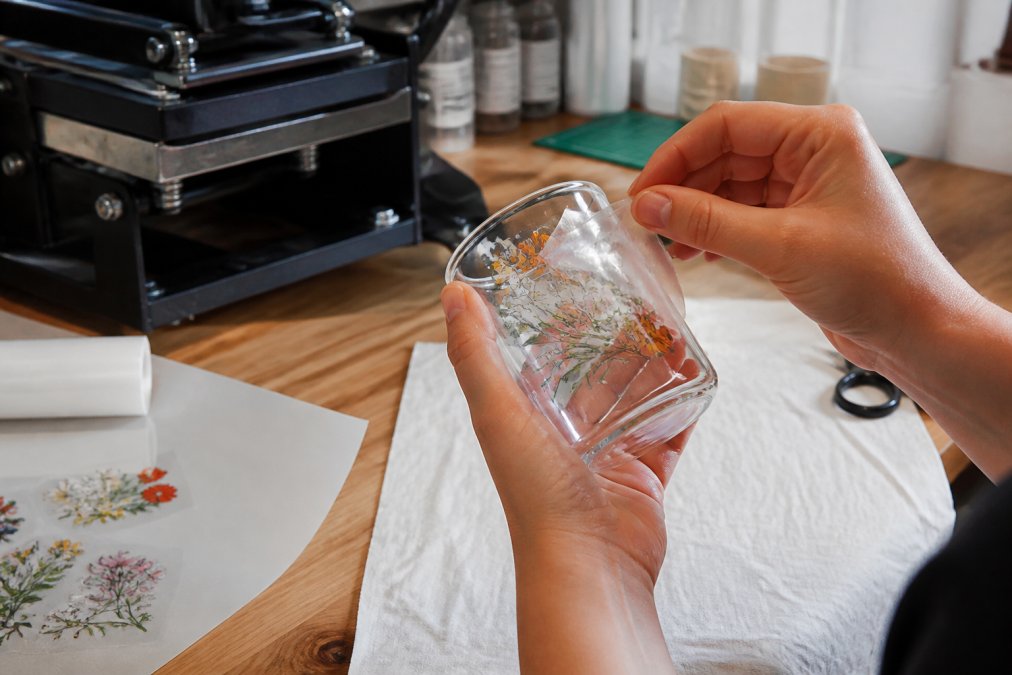
Here is the full application sequence:
- Clean the surface with isopropyl alcohol to remove oils, dust, and release agents. Allow it to dry completely.
- Peel the backing film from the transfer, keeping the design face-up on its carrier sheet.
- Position the transfer on the surface. UV DTF transfers do not slide easily once they touch, so hold it close and lower it into place.
- Apply firm, even pressure from the centre outward using a squeegee or your thumb. This pushes out air bubbles and ensures full adhesive contact.
- Peel the clear carrier film away slowly at a sharp angle. If the design lifts with the film, press it back down and burnish again.
- Let the adhesive cure for 24 hours before exposing the sticker to water or heavy handling.
Air bubbles are the other common issue. Pressing from the centre outward rather than from one edge prevents trapping air. For curved surfaces like bottles, centre the design on the curve and use a soft cloth to mould the film into the radius.
Cost-Benefit Analysis: What Custom UV DTF Stickers Actually Save You
The financial case for UV DTF rests on three savings: no setup fees, no wasted stock, and no minimum order quantities. Traditional printed labels usually require a screen or plate charge that only becomes economical at volume. UV DTF has none of that, so a business testing a new product line can order a handful of sheets rather than a thousand labels. Here are real numbers against a typical small-batch packaging scenario.
Worked Example: A Small Cosmetics Brand Launching Three Jar Designs
Consider a business launching three new 50ml jar designs, a moisturiser, a serum, and a balm. They need 200 labels per design (600 labels total) for their first production run.
Option 1: Traditional adhesive labels (digital print, die-cut)
A typical UK short-run digital label printer charges a setup fee of £40-£60 per design plus £0.12-£0.25 per label at this quantity (gov.uk). For three designs at 200 labels each:
- Setup: 3 × £50 = £150
- Labels: 600 × £0.18 (mid-range) = £108
- Total: £258
- Lead time: 5-7 working days plus delivery
Option 2: Screen-printed labels
Screen printing requires a screen per colour per design. A one-colour screen costs £35-£75; a two-colour design needs two screens. For three designs at two colours each:
- Screens: 6 × £50 = £300
- Printing: 600 × £0.35 = £210
- Total: £510
- Lead time: 7-10 working days
- Minimum order quantities often force you to buy 500+ per design, not 200
Option 3: UV DTF gang sheet
With a UV DTF gang sheet at £3.95 per sheet, you combine all three designs on one sheet. A typical A4 sheet fits roughly 12-15 labels at 50mm diameter. For 600 labels:
- Sheets needed: 600 ÷ 13 (average per sheet) ≈ 47 sheets
- Total: 47 × £3.95 = £185.65
- No setup fees, no minimum order quantity
- Lead time: 24-48 hour turnaround plus delivery
The Hidden Cost: Waste and Obsolescence
The figures above cover direct costs, but the real saving is in avoided waste. With traditional labelling, a business launching three new designs typically orders 500-1,000 labels per design because minimums make small runs uneconomical. If one formula underperforms, you are left with 400-800 obsolete labels per design.
At £0.18 per label, 600 obsolete labels is £108 of dead stock. UV DTF eliminates this entirely, you print what you sell, when you sell it.
The Labour Cost Comparison
Brands moving from vinyl to UV DTF also save on labour. Vinyl weeding is tedious and error-prone; UV DTF is ready to apply straight off the sheet. Cutting and weeding 50 vinyl decals takes 45-60 minutes; preparing 50 UV DTF transfers takes under 5 minutes. At £20/hour for your own time, that is £15-£18 saved per 50-unit batch, on top of the material cost difference.
When UV DTF Is NOT the Cheapest Option
UV DTF is not always the lowest-cost route. For simple, single-colour designs above 2,000 units, traditional flexographic or digital adhesive labels drop to £0.05-£0.08 per label, undercutting UV DTF on unit cost (gov.uk). Similarly, if your packaging is flat and you need 10,000 identical labels, a dedicated label printer will beat UV DTF on price per unit. The technology is designed for short runs, multiple designs, and rapid iteration, not mass production of a single SKU.
The Real ROI Picture
For small businesses, the shift from speculative stock to made-to-order production is the real value. Fast turnaround and door-to-door delivery mean a reorder can arrive before the current batch sells out, removing the need to over-order 'just in case.'
Adding avoided setup fees, eliminated dead stock, and labour savings, the true cost gap between UV DTF and traditional methods is larger than the unit price alone suggests. For a business running 10-15 orders a month across multiple product lines, those savings compound quickly.
Conclusion: Upgrade Your Packaging with UV DTF Stickers
Packaging is the first physical interaction a customer has with your product, and a poorly printed label undermines everything else you have built. UV DTF stickers deliver the vibrant, durable finish of a professionally printed logo while keeping the flexibility small businesses need to iterate quickly.
At BB5wholesale, we combine that print quality with an intuitive gang sheet builder, fast door-to-door shipping, and 24/7 customer support, so you can order with confidence whether it is your first test sheet or your hundredth production run. Our secure payment options protect your transaction, and our commitment to value means you are not paying for waste or minimums you do not need.
Smithers packaging decoration market analysis confirms that brands increasingly favour short-run, high-quality decoration methods over traditional bulk labelling. The technology is proven; the question is whether your packaging is keeping pace.
Upload your gang sheet today and see what a difference a properly printed transfer makes on your next product batch.
Frequently Asked Questions
Are UV DTF stickers waterproof and durable for retail packaging?
Yes. UV DTF stickers are printed with UV-cured ink that resists water, scratching and general wear. Once applied and pressed, the adhesive creates a strong bond with the surface, making the stickers suitable for retail packaging that may be handled, shipped or exposed to moisture. The gloss finish also protects against fading, ensuring your branding stays presentable throughout the product's journey to the customer.
What are the main advantages of UV DTF over traditional vinyl stickers?
UV DTF stickers offer a thicker, glossier finish that resembles a 3D effect, giving packaging a more premium feel than standard vinyl. They also adhere better to rigid surfaces such as glass, metal and textured plastic where vinyl often peels. Because UV DTF transfers are printed on gang sheets, you can produce multiple custom designs in one run without the cutting or weeding that vinyl requires.
Can UV DTF stickers be applied to curved packaging surfaces?
UV DTF transfers work on slightly curved surfaces like bottles, jars and cylindrical containers, provided the curve is not too sharp. The adhesive film is flexible enough to conform to gentle contours during application. For tight curves or corners, you may need to heat the transfer slightly to improve conformity. Always test a sample on your specific packaging before committing to a full production run.
How much do custom UV DTF stickers cost for small businesses?
Pricing depends on sheet size and how many designs you fit onto one gang sheet. BB5wholesale offers UV DTF gang sheets from £3.75 per sheet, with no minimum order quantity. This makes the technology accessible even for small businesses producing 10-15 orders per month. Since you arrange multiple designs on one sheet, you only pay for the surface area you use, reducing waste and cost per sticker.
This article was written using GrandRanker