


How Long Do UV DTF Decals Last Outdoors? 2026 Guide

Table of Contents
- Realistic UV DTF Decal Outdoor Lifespan: What to Expect
- UV DTF vs Vinyl Stickers Durability: Which Lasts Longer Outdoors?
- How to Apply UV DTF Decals for Maximum Adhesion
- UV DTF Printing Outdoor Applications: Where These Decals Perform Best
- Environmental Factors That Affect UV DTF Decal Longevity
- Surface Preparation and Substrate Compatibility: The Foundation of Decal Longevity
- Lamination, Curing, and Protective Coatings: Extending Outdoor Life
- Removal Process Without Surface Damage: What to Know Before You Peel
- Frequently Asked Questions
Last Updated: September 16, 2026
Realistic UV DTF Decal Outdoor Lifespan: What to Expect
Most well-applied UV DTF decals last one to three years outdoors, depending on substrate, sun exposure and whether a protective layer sits on top. UV DTF decals are a printed adhesive film, not a moulded plastic badge, so their outdoor life is decided by the bond underneath and the coating above.
UV DTF decals are transfer-printed graphics made with UV-curable ink on a clear film, applied cold to hard surfaces without heat. That gives sharp detail and a high-gloss finish, but the ink and adhesive age at different rates. This guide from BB5wholesale breaks down what drives that timeline, and how to push your decals toward the top of the range.
UV DTF vs Vinyl Stickers Durability: Which Lasts Longer Outdoors?
Vinyl stickers generally hold up longer in direct sun than unlaminated UV DTF decals, while laminated UV DTF often matches or beats standard vinyl for colour depth and scratch resistance. The difference is how each handles UV radiation and surface contact.
Vinyl is a solid coloured film, so fading happens in the pigment layer rather than a printed ink stack. UV DTF relies on UV-curable ink on a thin transfer film, which is more vulnerable to prolonged direct sunlight without a protective coating.
Where UV DTF wins is detail. Multi-colour artwork, gradients and fine type reproduce more accurately than cut vinyl, which is why it dominates custom tumblers, phone cases and promotional items.
| Factor | UV DTF (unlaminated) | UV DTF (laminated) | Cast vinyl |
|---|---|---|---|
| Typical outdoor life | 1-2 years | 2-3 years | 2-5 years |
| Colour detail | Excellent | Excellent | Limited |
| Scratch resistance | Moderate | High | High |
| Best for | Detailed artwork on hard goods | Branded outdoor items | Flat vehicle and sign work |
The practical takeaway: if the decal faces the sun daily, laminate it. If it lives indoors with occasional outdoor use, unlaminated UV DTF is fine.
How to Apply UV DTF Decals for Maximum Adhesion
Adhesion failure is the single biggest cause of premature decal loss, and it almost always traces back to surface preparation. A UV DTF transfer bonds through pressure-sensitive adhesive, so anything between the adhesive and the substrate, including dust, oil or moisture, weakens the bond from day one.
The good news is that the process takes minutes and needs no heat press.
Step-by-Step Application for Hard Surfaces
- Clean the surface. Wipe with isopropyl alcohol and a lint-free cloth to remove grease and residue.
- Dry completely. Any remaining moisture traps under the film and causes bubbling or lifting.
- Peel the backing film. Handle the decal by its edges to avoid transferring oils.
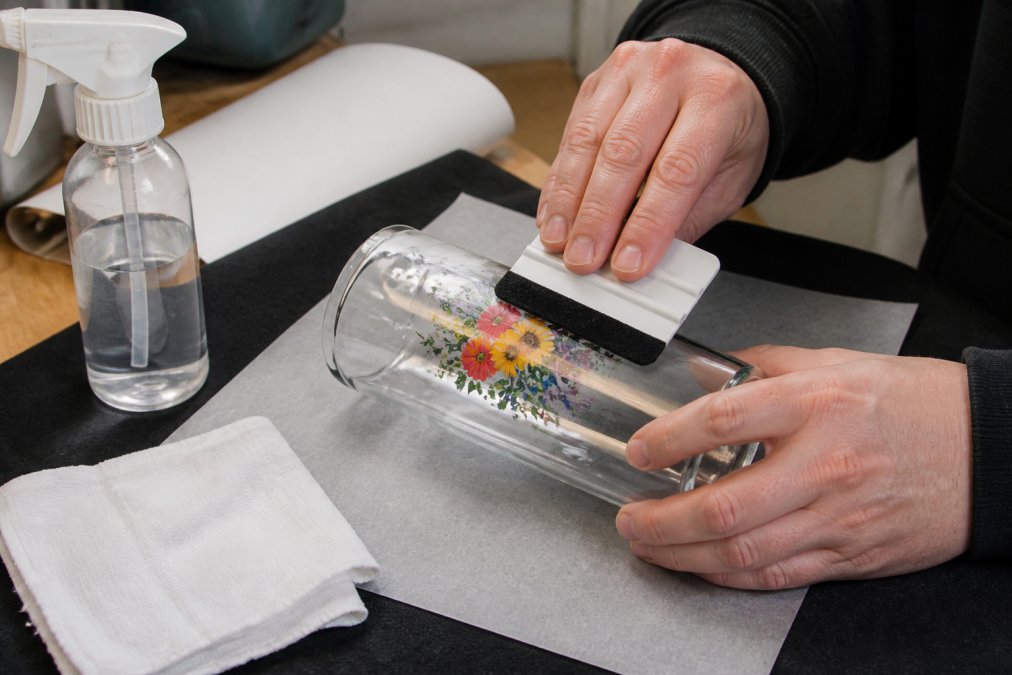
- Position and press. Place the design, then work a squeegee firmly from the centre outward.
- Remove the top film slowly. Peel at a low angle, keeping the decal flat against the surface.
- Let it cure. Leave the item undisturbed for 24 hours before washing or outdoor use.
Common Application Mistakes That Shorten Lifespan
Skipping the degreasing step is the most frequent error. Adhesive grips a slightly dusty surface at first, then fails within weeks once temperature swings begin.
Applying in cold conditions is the second. Adhesive needs a reasonable surface temperature to flow and grip, so a cold workshop in winter produces weaker bonds than a warm one.
The third mistake is rushing the top-film removal.
UV DTF Printing Outdoor Applications: Where These Decals Perform Best
UV DTF decals perform best on smooth, non-porous, rigid surfaces that see moderate rather than constant direct sun, a large share of promotional and product work.
Environmental Factors That Affect UV DTF Decal Longevity
Four environmental forces drive most outdoor degradation: UV radiation, temperature swings, moisture, and chemical contact. The useful question is which one dominates in your use case, because that decides whether lamination is optional or essential, and which failure mode you will see first.
UV Radiation and Fading
UV radiation breaks down the ink layer over time, causing colours to shift and whites to yellow. This is the primary reason unlaminated decals fade faster than laminated ones: a protective coating absorbs or reflects much of that radiation before it reaches the printed ink.
Temperature Thresholds and Thermal Stability
Thermal stability matters more than most guides suggest. Pressure-sensitive adhesives have a service temperature window: below roughly 10°C the adhesive is too firm to wet out the substrate properly, so cold-weather application produces weak bonds that fail months later. Above roughly 40°C sustained, the adhesive softens enough to creep, letting the decal slide or lift at the edges.
Water, Humidity, and Chemical Exposure
Water alone rarely destroys a UV DTF decal, because the film and ink are waterproof. The problem is what water carries: rain delivers pollutants, cleaning products deliver solvents. Chemical resistance is where unlaminated decals fall down fastest, repeated contact with alcohol-based cleaners or citrus solvents dulls the gloss and eventually breaks the adhesive bond.
Surface Preparation and Substrate Compatibility: The Foundation of Decal Longevity
Substrate compatibility determines the ceiling on decal life before you peel the backing. Adhesive bonds through surface energy, and different materials hold that bond very differently. The useful version is a comparative matrix showing what to expect on each material and what specifically goes wrong on it.
Substrate-Specific Durability: Glass, Metal, Wood, and Plastics
Glass and metal are the strongest performers. Both are smooth, non-porous and high in surface energy, so the adhesive forms a tight, even bond that resists moisture well, expect these at the top of the outdoor range when laminated. On glass, the main risk is residue left by glass cleaners. On metal, watch sharp edges and powder-coated finishes: powder coat is durable but slightly textured, so it needs a firmer squeegee pass than bare steel.
| Substrate | Bond strength | Typical outdoor life (laminated) | Typical outdoor life (unlaminated) | Primary failure mode |
|---|---|---|---|---|
| Glass | Excellent | Top of the 2-3 year range | 1-2 years | Surface residue, edge lift |
| Stainless steel | Excellent | Top of the 2-3 year range | 1-2 years | Sharp edges, cleaning chemicals |
| Powder-coated metal | Good | 2-3 years | 1-2 years | Texture reducing contact area |
| Hard plastic | Good | 2-3 years | 1-2 years | Mould release agents |
| Acrylic | Good | 2-3 years | 1-2 years | Static dust, bubbles |
| Wood (sealed) | Fair | 1-2 years | Under 1 year | Humidity movement |
| Wood (bare) | Poor | Under 1 year | Weeks to months | Porosity, moisture ingress |
Matching Substrate to Use Case
For promotional drinkware, glass and stainless steel give the longest life and cleanest finish. For branded tools or equipment, powder-coated metal is practical, but budget for a slightly shorter life than bare steel. For signage on wood, seal the timber first and accept the decal as a consumable. For phone cases and small accessories, hard plastic and acrylic are fine, the decal rarely sees enough sustained sun to reach its ceiling.
Lamination, Curing, and Protective Coatings: Extending Outdoor Life
Lamination is the single most effective upgrade for outdoor life. A protective coating over the printed ink blocks UV radiation, adds scratch resistance, and gives the decal a sacrificial layer that wears before the artwork does.
Removal Process Without Surface Damage: What to Know Before You Peel
Removing a UV DTF decal without damaging the surface is straightforward if you warm the adhesive first and peel slowly. Cold, fast removal pulls paint, lifts laminate and leaves adhesive residue behind.
Work in this order:
- Warm the decal with a hairdryer on a low setting, moving constantly.
- Lift one corner with a plastic scraper, never a metal blade.
- Peel back at a low angle, keeping the film close to the surface.
- Apply more heat as resistance increases.
- Remove leftover adhesive with isopropyl alcohol.
Frequently Asked Questions
How long do UV DTF decals typically last outdoors?
UV DTF decals last 1 to 3 years outdoors depending on substrate, sun exposure, and weather. Vertical surfaces in shaded areas can reach 3 years. Horizontal surfaces facing direct sun may fade within 12 to 18 months. Lamination and proper surface preparation extend lifespan significantly.
Do UV DTF decals fade in direct sunlight?
Yes, UV radiation degrades UV-curable inks over time, causing colours to lose vibrancy. Decals on south-facing surfaces fade faster. Protective coatings or lamination slow fading. Using UV DTF printing for outdoor applications on vertical surfaces reduces direct sun exposure and extends colour life.
Are UV DTF decals waterproof and scratch-resistant?
UV DTF decals are waterproof and scratch-resistant when applied correctly to compatible surfaces. The protective varnish layer shields against rain and minor abrasion. However, harsh chemicals, abrasive cleaners, and dishwasher cycles degrade the adhesive bond and finish. Hand wash decorated items to maintain durability.
Can UV DTF decals withstand UK weather conditions?
UV DTF decals handle UK rain, humidity, and temperature swings well when applied to smooth, clean surfaces. Freeze-thaw cycles stress the adhesive bond, so avoid applying in cold conditions. A UV DTF gang sheet from BB5wholesale offers waterproof and weather-resistant transfers suited to outdoor promotional items and branded merchandise.