


Alternatives to UV DTF for Promotional Merchandise

Table of Contents
- Why Businesses Look Beyond UV DTF
- Screen Printing vs UV DTF: When Traditional Methods Win
- Sublimation for Hard Goods and Drinkware
- Laser Engraving vs UV DTF: Precision and Permanence
- Pad Printing and Embroidery for Corporate Branding
- Cost Comparison of Printing Methods
- Choosing the Right Method for Your Merchandise
Last Updated: August 26, 2026
Why Businesses Look Beyond UV DTF
When you're sourcing promotional merchandise, UV DTF printing feels like the obvious choice. Fast application, vibrant colours, works on hard surfaces. But the reality is more complicated than the marketing suggests.
Businesses abandon UV DTF for three reasons: cost per unit at small volumes, durability concerns on certain materials, and the sheer inflexibility when you need something traditional methods do better. A corporate event organiser printing 50 branded water bottles faces completely different economics than a print shop running 5,000 units. A graphic designer creating fine-detail artwork on fabric gets different results than someone printing solid-colour logos on rigid goods.
The alternatives to UV DTF for promotional merchandise aren't newer or flashier. They're older, proven methods that solve specific problems UV DTF either can't handle or handles inefficiently. Screen printing still dominates high-volume apparel runs. Sublimation remains unmatched for drinkware and hard goods. Laser engraving delivers permanence that no transfer can match. Embroidery commands premium positioning for corporate branding.
Understanding which method fits your specific constraints, volume, material, budget, durability requirement, is what separates profitable merchandise operations from ones that struggle with waste and customer complaints. At BB5wholesale, we work with businesses across all these methods, and the pattern is always the same: the best choice depends entirely on what you're printing, how many units you need, and what your end customer expects to pay.
Below, we'll walk through the main alternatives to UV DTF for promotional merchandise, what each does better, and the real trade-offs you'll face with each approach.
Screen Printing vs UV DTF: When Traditional Methods Win
Screen printing remains the gold standard for high-volume apparel because it delivers unit economics that UV DTF simply cannot match at scale. When you're printing 500 or more units of the same design, the cost per shirt drops dramatically, often below half what you'd pay per unit with UV DTF transfers (peer-reviewed research).
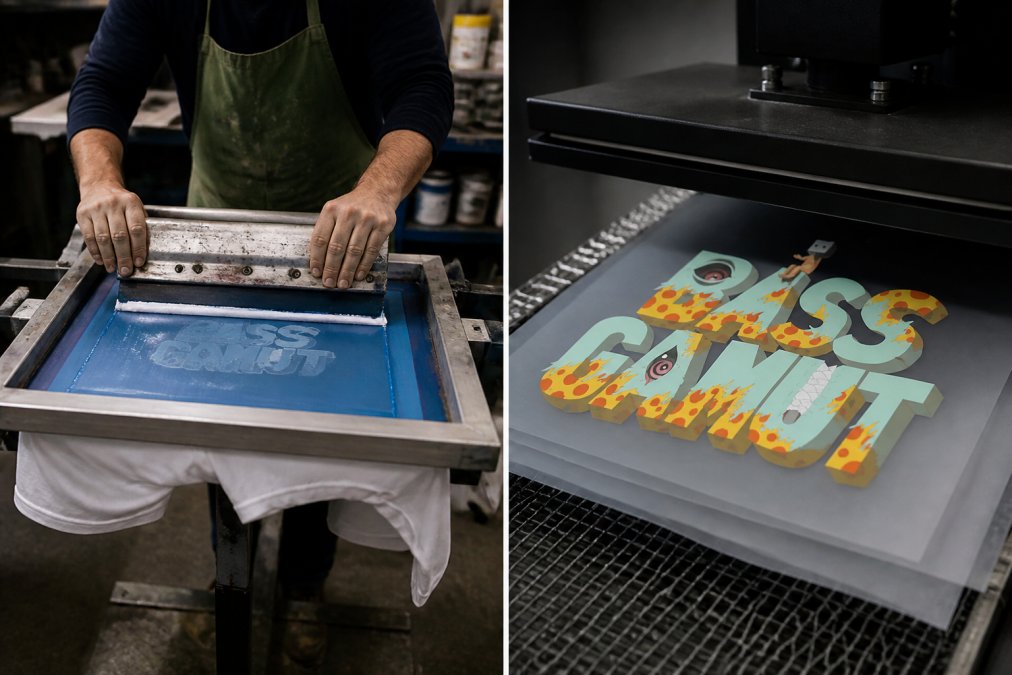
The mechanics are straightforward: a mesh screen is coated with emulsion, your design is burned onto it, and ink is squeezed through the mesh onto fabric. Each colour requires a separate screen, which is why screen printing shines on single-colour or two-colour designs. Add five colours and your setup costs climb. But once you've paid for the screens, printing another 1,000 shirts costs almost nothing per unit.
Where screen printing outperforms UV DTF:
- Unit cost below £0.50 per shirt at 500+ volume (versus £1.50-£2.50 per transfer with UV DTF) (peer-reviewed research)
- Ink sits on top of fabric in a way that feels premium and lasts through dozens of washes
- No transfer film to peel, no curing time, no risk of peeling after washing
- Ideal for corporate apparel where durability is non-negotiable
- Works beautifully on 100% cotton and cotton-blend fabrics
The catch is minimum order quantities. Most screen printers require 50-100 units minimum per design. If you're running a small Etsy shop printing 10-15 custom shirts monthly, screen printing makes no sense. The setup costs eat your profit.
Screen printing also struggles with photorealistic images and gradients. Fine detail gets lost. Complex multi-colour artwork requires too many screens to be economical. This is where UV DTF transfers have a genuine advantage, they handle full-colour, detailed graphics on a single transfer. But if your design is a solid-colour logo or simple two-colour artwork, screen printing delivers superior durability and better unit economics.
Sublimation for Hard Goods and Drinkware
If you're printing on mugs, water bottles, ceramic tiles, or other hard goods, sublimation is the method that works. UV DTF can technically print on hard surfaces, but sublimation is purpose-built for them, and the results show it.
Sublimation works by converting solid dye into gas under heat, which bonds directly into the material's surface rather than sitting on top (peer-reviewed research). The result is a print that's genuinely permanent. Scratch it, wash it a thousand times, leave it in the sun for years, the image doesn't fade or peel because it's part of the material itself.
The process requires a sublimation printer, heat press, and sublimation paper. You print your design onto special paper, place it face-down on the product, and press it under heat and pressure. The dye transfers and becomes permanent. Setup costs are lower than screen printing, a decent sublimation printer and heat press can be acquired for £2,000-£4,000 total.
Where sublimation excels:
- Drinkware (mugs, water bottles, tumblers)
- Ceramic tiles and coasters
- Mouse pads and desk accessories
- Personalised gifts and awards
- Full-colour, photorealistic images with no loss of detail
- Permanent, fade-resistant prints that survive decades
The limitations are real. Sublimation only works on polyester or specially coated surfaces. Natural fibres like 100% cotton won't accept sublimation dye. You can't sublimate onto dark fabrics, the dye is translucent and won't show on dark backgrounds. And the heat press takes up space; you're looking at a dedicated workstation.
For promotional merchandise, sublimation dominates the drinkware market. Corporate clients ordering 200 branded water bottles expect prints that last. Sublimation delivers that. UV DTF transfers on drinkware will peel after a few months of regular use, the adhesion isn't strong enough on smooth, non-porous surfaces.
Laser Engraving vs UV DTF: Precision and Permanence
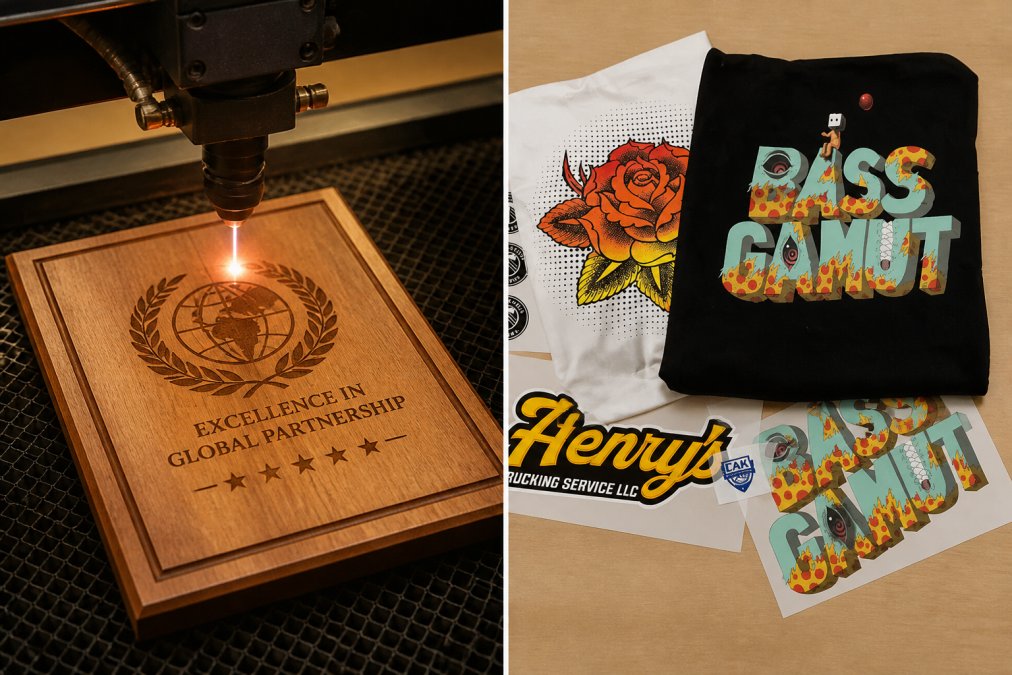
Laser engraving produces results that feel fundamentally different from any transfer method. Instead of applying colour or ink, a laser removes the surface layer of material, revealing a contrasting colour underneath or burning a mark directly into the surface.
The effect is permanent by definition. You can't peel or scratch away an engraved mark because it's physically part of the material. Corporate clients perceive laser-engraved items as premium, there's a weight and permanence to the method that reflects quality.
Laser engraving works on wood, acrylic, leather, anodised aluminium, and many other rigid materials. The laser can achieve fine detail and precision that transfers can't match. Intricate logos, fine text, and complex artwork all render sharply. The speed is also impressive, a laser can engrave a complex design in seconds.
Setup costs are significant. A decent laser engraver suitable for promotional merchandise starts around £3,000-£5,000. Larger industrial systems cost £15,000+. This makes laser engraving viable for print shops and established merchandise businesses, but not for small-scale operations.
Where laser engraving outperforms UV DTF:
- Wooden awards and plaques
- Acrylic trophies and desk accessories
- Leather goods (wallets, belts, bags)
- Anodised aluminium items
- Situations where permanence and premium perception matter
- Fine detail and intricate artwork
- Small-batch custom orders where unit cost is secondary to perceived value
The trade-off is material flexibility. You're limited to materials that respond well to laser treatment. And the capital investment is substantial. For a business doing 50-100 units monthly, laser engraving might be overkill. For a print shop running 500+ units annually across multiple clients, it becomes viable.
Pad Printing and Embroidery for Corporate Branding
Pad printing is the workhorse method for printing on curved, uneven, or small surfaces where screen printing and transfers struggle. It uses a silicone pad to pick up ink from an engraved plate and transfer it to the product. Golf balls, pens, bottle caps, and small promotional items are pad printing's domain.
The method is precise and reliable. Setup costs are moderate, an engraved plate and pad printing machine run £1,500-£3,000. The per-unit cost is low once you've paid for the plate. Pad printing handles multiple colours, though each colour requires a separate plate.
Pad printing limitations:
- Smaller print areas (typically 2-5cm)
- Not suitable for large, full-colour graphics
- Best for simple logos and text
- Setup costs favour larger volumes (100+ units)
Embroidery is the premium choice for corporate apparel. A embroidered logo on a polo shirt or jacket communicates quality in a way that printed transfers cannot. The stitching is tactile, durable, and perceived as high-end.
Embroidery works by digitising your design and running it through an embroidery machine that stitches thread onto fabric. The result is permanent and improves with washing, the stitches lock in over time.
Embroidery economics:
- Setup cost: £500-£1,500 for digitisation and machine access
- Per-unit cost: £2-£8 depending on design complexity and stitch count
- Minimum orders: 12-25 units typically
- Best for: Corporate uniforms, premium branded apparel, gifts
Where embroidery wins: Corporate clients ordering branded polo shirts, jackets, or caps for employees or high-value clients. The embroidered logo positions the merchandise as premium and builds brand perception. UV DTF transfers feel cheaper by comparison, they look fine, but they don't command the same respect.
Cost Comparison of Printing Methods
The cost-per-unit calculation changes everything. A method that's expensive at 50 units becomes economical at 500. A method that dominates at high volume makes no sense at low volume.
| Method | Setup Cost | Cost per Unit (100 units) | Cost per Unit (1,000 units) | Best Volume Range |
|---|---|---|---|---|
| UV DTF Transfer | £200-£500 | £1.50-£2.50 | £1.20-£2.00 | 10-500 units |
| Screen Printing | £300-£800 | £0.80-£1.50 | £0.30-£0.60 | 100+ units |
| Sublimation | £2,000-£4,000 | £0.80-£1.50 | £0.60-£1.00 | 50+ units (hard goods) |
| Laser Engraving | £3,000-£5,000 | £1.50-£3.00 | £0.80-£2.00 | 50+ units (premium items) |
| Pad Printing | £1,500-£3,000 | £0.40-£0.80 | £0.25-£0.50 | 100+ units (small items) |
| Embroidery | £500-£1,500 | £2.50-£5.00 | £1.50-£3.00 | 25+ units (apparel) |
The real insight is this: UV DTF transfers shine in the 10-200 unit range. Below 100 units, the setup costs of other methods make them uneconomical. Above 500 units, screen printing and pad printing deliver better unit costs. For hard goods, sublimation is the only method that makes sense.
At BB5wholesale, we see small businesses and Etsy sellers consistently choosing UV DTF transfers because the low minimum orders (often just 10-15 units) and fast turnaround match their actual production volume. A business printing 50 custom shirts monthly would spend more on screen printing setup than on the entire order. UV DTF transfers eliminate that barrier.
But a print shop running 5,000 shirts monthly across multiple clients? Screen printing becomes mandatory. The unit savings compound across hundreds of orders.
Choosing the Right Method for Your Merchandise
The decision comes down to four variables: volume, material, design complexity, and perceived value.
If you're printing apparel at 10-200 units: UV DTF transfers are your baseline. They work, they're affordable, and they're fast. If your design is photorealistic or full-colour, UV DTF is your only practical option at low volumes. If your design is simple and you're printing 200+ units, screen printing starts to make financial sense.
If you're printing apparel at 500+ units: Screen printing is the method to use. The unit cost advantage compounds across large orders. Durability is superior. Customers perceive screen-printed apparel as higher quality.
If you're printing hard goods (mugs, bottles, tiles): Sublimation is the answer. It's the only method that produces genuinely permanent results on non-fabric surfaces. UV DTF transfers will peel within months.
If you're printing premium corporate items (awards, plaques, high-end gifts): Laser engraving creates perceived value that transfers cannot match. The permanence and precision justify the higher per-unit cost for clients who care about quality.
If you're printing small promotional items (pens, golf balls, bottle caps): Pad printing delivers the best economics and precision for tiny surfaces.
If you're printing corporate apparel where brand perception matters: Embroidery is the premium choice. It costs more per unit but positions your brand as high-quality.
Most businesses don't choose one method and stick with it. You choose based on the specific job. A print shop might use screen printing for a bulk apparel order, UV DTF transfers for a small custom job, and sublimation for a drinkware client, all in the same week.
The mistake is forcing one method across all projects. UV DTF transfers are excellent at what they're designed for, fast, affordable, full-colour production at low to medium volumes. They're not the best choice for everything, and understanding the alternatives to UV DTF for promotional merchandise means you can quote jobs accurately, deliver better results, and build customer loyalty by recommending the right method for each specific project.
BB5wholesale's gang sheet builder makes it easy to maximise UV DTF efficiency when that's the right choice for your job. Upload multiple designs, arrange them on a single sheet to minimise waste, and reduce your per-unit costs. But for jobs where another method makes more sense, you'll now know exactly which alternative to recommend and why. Upload Your Gang Sheet and start optimising your UV DTF orders, or explore our DTF Transfers By Size for straightforward, reliable transfers at competitive pricing.
Choosing between UV DTF and its alternatives doesn't require expensive trial and error. Each method solves a specific problem: UV DTF handles fast, affordable, full-colour production at low volumes. Screen printing dominates apparel at scale. Sublimation is unmatched for hard goods. Laser engraving builds premium brand perception. The right choice depends on your volume, material, and customer expectations. BB5wholesale supports your UV DTF production with professional transfers and a gang sheet builder designed for efficiency. When you're ready to optimise your orders, our 24/7 support team is here to help you get the best value for your merchandise projects.
Frequently Asked Questions
What is the best alternative to UV DTF for hard-surface branding?
Laser engraving and sublimation are the strongest alternatives for hard goods. Laser engraving produces permanent, scratch-resistant marks on wood, acrylic, and metal, ideal for corporate gifts. Sublimation works exceptionally well on polyester-coated drinkware and ceramic items, delivering vibrant, full-colour graphics that won't fade. Your choice depends on the substrate: use laser for rigid materials requiring precision, sublimation for coated surfaces needing colour vibrancy.
Is screen printing more cost-effective than UV DTF for bulk orders?
Yes, screen printing becomes significantly cheaper at high volumes. Setup costs are substantial (£150-500 per colour), but per-unit costs drop dramatically once you exceed 100 units. For 500+ items, screen printing typically costs 30-50% less than UV DTF. However, for small batches under 50 units, UV DTF and DTF transfers offer better value. Consider your order volume before committing, screen printing rewards scale, while UV DTF excels at flexibility.
How does laser engraving compare to UV DTF for corporate gifts?
Laser engraving creates permanent, professional branding that won't wear off, critical for corporate merchandise. UV DTF offers full-colour capability and faster turnaround, but durability can vary depending on substrate preparation and ink quality. Laser engraving works best on wood, leather, and anodised metal; UV DTF suits polyester, cotton blends, and rigid plastics. For long-term corporate branding that reflects quality, laser engraving typically outperforms UV DTF in perceived value and permanence.
Can I use standard DTF transfers on promotional merchandise?
Standard DTF transfers work well on fabric-based promotional items like t-shirts, hoodies, and tote bags, but they're not ideal for hard goods like mugs, phone cases, or rigid items. UV DTF and sublimation are better suited for non-fabric surfaces. If you're ordering promotional merchandise across mixed materials, you'll likely need multiple printing methods. BB5wholesale's DTF Transfers By Size are optimised for apparel; for hard goods, consider sublimation or laser engraving instead.
This article was written using GrandRanker